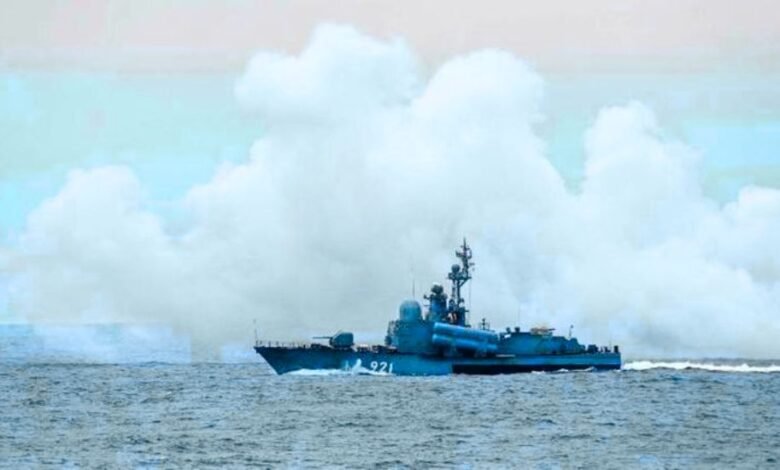
The Pacific Ocean has long been a vast stage for strategic competition — a theater where global powers project strength, secure trade routes, and shape the balance of influence across the Indo-Pacific. In recent years, one of the most consequential developments in this maritime landscape has been the deepening naval cooperation between Russia and China.
Their joint naval exercises and patrols in the Pacific are not simply military drills — they are potent symbols of a shifting world order. Against the backdrop of mounting tensions between the United States and its allies on one side, and the Russia-China strategic partnership on the other, these operations mark the consolidation of a formidable maritime partnership with global implications.
From the Sea of Japan to the central Pacific Ocean, the Russia-China naval partnership has expanded in scope, sophistication, and ambition. It underscores both nations’ intent to challenge U.S. maritime dominance and reshape the regional security architecture of the Asia-Pacific.
The Evolution of the Russia-China Naval Partnership
The seeds of Russian-Chinese naval collaboration were sown in the early 2000s, when both countries began conducting small-scale maritime exercises under the Shanghai Cooperation Organization (SCO) framework. However, the true acceleration came after 2014, following Russia’s annexation of Crimea and its deteriorating ties with the West. Facing economic sanctions and strategic isolation, Moscow turned eastward, finding a receptive partner in Beijing, which sought to expand its own regional and global reach.
The Joint Sea series of exercises, launched in 2012, became the backbone of their naval cooperation. What started as limited drills soon evolved into complex, multi-domain operations. Over the past decade, these exercises have spanned several regions — from the Baltic and Mediterranean Seas to the Sea of Japan and Philippine Sea — signaling the global ambitions of the partnership.
By 2021, the partnership took a major leap forward. That year, Russia and China conducted their first joint naval patrol around Japan’s main island, an unprecedented move that drew strong responses from Tokyo and Washington. It marked a transition from symbolic exercises to real operational patrols, showcasing the ability of both fleets to coordinate beyond their immediate waters.
Maritime Interaction-2025: The New Phase
The most recent and notable iteration of this cooperation occurred in August 2025, when both nations conducted the “Maritime Interaction-2025” exercise in the Sea of Japan. The five-day drill featured a diverse fleet — surface combatants, submarines, and naval aviation assets — from Russia’s Pacific Fleet and the People’s Liberation Army Navy (PLAN).
According to reports from Special Eurasia and Reuters, the exercise included anti-submarine warfare (ASW) drills, air-defense operations, joint live-fire exercises, and search-and-rescue missions. The inclusion of diesel-electric submarines marked a new milestone: it was among the first times Russian and Chinese submarines conducted coordinated operations in the Pacific.
The drills were presented by both sides as “non-targeted” and “defensive”, yet their geopolitical symbolism was unmistakable. The message was clear — Russia and China were demonstrating that they could jointly operate advanced maritime forces in close proximity to Japan and U.S. bases, projecting power and cohesion in a region dominated by American naval presence.
Beyond Exercises: Real Patrols in the Pacific
Following Maritime Interaction-2025, the two navies continued to deepen operational coordination through joint patrols. These are not mere training events but sustained deployments across vast oceanic zones.
According to USNI News and The National Interest, Russian and Chinese vessels conducted a joint submarine patrol covering more than 2,000 nautical miles — from the Sea of Japan through the East China Sea into the western Pacific. Participating assets reportedly included Russia’s Project 636.3 Kilo-class submarine “Volkhov” (B-603), escorted by a corvette and rescue tug, alongside an unspecified Chinese submarine and surface ships.
The two navies have also been spotted in central Pacific waters, operating hundreds of miles from their home ports. This demonstrates growing confidence in blue-water coordination, an area traditionally dominated by the U.S. Navy.
The shift from short-term exercises to sustained maritime patrols represents a profound transformation — signaling that Moscow and Beijing are intent on maintaining a continuous naval presence in the Pacific and potentially beyond.
Strategic Motivations: What Drives Moscow and Beijing
Although both powers share a common interest in countering U.S. influence, their motivations differ subtly.
- For China, the Pacific is the frontline of its geopolitical ambition. The PLA Navy — now the world’s largest by number of ships — is seeking to break through the so-called “First Island Chain” that includes Japan, Taiwan, and the Philippines. Joint operations with Russia allow Beijing to expand operational experience, especially in anti-submarine and long-range deployments, while showcasing that it has credible partners in maritime power projection.
- For Russia, participation serves multiple goals. Militarily, it allows the Pacific Fleet to maintain relevance despite the country’s focus on Europe and Ukraine. Politically, it underscores Moscow’s ability to operate globally and avoid strategic isolation. Economically, the partnership with China opens access to maritime routes, energy projects, and technological cooperation that offset Western sanctions.
Together, these motivations converge into a mutual interest in balancing U.S. alliances — notably the QUAD (U.S., Japan, India, Australia) and AUKUS (Australia, U.K., U.S.) frameworks — which Russia and China both perceive as containment strategies.
Capabilities and Coordination: What Each Brings to the Table
China’s navy brings scale, modernization, and industrial momentum. Over the past decade, the PLAN has commissioned dozens of advanced destroyers, frigates, and submarines, as well as its third aircraft carrier. It also possesses advanced surveillance and missile systems that complement Russia’s extensive combat experience and robust undersea warfare capabilities.
Russia contributes technological depth — particularly in submarine warfare, missile systems, and Arctic operations. Its Pacific Fleet remains one of its most capable naval arms, with assets such as the Admiral Shaposhnikov-class destroyers, Kilo-class submarines, and Borei-class ballistic missile submarines.
When operating together, the two forces combine quantity and quality, giving them a credible regional deterrent. However, as noted by Special Eurasia analysts, interoperability remains limited. Communication systems, operational doctrines, and command structures differ. Thus, the cooperation is still political and symbolic, though steadily moving toward greater operational integration.
Geopolitical Messaging and Symbolism
The political dimension of these joint naval activities cannot be overstated.
Every major exercise or patrol is accompanied by official statements emphasizing “non-alignment and peaceful cooperation” — yet the timing and locations often coincide with heightened tensions involving the U.S. or its allies.
For example:
- The 2021 joint patrol circled Japan shortly after Tokyo hosted large-scale drills with U.S. and Australian forces.
- The 2023 Sea of Japan drills occurred as Washington and Seoul conducted naval exercises off the Korean Peninsula.
- The 2025 Maritime Interaction exercise came weeks after NATO publicly reaffirmed its interest in the Indo-Pacific.
This pattern suggests that Moscow and Beijing use these naval operations as strategic messaging tools, showing they can challenge Western coalitions and assert alternative poles of power.
At the same time, both countries gain valuable diplomatic leverage: their ability to coordinate at sea underscores their “no-limits partnership” declared in early 2022, reinforcing the perception of an emerging Eurasian maritime bloc.
Regional Reactions and Security Implications
The reaction across the Indo-Pacific has been one of growing concern.
Japan, which sits at the geographic center of these activities, has repeatedly scrambled naval and air assets to monitor Russian and Chinese movements. Tokyo’s defense ministry reported that the 2021 patrol around its islands was the first time foreign warships had circumnavigated Japan since World War II.
South Korea has similarly stepped up maritime surveillance and joined trilateral drills with the United States and Japan to counterbalance the joint Russia-China operations.
Australia and the Philippines, both U.S. allies, interpret these developments as indicators of a more assertive Sino-Russian bloc extending from the western Pacific to the South China Sea.
For the United States, the implications are strategic and psychological. Although the U.S. Navy still vastly outclasses the Russian and Chinese fleets in global reach and power projection, the growing cooperation between the two rivals presents a multi-theater challenge — forcing Washington to divide attention and resources between the Atlantic, Pacific, and Arctic fronts.
Submarine Cooperation: The Deepest Signal
Perhaps the most striking recent development is the inclusion of joint submarine patrols.
Submarine operations represent one of the most sensitive areas of military cooperation, demanding high levels of trust and coordination. Russia’s decision to allow joint patrols — possibly sharing acoustic signatures and operational data — indicates a level of strategic intimacy previously unseen even during the Cold War.
For China, access to Russian undersea expertise could help accelerate improvements in its Yuan-class and Type 094/096 nuclear submarines. For Russia, these patrols demonstrate that its Pacific Fleet remains capable of meaningful global operations despite resource constraints.
Such developments raise the stakes for regional anti-submarine warfare (ASW) capabilities and complicate detection efforts by Japan, the U.S., and Australia.
Economic and Technological Dimensions
Beyond pure military symbolism, the cooperation also carries economic and technological undercurrents.
Russia seeks to leverage its naval shipbuilding and defense technology to secure Chinese investment and access to industrial components restricted by Western sanctions. In return, China gains exposure to advanced Russian submarine propulsion, sonar, and missile technologies.
Moreover, both nations are exploring expanded cooperation in Arctic and northern Pacific routes, as climate change opens new maritime corridors. Joint patrols and coast-guard missions in the Arctic, reported by Reuters in 2024, suggest that the partnership is not confined to the western Pacific but extends toward the Polar Silk Road — China’s term for its Arctic ambitions.
Thus, the naval cooperation is as much about maritime economics and global trade routes as it is about military signaling.
Challenges and Constraints
Despite the growing cooperation, several constraints temper the partnership’s effectiveness:
- Divergent Strategic Priorities – China’s main focus is the Indo-Pacific and Taiwan; Russia’s remains Europe and the Arctic. Sustained alignment in strategy may prove difficult.
- Asymmetry in Capabilities – China’s navy is expanding rapidly; Russia’s is constrained by sanctions and industrial decline. This imbalance could eventually generate friction.
- Lack of Formal Alliance – The partnership is pragmatic, not institutionalized. Unlike NATO, there is no binding defense pact.
- Operational Interoperability – Language, communications, and tactical doctrines differ significantly. Integration is still evolving.
Nevertheless, both countries are content with a flexible, situational partnership that allows them to coordinate when interests converge without formal commitments.
The Broader Strategic Outlook
Looking ahead, the Russia-China naval partnership in the Pacific is likely to intensify rather than recede.
The U.S. and its allies are expanding their presence through AUKUS, QUAD, and enhanced freedom-of-navigation operations (FONOPs). In response, Russia and China will seek to counterbalance this presence by maintaining joint patrols, enhancing submarine cooperation, and possibly establishing permanent maritime coordination centers.
Future cooperation could extend into the South China Sea, the Indian Ocean, or even the Arctic Circle, where overlapping interests in sea-lanes and resource extraction are already visible.
Ultimately, the partnership represents more than military choreography; it is part of a global realignment, where authoritarian powers are pooling capabilities to reshape the norms of international security.
Conclusion: A New Maritime Era
The Russia-China joint naval presence in the Pacific marks the rise of a new maritime axis challenging decades of Western dominance. While the cooperation remains far from a formal alliance, its impact on the strategic landscape is undeniable.
Every exercise, every patrol, every coordinated maneuver sends the same message: that Moscow and Beijing are prepared to act together to protect their shared interests and project a united front at sea.
Whether these activities will translate into sustained strategic parity with the West remains to be seen. Yet one fact is certain — the Pacific Ocean has become not only a vast expanse of water but a mirror reflecting the changing power dynamics of the 21st century.
Article written for Empire Magazine, a publication dedicated to global affairs, strategy, and international insights.