The Pittsburgh Steelers vs Cleveland Browns rivalry is one of the most enduring, emotional, and regionally charged matchups in all of American football. Though often overshadowed by flashier duels like Packers-Bears or Cowboys-Eagles, the Steelers-Browns series tells a deeper story — one about industrial cities, blue-collar pride, and decades of gridiron power shifts between two football-obsessed fan bases.
It’s a saga that stretches back to the 1950s, marked by blowouts, heartbreaks, playoff epics, and the kind of old-school hatred that makes every Sunday meeting between these AFC North neighbors feel like a chapter in a family feud that never ends.
1. The Origins: Two Cities, One Turnpike, and a Brewing Rivalry
When the Cleveland Browns entered the NFL in 1950 after dominating the All-America Football Conference, they immediately became the standard for professional excellence. The Pittsburgh Steelers, on the other hand, were still finding their footing as a franchise that had mostly struggled through the 1940s.
The cities themselves — Cleveland, Ohio, and Pittsburgh, Pennsylvania — sat just 135 miles apart, connected by the Pennsylvania and Ohio Turnpikes. Both were steel-belt towns with deep working-class roots, fueled by factories, foundries, and football. The stage was set for a rivalry not just between teams, but between cultures.
In their first meeting on October 7, 1950, the Browns dominated the Steelers 30–17, setting the tone for much of the next two decades. Through the 1950s and 1960s, Cleveland ruled the series, powered by legends like Otto Graham, Jim Brown, and Lou Groza. The Steelers, still decades away from their dynasty years, were often the little brother struggling to keep up.
For Cleveland, beating Pittsburgh was business as usual. For Pittsburgh, beating Cleveland was an event.
2. The Shift: Steelers Rise, Browns Stumble
Everything changed in the 1970s.
With Chuck Noll at the helm and a draft class that redefined football — including Terry Bradshaw, Joe Greene, Jack Lambert, and Franco Harris — the Steelers became the face of dominance. They won four Super Bowls in six years, turning the Steel City into Title Town.
The Browns, meanwhile, entered a period of inconsistency. While they still fielded solid teams under coaches like Sam Rutigliano and Marty Schottenheimer, they could never quite reach the same championship heights. Yet their clashes with the Steelers remained fiercely contested — physical, emotional, and drenched in mutual contempt.
During the 1980s, the Browns occasionally surged back into contention with quarterbacks like Brian Sipe and later Bernie Kosar, giving fans memorable moments — “The Kardiac Kids” era among them. Still, when it came to Pittsburgh, victories were often bittersweet. The Steelers’ defense, “The Steel Curtain,” seemed to grow stronger in rivalry games, symbolizing the city’s industrial toughness.
3. The 1990s Collapse and a City’s Rebirth
Perhaps the darkest era of the rivalry came not from a loss, but from a disappearance.
In 1995, Browns owner Art Modell moved the team to Baltimore, turning the franchise into what became the Ravens — ironically, another fierce Steelers rival. The city of Cleveland was left heartbroken. Pittsburgh fans, though sympathetic, felt the rivalry die that day.
When the Browns returned in 1999 as an expansion franchise, the emotional spark reignited — but the competition had changed. The new Browns were rebuilding from scratch, while the Steelers, under Bill Cowher, were consistent playoff contenders. The rivalry felt one-sided, yet the old emotional weight remained. Cleveland wanted revenge, not just for losses, but for being left behind by history.
The early 2000s meetings were brutal. Pittsburgh routinely thrashed Cleveland — and in many ways, that frustration mirrored the economic decline Cleveland faced compared to its resurgent neighbor across the state line.
4. The Ben Roethlisberger Era: Dominance Redefined
If there’s a single name that symbolizes the Browns’ misery, it’s Ben Roethlisberger.
From his debut in 2004 until his retirement, Roethlisberger tormented Cleveland. His personal record versus the Browns stood at 29–6–1, including a jaw-dropping 17–1 at home.
Every time the Browns seemed to have momentum, Big Ben would dismantle their hopes — with clutch throws, last-minute drives, or blowout wins that felt like foregone conclusions. Pittsburgh fans joked that Cleveland was “Ben’s second home,” and in truth, he was undefeated against them in Pittsburgh for nearly two decades.
Meanwhile, Cleveland’s revolving door of quarterbacks — from Tim Couch to Johnny Manziel to Baker Mayfield — symbolized instability. In that same span, the Steelers fielded two head coaches (Cowher, Tomlin) and one franchise quarterback. Stability breeds success, and Pittsburgh embodied it.
5. The 2019 Incident: When the Rivalry Boiled Over
If there’s one game that reignited the old hatred, it was the November 14, 2019 “Helmet Incident.”
Late in a Thursday Night Football matchup, Browns defensive end Myles Garrett ripped off Mason Rudolph’s helmet and swung it at him — a shocking act that led to one of the longest on-field suspensions in NFL history. The brawl spilled into sideline chaos, players were fined and suspended, and the rivalry’s temperature skyrocketed overnight.
For many, it was a reminder that the Steelers-Browns feud still burned hot beneath years of lopsided results.
Cleveland fans defended Garrett as provoked; Steelers fans saw it as unforgivable. National media called it “a flashpoint moment in one of football’s most bitter rivalries.”
6. The 2020 Playoffs: Cleveland’s Revenge
The 2020 AFC Wild Card Game remains one of the most shocking playoff outcomes in NFL memory.
After decades of humiliation, the Browns marched into Heinz Field and stunned the Steelers 48–37. It was their first playoff win since 1994 — and their first postseason victory ever against Pittsburgh. Cleveland jumped out to a 28–0 first-quarter lead, capitalizing on early turnovers and playing with unrelenting energy.
For Steelers fans, it was surreal. For Browns fans, it was cathartic.
The victory wasn’t just a game — it was an exorcism. As ESPN wrote, “For the first time in decades, Cleveland didn’t just beat Pittsburgh. They outclassed them.”
Though Pittsburgh still leads the all-time series by a wide margin, that night changed the narrative. Suddenly, it felt like the Browns could stand toe-to-toe with their longtime nemesis again.
7. The Modern Era: Defense, Pride, and Parity
In recent seasons, the rivalry has taken on a grittier, more balanced tone.
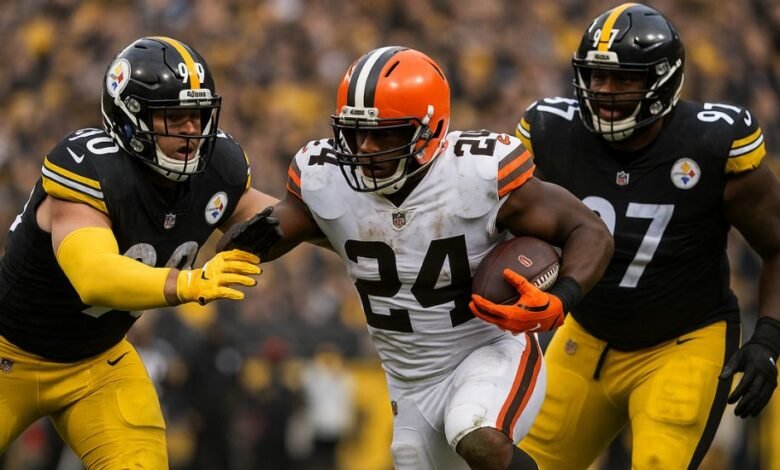
Both teams boast elite defenses, strong running games, and passionate fan bases. Players like T.J. Watt, Myles Garrett, Nick Chubb, and Minkah Fitzpatrick define the physicality and aggression that have long been hallmarks of this matchup.
In 2025, Pittsburgh defeated Cleveland 23–9, with six sacks and a dominant defensive performance that held the Browns out of the end zone. Headlines read, “Steelers defense shines, Browns silenced in Pittsburgh.” Yet even in defeat, Cleveland showed improvement — no longer an easy out, but a legitimate AFC North competitor.
The Browns’ new-age offensive schemes under modern coaches, their attempts to stabilize the quarterback position, and their defensive resurgence under Myles Garrett suggest that parity may finally be arriving. The Steelers, ever disciplined under Mike Tomlin, remain the model of consistency — rarely great, never bad, always dangerous.
8. More Than a Game: Rust Belt Identity and Fan Culture
At its heart, Steelers vs Browns represents something bigger than football.
It’s the Rust Belt Rivalry — a clash of cities with similar DNA: hard-working, loyal, proud, and resilient. Both Pittsburgh and Cleveland have fought through economic downturns, population loss, and national ridicule. Yet every Sunday, fans pack their stadiums, wave their towels or dog masks, and remind America that heartland football still matters.
In Cleveland, the “Dawg Pound” remains one of the loudest and most passionate fan sections in sports. In Pittsburgh, the Terrible Towels fly like gold lightning across Acrisure Stadium. The energy is unmatched, the pride generational.
It’s that emotional core — not the win-loss column — that keeps this rivalry alive.
Because even when one team dominates, both sides care deeply. And that’s what defines a real rivalry: shared history, mutual disdain, and grudging respect.
9. Legendary Games That Defined Eras
Several games over the decades have shaped the story:
- 1950 — The inaugural clash: Browns 30, Steelers 17. The dawn of dominance.
- 1989 — Browns 51, Steelers 0: Cleveland’s biggest win in the series and one of Pittsburgh’s worst defeats ever.
- 2002 Wild Card — Steelers 36, Browns 33: A heartbreaking Cleveland collapse after leading 24–7, remembered as one of the NFL’s wildest playoff finishes.
- 2019 Helmet Game — The night Myles Garrett and Mason Rudolph forever changed the rivalry’s image.
- 2020 Wild Card — Browns 48, Steelers 37: Cleveland’s redemption, ending years of playoff drought and humiliation.
Each of these matchups carried emotional resonance far beyond the scoreboard. They marked turning points — reminders that history can bend but never break this rivalry.
10. What Lies Ahead
Looking forward, the Steelers vs Browns rivalry enters a new phase. The AFC North is arguably the toughest division in football, featuring the Bengals’ Joe Burrow and the Ravens’ Lamar Jackson. Yet amid those new storylines, this old rivalry endures like iron.
The Steelers continue to rebuild around a new generation of stars. The Browns are still searching for the right formula to turn talent into sustained success. Both teams have strong defensive identities and fan bases that crave bragging rights.
Every matchup feels like a referendum — not just on team strength, but on city pride. When Cleveland beats Pittsburgh, it feels like a victory for every factory worker, every lifelong fan who endured decades of mockery. When Pittsburgh wins, it’s a reaffirmation of a legacy built on toughness and excellence.
It’s not just football. It’s personal.
11. The Legacy: Beyond Wins and Losses
Ultimately, the Steelers-Browns rivalry is about heritage. It’s about fathers and sons arguing over dinner tables, friends in Ohio and Pennsylvania teasing each other for decades, and fans who live and die by their teams.
Few rivalries capture the spirit of the American Midwest quite like this one.
From steel mills to stadium lights, from Jim Brown’s power runs to T.J. Watt’s sacks, it’s a story of endurance — of two proud fan bases who refuse to back down.
And while the scoreboard may tilt Pittsburgh’s way, the emotional stakes have always been even. Because in this rivalry, every game feels like a chapter in a 75-year-old novel that still hasn’t finished its final page.
Written for Empire Magazines
At Empire Magazines, we celebrate the rivalries, traditions, and communities that make sports more than just a game — they make it a legacy.