When the French football calendar delivered the Olympique de Marseille vs Paris FC fixture, it was more than just another Ligue 1 encounter. The contest between one of France’s historical giants and a rapidly improving Paris FC side symbolized the evolving dynamics within French football — tradition versus ambition, legacy versus resurgence. The lineup choices for both teams revealed not only tactical philosophies but also the identity and ambitions of their managers.
This article dives deep into the Olympique de Marseille vs Paris FC lineups, tactical setups, and how those decisions shaped the outcome of their thrilling 5-2 encounter at the Stade Vélodrome on August 23, 2025.
Pre-Match Context
Marseille’s Form and Ambition
Olympique de Marseille entered the match in fine domestic form, riding a wave of attacking momentum. Under the guidance of a rejuvenated coaching staff, OM had embraced a possession-based attacking style that relied on pace, creativity, and pressing intensity. The Vélodrome had once again become a fortress — a venue echoing with the pride of supporters eager to see their team return to European prominence.
Aubameyang’s resurgence, Mason Greenwood’s arrival, and the technical brilliance of Amine Gouiri gave OM an edge in the final third. Their tactical shift toward a fluid 4-2-3-1 formation allowed versatility and rapid transitions, a marked improvement over the more rigid 4-3-3 systems of previous seasons.
Paris FC’s Aspirations
For Paris FC, the trip to Marseille was both a test and an opportunity. Despite their underdog status, Paris FC had displayed flashes of quality in earlier fixtures. The club’s investment in young, dynamic players and experienced professionals like Moses Simon and Ilan Kebbal reflected a clear vision: to become a mainstay in the top half of Ligue 1.
The managerial approach leaned heavily on structure and discipline — favoring a compact 4-3-3 built around midfield control and counter-attacking transitions. Against Marseille, Paris FC aimed to frustrate their opponents while exploiting defensive gaps through pace on the wings.
Olympique de Marseille Lineup and Formation
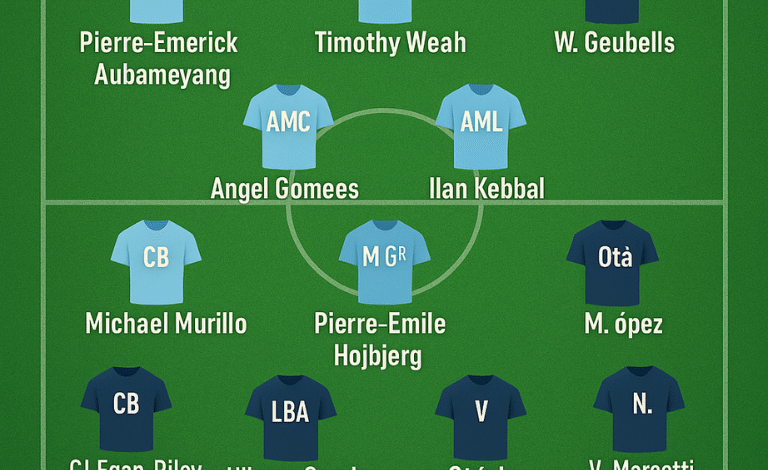
Formation: 4-2-3-1
- Goalkeeper: Gerónimo Rulli
- Right-Back: Michael Murillo
- Centre-Backs: CJ Egan-Riley and Leonardo Balerdi (c)
- Left-Back: Ulisses Garcia
- Defensive Midfielders: Pierre-Emile Højbjerg and Angel Gomes
- Attacking Midfield Trio: Mason Greenwood (RW), Amine Gouiri (CAM), Timothy Weah (LW)
- Striker: Pierre-Emerick Aubameyang
Tactical Overview
Marseille’s system hinged on positional interchanges and vertical progression. The full-backs, Murillo and Garcia, provided overlapping width, allowing Greenwood and Weah to drift inward as secondary forwards. Højbjerg acted as the stabilizer — sitting deep to recycle possession and shield the defense — while Angel Gomes operated as the link between defense and attack, distributing with elegance and precision.
Gouiri, stationed centrally behind Aubameyang, was crucial in threading the lines. His creativity and intelligent positioning pulled Paris FC’s defenders out of shape, opening channels for Greenwood and Weah to exploit. Aubameyang’s off-the-shoulder runs and sharp finishing gave OM a constant cutting edge.
Key Strengths
- Fluid attacking transitions: Marseille’s front four interchanged positions seamlessly, creating confusion for Paris FC’s defenders.
- Wide overloads: Murillo’s overlapping runs allowed Greenwood to cut inside and shoot, a pattern that led to two of Marseille’s goals.
- Leadership at the back: Balerdi’s composure and command were vital, especially when dealing with Paris FC’s sporadic counters.
Weaknesses
Despite their control, Marseille’s adventurous full-backs occasionally left space in transition, forcing Egan-Riley and Balerdi to defend two-on-two situations.
Paris FC Lineup and Formation
Formation: 4-3-3
- Goalkeeper: Obed Nkambadio
- Right-Back: Amir Murillo (possibly mislisted due to transfer overlap)
- Centre-Backs: Mbow and Sangui
- Left-Back: Marchetti
- Midfield Three: Otávio, M. López, A. Camara
- Forwards: Moses Simon (RW), Ilan Kebbal (ST), Willem Geubbels (LW)
Tactical Overview
Paris FC’s tactical design emphasized compactness and swift counters. The midfield trio formed a disciplined triangle that sought to stifle Marseille’s playmakers. Otávio’s ball-winning instincts and López’s passing range were central to this setup. On the flanks, Moses Simon and Geubbels provided explosive pace, while Kebbal dropped deeper to link play.
However, the system struggled against Marseille’s intensity. Each time Paris FC regained the ball, they faced immediate counter-pressing waves from Højbjerg and Gomes. As a result, their counters were stifled, and the defensive shape frequently stretched beyond recovery.
Key Strengths
- Pace in attack: Simon and Geubbels constantly threatened in transition.
- Midfield resilience: Camara’s work rate allowed brief spells of containment.
- Goalkeeping heroics: Nkambadio’s saves prevented a heavier defeat.
Weaknesses
- Lack of vertical outlet: Kebbal’s isolation up front left Paris FC unable to relieve pressure.
- Disorganized pressing: The wingers often failed to track back, exposing full-backs to overloads.
- Central vulnerability: Marseille’s creative midfielders found space between the lines far too easily.
How the Lineups Shaped the Match
First-Half Dynamics
The match began with Marseille asserting dominance. Their double pivot dictated tempo, pushing Paris FC deep into their half. Within ten minutes, Greenwood’s intelligent movement resulted in the opener — a sharp finish from the right after combining with Gouiri. The goal epitomized OM’s attacking blueprint: wide overloads, quick passing triangles, and positional rotation.
Paris FC attempted to counter through Simon, but Garcia’s defensive discipline limited his impact. The visitors found themselves overrun in midfield, and by the 30-minute mark, Marseille had already doubled their lead through Aubameyang’s trademark poacher’s finish following a cross from Weah.
Højbjerg’s presence was particularly influential. He dictated rhythm and neutralized Camara, cutting off Paris FC’s build-up from deep. Every misplaced Paris FC pass was met with Marseille’s immediate surge forward.
Second-Half Adjustments
Paris FC’s manager made tactical tweaks, shifting López slightly higher to support Kebbal. This adjustment briefly disrupted Marseille’s flow, leading to a well-worked goal by Geubbels, who capitalized on a defensive lapse. However, any hope of a comeback was short-lived. Marseille’s response was emphatic — Gouiri’s deft through-ball found Greenwood again, who unselfishly squared for Weah to make it 3-1.
In the closing stages, both sides introduced fresh legs. Paris FC pushed higher, but this only opened more space behind them. Aubameyang completed his brace, while substitute midfielders added further control. Despite a late consolation for Paris FC, Marseille sealed an emphatic 5-2 victory.
Player Ratings and Key Performers
| Player | Club | Rating | Summary |
|---|---|---|---|
| Mason Greenwood | Marseille | ★9.0 | Two assists, relentless energy, and creativity on the right. |
| Pierre-Emerick Aubameyang | Marseille | ★8.8 | Clinical finishing, strong leadership. |
| Amine Gouiri | Marseille | ★8.5 | Excellent vision; dictated tempo in the final third. |
| Pierre-Emile Højbjerg | Marseille | ★8.0 | Controlled midfield, intercepted numerous passes. |
| Gerónimo Rulli | Marseille | ★7.5 | Composed and reliable under pressure. |
| Moses Simon | Paris FC | ★7.0 | Lively but isolated; one assist. |
| Obed Nkambadio | Paris FC | ★6.5 | Prevented humiliation with key saves. |
| Willem Geubbels | Paris FC | ★6.5 | Scored and worked hard but lacked service. |
Tactical Takeaways
1. Marseille’s Positional Mastery
The 4-2-3-1 formation was more than just a shape — it was a structure for fluid creativity. The movement between Greenwood, Gouiri, and Weah made Marseille unpredictable. Angel Gomes’s adaptability as a deep-lying playmaker allowed the side to maintain control, and Højbjerg’s tactical intelligence ensured balance.
2. Paris FC’s Learning Curve
Despite the heavy loss, Paris FC showed glimpses of potential. Their young squad remains tactically naïve against high-pressing sides, but the energy of Geubbels and Simon suggests long-term promise. Strengthening the midfield and adding a more physical striker could turn future meetings into tighter contests.
3. The Aubameyang Effect
Few strikers in Europe possess Aubameyang’s sense of timing. Even at 36, his pace, movement, and professionalism inspired Marseille’s younger forwards. His presence lifted the overall intensity — a hallmark of his leadership.
Historical Rivalry Context
While not a traditional rivalry on the scale of Le Classique (Marseille vs PSG), meetings between Marseille and Paris FC carry emotional undertones. Both represent contrasting footballing identities — Marseille’s southern flair versus Paris FC’s urban ambition.
Paris FC’s recent rise, fueled by investments in youth academies and modern infrastructure, has rekindled this dynamic. Matches like this serve as a barometer of their progress against France’s elite.
Marseille, on the other hand, continues to symbolize the passion and unpredictability of French football. Every home match at the Vélodrome is a spectacle — a combination of football artistry and raw emotion.
Post-Match Reactions
Marseille’s Camp
Manager and captain alike praised the team’s intensity and creativity.
“We wanted to dominate both with and without the ball — and we did. This team is maturing,” said Leonardo Balerdi after the match.
Supporters hailed Greenwood’s integration and Aubameyang’s finishing, calling the win a statement of intent. Many see Marseille’s refreshed approach as a step toward reclaiming a top-three Ligue 1 finish and securing Champions League qualification.
Paris FC’s Response
Despite defeat, Paris FC’s coaching staff emphasized the positives: exposure to a top-tier opponent, lessons in defensive structure, and individual growth.
“We must learn from these games. Marseille’s intensity showed us what we aspire to become,” said head coach Stéphane Gautier.
Statistical Summary
- Possession: Marseille 64% – 36% Paris FC
- Shots: Marseille 17 (10 on target) – 8 (3 on target)
- Pass Accuracy: Marseille 89% – 77% Paris FC
- Corners: Marseille 8 – Paris FC 2
- Expected Goals (xG): Marseille 3.9 – Paris FC 1.4
These numbers underline Marseille’s technical superiority and control. Yet, they also highlight Paris FC’s resilience and ability to create chances even under heavy pressure.
Conclusion: The Significance of Lineups in Modern French Football
The Olympique de Marseille vs Paris FC lineups exemplify the contrast between established excellence and emerging ambition. Marseille’s coherent system — blending experience, tactical clarity, and individual flair — overwhelmed Paris FC’s still-developing structure. Yet, for Paris FC, the night provided invaluable experience and exposure.
Football, after all, evolves through such encounters. Marseille demonstrated that tactical identity and depth are essential for sustained success. Paris FC, meanwhile, showed that courage and youthful energy can narrow the gap faster than expected.
As both clubs move forward, this fixture will be remembered not just for its goals, but for the strategic lessons it offered French football’s next generation.
Written for Empire Magazines
This comprehensive breakdown of the Olympique de Marseille vs Paris FC lineups is proudly published by Empire Magazines, your trusted source for in-depth football analysis and global sports storytelling.