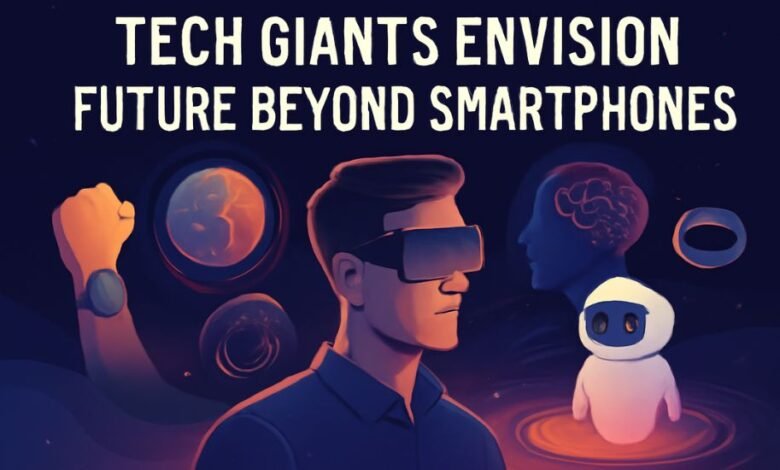
In the ever-evolving world of technology, the smartphone has been the dominant force for over a decade. As of 2025, smartphones are still central to our daily lives, but tech giants are increasingly looking beyond this ubiquitous device, envisioning a future where the phone no longer holds its throne as the primary computing tool. The race to redefine the future of personal technology is underway, with companies like Apple, Meta, Google, and Microsoft exploring a range of next-generation technologies that promise to reshape how we interact with the world.
The End of an Era: The Smartphone as the Central Hub
The smartphone has become the default hub for communication, entertainment, productivity, and even personal health. With advancements in 5G, AI, and mobile applications, the device has evolved into a powerful tool that connects individuals to nearly every aspect of their digital lives. However, this central role is under increasing pressure as tech companies develop alternative technologies that promise to provide more seamless, immersive, and integrated experiences.
Several factors contribute to the growing sentiment that the era of the smartphone, as we know it, is drawing to a close. First, the smartphone market is reaching saturation. Sales growth is slowing down, especially in mature markets like the U.S. and Europe. In emerging markets, the race to own a smartphone has also plateaued, with many consumers already owning a device. Second, the limitations of current smartphone designs have become more apparent. Although these devices are powerful, they still require manual interaction through screens and buttons, which can be cumbersome and distracting. Moreover, as technology advances, users are demanding more intuitive, integrated experiences that extend beyond the limitations of the small, rectangular screen.
The Rise of Wearables: Smart Glasses and Beyond
As smartphone growth slows, tech companies are increasingly betting on wearables as the next big thing. The wearable tech market is booming, with devices like smartwatches, fitness trackers, and augmented reality (AR) glasses gaining traction. These devices promise to provide a more immersive, hands-free experience that can seamlessly integrate into everyday life.
Augmented Reality Glasses: The Future of Computing
One of the most talked-about wearable technologies is augmented reality (AR) glasses. Companies like Apple and Meta have been at the forefront of developing AR glasses that will eventually replace smartphones as our primary interface with the digital world. Apple’s Vision Pro and Meta’s Project Cambria are early examples of devices designed to merge the physical and digital worlds in a way that smartphones simply cannot.
Unlike smartphones, which require users to look down and interact with a screen, AR glasses provide a hands-free experience where digital information is displayed overlaid onto the real world. This enables users to engage with their environment more naturally, whether they are navigating a city, collaborating with coworkers, or simply enjoying a digital game. The potential of AR glasses is vast, with applications ranging from entertainment and gaming to productivity and education.
However, there are still significant challenges to overcome. These include issues related to hardware design (e.g., making the glasses lightweight and comfortable for long periods), battery life, and user interface (e.g., intuitive controls that don’t distract from the real world). Nonetheless, the momentum behind AR technology is undeniable, and many believe that these glasses will eventually replace smartphones as the primary computing device.
Wearable AI Assistants
Beyond AR glasses, other wearable technologies are also gaining traction, including AI-driven smartwatches and rings. These devices are designed to be always-on, providing users with real-time information, reminders, and even health insights without the need to pull out a smartphone.
For instance, a smartwatch powered by AI could track your health metrics, schedule appointments, answer questions, and even anticipate your needs based on your daily patterns. In many ways, these devices are poised to become the true personal assistants of the future, seamlessly integrating with your lifestyle.
The Age of Spatial Computing: Merging the Physical and Digital Worlds
In addition to wearables, spatial computing is another frontier that tech giants are heavily investing in. Spatial computing refers to technologies that enable digital content to be overlaid onto or interact with the physical world. This includes virtual reality (VR) and augmented reality (AR), which offer new ways of interacting with digital content and the world around us.
Spatial computing is poised to revolutionize industries such as gaming, entertainment, education, and remote work. For instance, VR headsets like Meta’s Quest and Microsoft’s HoloLens allow users to fully immerse themselves in digital environments, providing an experience far more immersive than a smartphone screen could ever offer.
Meanwhile, AR devices, like Apple’s Vision Pro, offer a more integrated experience by blending digital and physical spaces. These devices can display digital information in your real-world environment, making it possible to interact with both simultaneously. Whether it’s for virtual meetings, remote collaboration, or even gaming, the possibilities of spatial computing are virtually limitless.
AI and Neural Interfaces: The Future of Interaction
Another significant shift is the movement toward AI-powered systems that serve as the central interface for technology, replacing the touchscreen-based smartphone experience. Imagine a world where you no longer have to press buttons, swipe, or type to interact with your devices. Instead, your voice, gestures, and even thoughts could be enough to control the technology around you.
Neural interfaces, in particular, are a futuristic concept that many tech giants are exploring. These devices, which are still in their infancy, have the potential to read and interpret brain signals, enabling users to control devices with their minds. Companies like Neuralink, founded by Elon Musk, are actively working on brain-machine interfaces that could one day allow people to interact with technology in entirely new ways.
Although the technology is far from being widely available, the potential for neural interfaces is enormous. In the future, we could see devices that are completely voice or thought-controlled, making the smartphone, with its physical screen and buttons, look antiquated by comparison.
Business Drivers: Why the Shift Away from Smartphones?
The push away from smartphones is not solely driven by technological advancements. Business motivations play a significant role in this shift. Smartphone sales have plateaued, and tech companies are looking for new ways to generate growth and stay ahead of the competition.
For many companies, especially those that have saturated the smartphone market, wearables, AR/VR, and AI-powered devices represent a new frontier for innovation and profit. These technologies offer new ways to capture consumer attention and generate revenue streams, from hardware sales to software and services.
Furthermore, the rapid advancement of AI, cloud computing, and edge computing provides the infrastructure needed to support these new devices. Companies like Apple, Meta, and Google are investing heavily in these technologies, hoping to position themselves at the forefront of the next wave of innovation.
Challenges: Overcoming Obstacles in the Shift Beyond Smartphones
While the future beyond smartphones looks promising, several challenges remain. First, consumer adoption of new technologies will take time. Many people are still heavily reliant on their smartphones, and transitioning to new devices may require a shift in mindset and habits.
Moreover, the development of new hardware and software solutions is expensive and complex. Creating AR glasses that are both functional and stylish, for example, requires breakthroughs in optics, battery technology, and miniaturization. Similarly, AI and neural interfaces will require massive advances in both hardware and software to reach a level where they can replace smartphones.
There are also ethical and privacy concerns surrounding new technologies. As devices become more integrated into our daily lives, there will be growing concerns about data privacy, surveillance, and the potential misuse of AI.
The Future is Here: What a Day Without a Smartphone Could Look Like
Imagine a day without a smartphone. Instead of pulling out your phone to check the weather, you look up and see real-time data overlaid on your surroundings via AR glasses. Instead of texting a friend, you speak directly to your AI assistant, which schedules your day and sends messages for you. Instead of browsing the internet on your phone, you interact with holographic displays or immersive virtual environments.
In this future, technology will be more seamless and integrated into our lives, allowing us to focus on the world around us rather than being constantly distracted by screens. The smartphone will no longer be the centerpiece of our digital lives, and the new devices that take its place will offer a more natural, intuitive, and personalized experience.
Conclusion
The smartphone has undoubtedly changed the way we live, but the tech giants of today are already envisioning a future where the smartphone is no longer the dominant device. With the rise of wearables, spatial computing, AI-powered interfaces, and even neural technology, the next generation of computing promises to be more integrated, immersive, and seamless than ever before. While the transition will take time and face significant hurdles, the future beyond smartphones is already on the horizon.
As these new technologies continue to develop, the potential for innovation is endless, offering exciting new possibilities for consumers and businesses alike. The question is not whether smartphones will be replaced, but when, and how these new devices will reshape our relationship with technology.
For more on the latest trends in technology, visit Empire Magazines for in-depth articles, insights, and updates.
FAQS
1. What technologies are tech giants focusing on as the future beyond smartphones?
Tech giants are investing heavily in wearables like smart glasses, augmented reality (AR) devices, virtual reality (VR) headsets, AI-powered assistants, and neural interfaces. These technologies aim to create more immersive, intuitive experiences that move beyond the limitations of traditional smartphones.
2. How will augmented reality (AR) glasses change the way we interact with technology?
AR glasses will overlay digital information onto the physical world, offering hands-free interaction. This can revolutionize tasks like navigation, virtual meetings, gaming, and even real-time data analysis, offering a more natural and integrated experience compared to smartphones.
3. Will the smartphone completely disappear in the future?
While the smartphone may not entirely disappear in the near future, its role is likely to diminish as new technologies like AR glasses, wearables, and AI-powered devices become more mainstream. The shift will likely be gradual, with smartphones coexisting alongside new technologies.
4. How are AI and machine learning influencing the post-smartphone future?
AI and machine learning are enabling smarter devices that can predict user behavior, automate tasks, and offer personalized experiences. In the post-smartphone future, AI-powered assistants will likely be the primary interface, helping users interact with various devices and services seamlessly.
5. What are the challenges tech giants face in moving beyond smartphones?
There are several hurdles to overcome, including the development of wearable technologies that are comfortable, energy-efficient, and functional. There’s also the challenge of convincing users to transition from smartphones to new interfaces, as well as privacy and security concerns related to the new devices and technologies.
6. What is spatial computing, and why is it important?
Spatial computing refers to the ability to interact with digital content that is integrated into the physical world, such as through AR and VR. This technology is important because it offers a more immersive, interactive way of working and experiencing digital content, which could replace the need for smartphones in certain applications.
7. How far are we from seeing widespread adoption of AR glasses or neural interfaces?
The adoption of AR glasses and neural interfaces is still in its early stages. Companies like Apple and Meta are making significant progress, but these technologies face challenges in terms of user comfort, battery life, and overall design. Widespread adoption could take several more years, depending on how quickly these obstacles are overcome.
8. How will the future of smartphones affect businesses and industries?
The shift away from smartphones will impact various industries, from app developers to retailers. Businesses will need to adapt by developing new software for AR glasses and other wearable devices, while marketers and advertisers will have to find innovative ways to engage users in an environment where screens are no longer the primary interface.
9. What role will AI companions and virtual assistants play in the post-smartphone world?
AI companions and virtual assistants will become more integrated into daily life, helping users manage tasks, schedule events, and interact with their environment. These assistants will likely be available across various devices, such as wearables, AR glasses, and even neural interfaces, providing a seamless experience across different platforms.
10. What is the future of smartphone companies like Apple and Samsung in a post-smartphone world?
Apple, Samsung, and other major smartphone companies are already investing in technologies like AR, wearables, and AI. While the smartphone market may decline, these companies are positioning themselves to lead in the next wave of technology, ensuring that they remain relevant in a future where devices are more integrated into daily life.