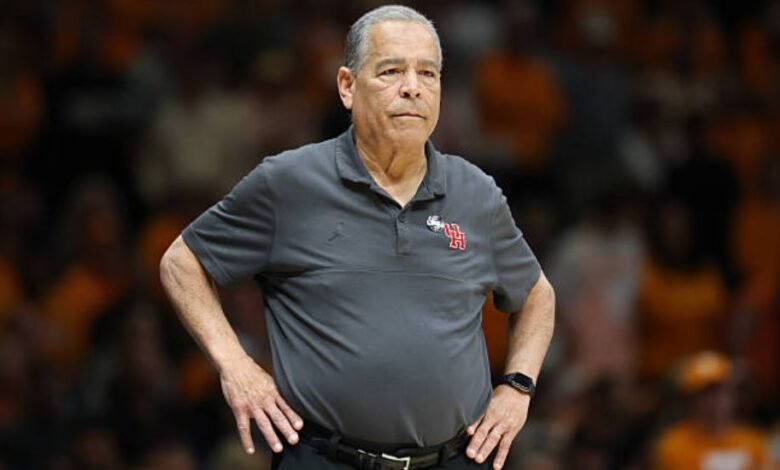
Kelvin Dale Sampson was born on October 5, 1955, in the small, rural community of Laurinburg, North Carolina. Raised in the heart of Robeson County, home to the Lumbee Tribe, Sampson’s upbringing was defined by humility, resilience, and cultural pride. His father, John “Ned” Sampson, served as both a coach and mentor at Pembroke High School, instilling in young Kelvin not only the love of basketball but also the discipline to pursue excellence beyond the court.
Sampson’s journey began long before he ever drew up his first game plan. Growing up in a region marked by poverty and limited opportunity, he learned early that effort often outweighs privilege. As a member of the Lumbee Tribe, his identity shaped his worldview—facing subtle racial bias and systemic challenges that made success not just an aspiration, but an act of defiance. Those early battles carved the foundation for the man who would later become one of the most resilient and respected coaches in modern college basketball.
A Scholar and an Athlete
Before becoming one of the sport’s most respected tacticians, Sampson was a multi-sport athlete at Pembroke State University (now UNC Pembroke). There, he earned four varsity letters in basketball and three in baseball. But his most defining moments came not only on the court but in the classroom. He was a Dean’s List student who majored in Health and Physical Education and minored in Political Science, later earning his master’s degree in coaching and administration at Michigan State University. His pursuit of knowledge reflected a lifelong obsession with understanding how people think, lead, and perform under pressure—a skill that would later define his coaching brilliance.
Montana Tech: Building from the Ground Up
Sampson’s first head coaching opportunity came at Montana Tech, a small program with few resources and even fewer expectations. From 1981 to 1985, he transformed the struggling Orediggers into a respected team within the NAIA ranks. His relentless energy and demand for discipline immediately stood out. Montana Tech was not a glamorous job, but Sampson treated it as if it were Duke or Kentucky. His success there—winning over 70% of his games—earned him recognition as one of college basketball’s brightest young minds.
It was also at Montana Tech where Sampson began crafting his defensive philosophy: relentless ball pressure, team rebounding, and mental toughness. He once said, “You can’t teach heart, but you can demand effort.” Those words would follow him throughout his career, becoming a mantra for every team he led.
also read about: Rick Pitino: The Rise, Fall, and Relentless Reinvention of a Basketball Legend
Washington State: The Program Rebuilder
In 1987, Sampson took over at Washington State University, a program buried at the bottom of the Pac-10 standings. For seven seasons, he labored to change the culture in Pullman, preaching defense, conditioning, and pride. His teams were rarely the most talented, but they were almost always the most prepared. By 1994, the Cougars had reached the NCAA Tournament for the first time in over a decade—a monumental achievement that put Sampson on the national radar.
Sampson’s tenure at Washington State was defined by his ability to turn limited resources into sustained competitiveness. He turned a small-market program into a respected contender, showing that great coaching could outshine recruiting rankings. That ability to rebuild from the ashes would become his calling card in the years to come.
Oklahoma: The Ascent to the National Stage
In 1994, the University of Oklahoma offered Sampson the opportunity to take his coaching to the next level. The Sooners were a proud program in need of revival after a period of inconsistency. Sampson accepted the challenge with trademark tenacity. His debut season yielded a 23-9 record, earning him several national Coach of the Year honors, including the prestigious Associated Press award.
During his 12 seasons at Oklahoma, Sampson built a powerhouse. The Sooners reached the NCAA Tournament 11 times, made a Final Four appearance in 2002, and consistently ranked among the nation’s elite. His .719 winning percentage remains one of the best in school history. Players under his guidance developed not only as athletes but as men—hardened by the demands of his practices and inspired by his belief that “toughness is a talent.”
However, as his star rose, the scrutiny intensified. In 2006, Sampson left Oklahoma to take on a new challenge at Indiana University—a decision that would temporarily derail his career.
Indiana and the Fall from Grace
When Sampson took the Indiana job, expectations were sky-high. The Hoosiers, a storied basketball program, were desperate for a revival of their own. Sampson’s intense energy and proven success seemed like the perfect fit. But within two years, it all came crashing down. The NCAA launched an investigation into recruiting violations involving impermissible phone calls to recruits, a violation of NCAA rules at the time. The scandal led to Sampson’s resignation in 2008 and a five-year “show-cause” penalty from the NCAA—a near-death sentence for any college coach.
For the first time in his career, Sampson faced public disgrace. His name became synonymous with NCAA violations. Many doubted he would ever return to the college ranks. Yet, those who knew Sampson best understood that the same fire that built programs from nothing would not let him fade quietly into the past.
The NBA Years: A Period of Reflection
During his exile from college basketball, Sampson didn’t retreat—he adapted. He joined the NBA coaching ranks, serving as an assistant for the Milwaukee Bucks and later for the Houston Rockets. Those years provided him with new insights into the game, the evolution of player psychology, and the nuances of professional-level strategy. More importantly, it gave him time to reflect on the mistakes that led to his downfall.
In the NBA, Sampson refined his communication style. Gone were the days of college-level paternalism; instead, he embraced collaboration and accountability. He learned how to coach grown men—and how to rebuild his image with humility and professionalism. The lessons from those years would later prove invaluable.
Redemption at Houston: The Rebirth of a Program and a Man
In 2014, the University of Houston took a chance on Sampson—a man once disgraced but now tempered by experience. The Cougars were far from the basketball powerhouse they had been during the “Phi Slama Jama” era. The facilities were outdated, recruiting pipelines weak, and fan engagement minimal. Sampson faced a mountain of challenges.
But if there was one thing Kelvin Sampson understood, it was how to rebuild. Within a few years, Houston was transformed into a national contender. By emphasizing defense, player development, and mental resilience, he restored pride to the program. The Cougars reached the NCAA Tournament multiple times, including a Final Four run in 2021—the school’s first in nearly four decades.
Under his leadership, Houston joined the Big 12 and seamlessly transitioned into one of the top programs in the nation. His teams became known for suffocating defense, elite rebounding, and an unrelenting work ethic. By 2025, Sampson had crossed the 800-win mark, becoming just the 17th coach in Division I history to do so—a milestone that underscored one of the most remarkable comebacks in college basketball history.
Philosophy and Leadership: Old-School Principles in a New-Age Game
Sampson is unapologetically old-school. In an era where players transfer freely and NIL deals dominate headlines, he has maintained a philosophy rooted in discipline, team unity, and personal growth. “You can’t coach effort,” he often says. “But you can demand it.” He believes in tough love, structured accountability, and the power of self-belief.
His practices are intense, his standards high, and his loyalty unwavering. Players describe him as demanding but deeply caring—a coach who will challenge them mercilessly on the court but stand by them like family off it. In an interview with Sports Illustrated, Sampson reflected, “My job isn’t just to make them better basketball players. It’s to make them better men.”
Despite the changing landscape of college sports, Sampson’s methods continue to produce results. His players thrive not just because they’re talented, but because they’re mentally prepared for the grind—a reflection of the man who refuses to let adversity define him.
The Legacy of Resilience
Kelvin Sampson’s story is not merely about basketball; it’s about perseverance, redemption, and the enduring human spirit. From the tribal lands of North Carolina to the bright lights of March Madness, his journey embodies the American ideal that failure is not final unless you stop fighting.
For every headline that once painted him as a rulebreaker, there are now countless stories of players who credit him with changing their lives. For every critic who questioned his integrity, there are peers who now praise his humility and authenticity. His journey through controversy and comeback reflects the timeless truth that redemption is earned, not granted.
Today, Sampson’s name stands not for scandal, but for survival. He has rebuilt his reputation through results, character, and mentorship. And while a national championship still eludes him, his true legacy may already be secure—not in banners, but in the lives he’s influenced and the programs he’s resurrected.
Beyond the Court: The Man Behind the Whistle
Off the court, Sampson remains deeply connected to his family and his Lumbee roots. His wife, Karen, and their children have stood by him through every triumph and trial. His son, Kellen Sampson, serves as an assistant coach at Houston—continuing the family’s basketball lineage and reinforcing the legacy of resilience and unity.
Sampson is also known for his philanthropic work within the Houston community. His initiatives focus on youth development, education, and outreach—particularly among underprivileged and Native American populations. His story resonates not just because of his victories, but because of his authenticity. He never pretended to be perfect; instead, he chose to be accountable.
Kelvin Sampson’s Continuing Story
As of 2025, Sampson remains at the helm of the Houston Cougars, his contract extended through 2029. His program continues to thrive, blending old-school grit with modern efficiency. Each season, his teams enter the tournament as contenders, and his presence on the sideline—arms folded, eyes sharp—reminds everyone of what persistence looks like.
He is living proof that second chances matter, and that integrity, when coupled with effort, can rebuild even the most fractured legacy. Whether he eventually wins a national title or not, Kelvin Sampson’s story will remain one of the most inspiring in college basketball history—a narrative of redemption that future generations will study not for its perfection, but for its perseverance.
Final Word – From Empire Magazines
Kelvin Sampson’s journey from the heart of the Lumbee community to the pinnacle of Division I basketball is a testament to endurance, discipline, and belief. His life teaches that greatness is not the absence of failure but the courage to rise after it. At Empire Magazines, we celebrate such stories—of men and women who rewrite their destinies through grit and grace. Sampson’s saga stands as a powerful reminder: redemption is always possible for those who refuse to quit.
Frequently Asked Questions (FAQs) about Kelvin Sampson
1. Who is Kelvin Sampson?
Kelvin Sampson is an American college basketball coach currently serving as the head coach of the University of Houston men’s basketball team. He is known for his defensive coaching philosophy, leadership, and remarkable career turnaround after past NCAA violations.
2. What is Kelvin Sampson’s background?
Born on October 5, 1955, in Laurinburg, North Carolina, Sampson is of Lumbee Native American descent. He played basketball and baseball at Pembroke State University (now UNC Pembroke) before beginning his coaching career.
3. Where has Kelvin Sampson coached?
Sampson has held head coaching positions at Montana Tech, Washington State, Oklahoma, Indiana, and currently Houston. He also worked as an NBA assistant with the Milwaukee Bucks and Houston Rockets.
4. Why was Kelvin Sampson suspended by the NCAA?
In 2008, while coaching at Indiana University, Sampson was penalized for making impermissible phone calls to recruits, which violated NCAA rules. He resigned and received a five-year “show-cause” penalty, effectively preventing him from coaching in college during that period.
5. How did Kelvin Sampson rebuild his career?
After serving in the NBA as an assistant coach, Sampson returned to college basketball in 2014 with the University of Houston. He rebuilt the Cougars into a national powerhouse, emphasizing discipline, player development, and defensive intensity.
6. How many career wins does Kelvin Sampson have?
As of late 2025, Sampson has surpassed 800 career NCAA Division I coaching victories, making him one of the winningest active coaches in college basketball.
7. What is Kelvin Sampson’s coaching philosophy?
Sampson focuses on toughness, discipline, and team defense. He believes in accountability, demanding maximum effort from his players, and helping them grow as individuals beyond basketball.
8. What is Kelvin Sampson’s current position?
Kelvin Sampson is the head coach of the University of Houston Cougars men’s basketball team. His current contract extends through the 2028–2029 season.
9. Has Kelvin Sampson won a national championship?
Despite reaching the Final Four and numerous NCAA Tournament appearances, Sampson has not yet captured a national championship as of 2025.
10. What is Kelvin Sampson’s legacy in college basketball?
Sampson’s legacy is one of redemption and resilience. From scandal to success, he has proven that determination and integrity can restore a tarnished reputation and redefine a career.