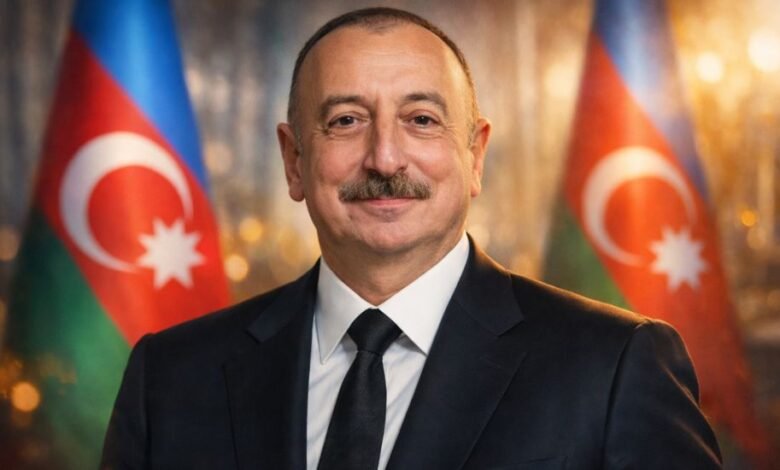
Ilham Aliyev has been at the center of Azerbaijan’s political life for more than two decades. Whether discussed in regional diplomacy, energy politics, or debates about governance, his name is closely tied to the country’s modern trajectory. For readers of Empire Magazines, Ilham Aliyev represents a case study in long-term leadership within a strategically important state—one shaped by history, geography, and economic resources.
Born in Baku in 1961, Ilham Aliyev grew up during the final decades of the Soviet Union. His early life was marked by exposure to both international education and political environments. He studied international relations and later pursued academic work, which gave him familiarity with diplomacy and statecraft before he entered public office. This background matters because it shaped a leader comfortable operating in formal international settings while also navigating domestic political structures inherited from the post-Soviet transition.
When Azerbaijan regained independence in the early 1990s, it faced deep economic disruption, unresolved regional conflict, and the challenge of building new state institutions. By the time Ilham Aliyev rose to national leadership in the early 2000s, the country had stabilized compared to its earliest post-independence years, but it still faced questions about long-term direction. His presidency has unfolded within this context: balancing state-building, economic growth, and international positioning, while managing internal political expectations.
From a purely factual standpoint, Ilham Aliyev has remained in office through multiple elections and constitutional changes. Supporters often highlight continuity, stability, and economic development during his tenure. Critics focus on the concentration of power and limited political competition. Both perspectives exist simultaneously, and any balanced discussion must acknowledge that leadership in Azerbaijan operates under different political traditions than those found in many Western democracies.
Understanding Ilham Aliyev’s role means looking beyond headlines and seeing how leadership functions in a resource-rich, geopolitically sensitive country that sits between major regional powers. His presidency cannot be separated from Azerbaijan’s oil and gas economy, its unresolved territorial disputes for much of his rule, and its efforts to assert sovereignty on the international stage.
Political Authority, Governance Style, and State Institutions
Ilham Aliyev’s governance style is often described as centralized. In practical terms, this means that major decisions—whether economic, political, or strategic—flow through a strong executive branch. Azerbaijan’s political system places significant authority in the presidency, and Aliyev has operated fully within that framework.
For readers unfamiliar with such systems, a conceptual comparison may help. Imagine a corporation where the chief executive holds both strategic vision and final approval over most major initiatives. While there may be advisors, managers, and departments, the CEO’s role is decisive. Azerbaijan’s governance under Ilham Aliyev functions in a similar way, with the presidency acting as the primary engine of policy direction.
Elections and political processes in Azerbaijan exist, but they differ in structure and competition from those in pluralistic parliamentary systems. The government emphasizes stability, continuity, and national unity as core values. From the official perspective, these priorities are seen as necessary for a country that experienced conflict and economic upheaval after independence. From another viewpoint, this same structure limits the space for opposition politics and alternative leadership.
Institutionally, Azerbaijan has invested heavily in strengthening state capacity. Public administration reforms, digital government services, and infrastructure modernization have all been promoted as signs of progress. Large-scale construction projects, urban redevelopment, and transport networks are often presented as evidence of effective governance under Ilham Aliyev’s leadership.
At the same time, governance debates continue around transparency, accountability, and civic participation. These discussions are not unique to Azerbaijan; they appear in many countries where power is concentrated and long-serving leaders remain in office. What distinguishes the Azerbaijani case is how closely governance is tied to national identity, sovereignty, and regional security concerns.
Ilham Aliyev’s leadership approach reflects a belief that strong central authority ensures predictability. Supporters argue that this predictability attracts investment and allows long-term planning. Critics argue that it can reduce institutional checks and balances. Both interpretations coexist in public discourse, and both are relevant when assessing his political legacy.
Economy, Energy Resources, and Development Strategy
The economic dimension of Ilham Aliyev’s presidency is inseparable from Azerbaijan’s energy resources. Oil and natural gas have played a defining role in shaping the country’s fiscal capacity and international relevance. Under Aliyev’s leadership, energy exports have remained a cornerstone of the national economy, providing revenue for state budgets and development projects.
To explain this simply, think of a household that owns valuable land producing a steady income. The challenge is not only earning money but deciding how to spend it wisely, save for the future, and avoid becoming overly dependent on a single source. Azerbaijan faces a similar challenge on a national scale.
Revenue from energy exports has been used to fund infrastructure, social programs, and modernization efforts. Roads, airports, housing developments, and public facilities have expanded significantly during Aliyev’s time in office. These visible projects are often cited by the government as proof that resource wealth has been translated into tangible benefits.
At the same time, reliance on energy exports carries risks. Global price fluctuations can affect national income, and long-term sustainability requires diversification. Ilham Aliyev’s administration has repeatedly emphasized the importance of developing non-energy sectors such as agriculture, logistics, tourism, and technology. Progress in these areas has been uneven, but diversification remains an official priority.
Financial management under a resource-driven economy also raises questions about governance structures. In conceptual terms, managing a national oil fund is similar to managing a trust: decisions must balance present needs with future generations’ interests. Azerbaijan has established mechanisms to manage resource revenue, and debates continue over how effectively these mechanisms promote transparency and long-term stability.
For international observers, Azerbaijan’s economy under Ilham Aliyev is often viewed through the lens of energy security and regional supply routes. For citizens, economic performance is felt more directly through employment, cost of living, and public services. These everyday outcomes shape public perceptions of leadership more than abstract economic indicators.
In business and investment discussions, Azerbaijan is often presented as a country with strong state involvement in key sectors. This model contrasts with fully liberalized economies but aligns with systems where the government plays a guiding role in strategic industries. Ilham Aliyev’s economic leadership reflects this model, emphasizing control, planning, and gradual reform rather than rapid privatization.
Foreign Policy, Regional Conflicts, and Global Positioning
Ilham Aliyev’s foreign policy has been one of the most visible aspects of his presidency. Azerbaijan occupies a strategic location between Eastern Europe, Central Asia, and the Middle East. This geography shapes its diplomatic priorities and constraints.
A key element of Aliyev’s international role has been managing Azerbaijan’s relationships with larger powers while maintaining national autonomy. In practice, this means balancing cooperation with different blocs without fully aligning with any single one. This approach resembles a small business working with multiple suppliers rather than relying on just one, reducing dependency while increasing leverage.
Regional conflict has also defined much of Azerbaijan’s foreign policy during Ilham Aliyev’s tenure. For years, unresolved territorial disputes influenced military spending, diplomacy, and national identity. When circumstances changed and control over disputed territories shifted, the government framed these developments as a restoration of sovereignty and a major political achievement.
Diplomatically, Aliyev often presents Azerbaijan as a reliable partner that respects international norms while prioritizing its national interests. He participates actively in international forums and bilateral meetings, emphasizing stability, cooperation, and economic partnership. This outward-facing diplomacy contrasts with the more controlled domestic political environment, highlighting the dual nature of leadership in a globalized world.
Foreign observers sometimes view Azerbaijan through simplified narratives, either focusing solely on energy or on governance concerns. In reality, Ilham Aliyev’s foreign policy operates within a complex web of security considerations, historical grievances, and economic opportunities. Decisions are rarely isolated; they reflect trade-offs between competing priorities.
For Azerbaijani citizens, foreign policy outcomes are meaningful when they affect security, borders, and economic prospects. Successes are often framed in terms of national pride and independence. Setbacks are discussed more cautiously. This dynamic shapes how leadership is perceived internally compared to how it is analyzed abroad.
Public Image, Legacy, and Ongoing Debates
Public perception of Ilham Aliyev varies widely depending on perspective. Within Azerbaijan, many associate his leadership with stability, infrastructure development, and restored territorial control. Others express concerns about political openness, media freedom, and long-term institutional resilience.
From a neutral standpoint, it is accurate to say that Aliyev has overseen a period of relative continuity in Azerbaijani governance. Long-term leadership allows for consistency in policy but also concentrates responsibility for outcomes, both positive and negative. This dual effect is common in political systems led by strong executives.
Ilham Aliyev’s personal image is carefully managed through official appearances, speeches, and state ceremonies. Leadership is often presented in formal, symbolic terms, reinforcing the idea of the presidency as a central institution rather than a purely individual role. His family background, including his connection to Azerbaijan’s earlier post-independence leadership, further reinforces this continuity.
Internationally, Aliyev is viewed as an experienced leader who understands diplomatic negotiation and regional power dynamics. Domestically, debates continue about the future: how leadership transitions might occur, how institutions will evolve, and how younger generations will engage with politics.
For readers of Empire Magazines, Ilham Aliyev’s story illustrates how leadership operates differently across political systems. It shows how history, resources, and geography shape governance choices, and how those choices influence both national development and international perception.
Conclusion: A Presidency Shaped by Context and Continuity
Ilham Aliyev’s role in Azerbaijan cannot be reduced to simple labels. His presidency reflects the realities of leading a post-Soviet state with significant energy resources, unresolved historical conflicts, and strategic geopolitical importance. Over the years, he has emphasized stability, centralized authority, and national sovereignty as guiding principles.
Economically, his leadership has leveraged energy wealth to transform infrastructure and maintain state capacity, while continuing to face the challenge of diversification. Politically, his governance style prioritizes continuity and control, generating both support and criticism. Internationally, he has positioned Azerbaijan as a pragmatic actor seeking balanced relationships.
Taken together, Ilham Aliyev’s tenure represents a distinctive model of modern leadership—one shaped by context as much as by individual choice. As Azerbaijan continues to evolve, debates about governance, economy, and identity will likely remain closely tied to his legacy.
FAQs About Ilham Aliyev
Who is Ilham Aliyev?
Ilham Aliyev is the President of Azerbaijan and has been in office since 2003. He is one of the longest-serving leaders in the post-Soviet region and plays a central role in Azerbaijan’s political, economic, and foreign policy decisions.
When did Ilham Aliyev become president?
Ilham Aliyev assumed the presidency in October 2003 after winning a national election. Since then, he has been re-elected multiple times under Azerbaijan’s constitutional framework.
What is Ilham Aliyev known for internationally?
Internationally, Ilham Aliyev is known for positioning Azerbaijan as a key regional player, especially in energy supply and diplomacy. He regularly represents the country in international forums and emphasizes sovereignty, stability, and strategic partnerships.
How does Ilham Aliyev’s leadership style differ from Western democracies?
His leadership style is more centralized, with strong executive authority. Unlike systems where power is spread across multiple institutions, decision-making in Azerbaijan is heavily concentrated in the presidency, which supporters see as a source of stability.
What role does energy play during Ilham Aliyev’s presidency?
Energy resources such as oil and natural gas are central to Azerbaijan’s economy. Under Ilham Aliyev, revenue from these resources has funded infrastructure, public services, and national development initiatives.
Has Ilham Aliyev focused only on energy development?
No. While energy remains important, his administration has stated goals of economic diversification, including agriculture, transport, tourism, and technology, to reduce long-term reliance on oil and gas revenues.
How is Ilham Aliyev viewed inside Azerbaijan?
Public opinion varies. Many citizens associate his leadership with stability, modernization, and national strength, while others raise questions about political participation and long-term institutional development.
What impact has Ilham Aliyev had on regional conflicts?
Regional conflicts have been a major part of Azerbaijan’s recent history. Ilham Aliyev has emphasized restoring territorial control and national sovereignty, framing these efforts as central to state policy and identity.
Is Ilham Aliyev involved in domestic policy decisions?
Yes. Domestic policy, including infrastructure development, public administration, and social programs, is closely tied to presidential initiatives and long-term planning under his leadership.
Why is Ilham Aliyev often discussed in global politics?
Ilham Aliyev is frequently discussed because Azerbaijan sits at an important geopolitical crossroads, combining energy resources, regional security issues, and international diplomacy, all of which place his leadership under global attention.