Lakers vs Denver Nuggets Match Player Stats: In‑Depth Analysis of Key Performances and Trends

The rivalry between the Los Angeles Lakers and the Denver Nuggets has emerged as one of the most compelling narratives of the contemporary NBA landscape, defined by their contrasting styles, elite talent, and strategic adjustments. In the 2024‑25 season in particular, this matchup captured the imagination of basketball fans, bringing together a blend of veteran leadership, rising stars, and statistical intrigue. Throughout multiple head‑to‑head clashes, both teams have unveiled distinct statistical patterns and individual contributions, which when examined closely reveal not only the on‑court dynamics but also the underlying narrative of two franchises striving for supremacy in the Western Conference. By analyzing key player performances, scoring trends, rebounding battles, assist distributions, and defensive impacts across games, we can trace how these elements shaped outcomes and highlighted the strengths and weaknesses of each roster. The Lakers, historically a franchise built on star power and versatile big men, saw significant performances from Luka Dončić, LeBron James, and Austin Reaves in their competitive duels with Denver, while the Nuggets leaned on Nikola Jokić’s all‑around brilliance and the secondary scoring of Jamal Murray, Michael Porter Jr., and Aaron Gordon. In dissecting these match player statistics with meticulous care, this article seeks to offer a definitive chronicle of how individual contributions influenced overall match results and what these figures suggest about the evolving identities of both teams within the NBA hierarchy.
February 22, 2025: Lakers Dominate with Balanced Scoring
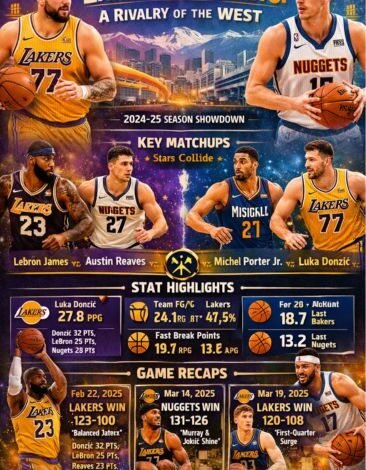
One of the defining games of the Lakers versus Nuggets season came on February 22, 2025, when the Los Angeles Lakers secured a decisive 123‑100 victory on Denver’s home floor, snapping a lengthy winning streak for the Nuggets and showcasing a blend of offensive efficiency and defensive resilience that underscored their potential. Luka Dončić and LeBron James led the charge with significant scoring and playmaking outputs, Dončić pouring in 32 points and 10 rebounds while James contributed 25 points and spearheaded the Lakers’ transition offense with his veteran instincts. Austin Reaves also made his presence felt with 23 points, demonstrating his ability to impact both scoring and ball distribution. This offensive outburst was supported by Rui Hachimura’s 21 points, adding crucial spacing and scoring balance that prevented Denver from focusing their defense solely on the Lakers’ primary stars. Denver, despite boasting a deep rotation featuring Nikola Jokić, Aaron Gordon, Jamal Murray, Russell Westbrook, and Michael Porter Jr., struggled to contain Los Angeles’s multifaceted offense, with Jokić’s triple‑double overshadowed by six turnovers that contributed to Denver’s 20 giveaways overall. Gordon led Denver with 24 points, but the rest of the roster could not muster enough consistent contributions to close the gap. The Lakers’ effective ball movement, high field goal percentages, and the ability to convert turnovers into fast‑break points reflected a comprehensive team performance that transcended individual box scores, illustrating a tactical masterclass in exploiting mismatches and creating scoring opportunities against a usually stout Nuggets defense. This game, therefore, stands as a testament to how a coordinated offensive scheme paired with disciplined defense can eclipse star talent when executed at a high level.
March 14, 2025: Nuggets Rebound with High‑Scoring Thriller
In stark contrast to the Lakers’ commanding win in Denver, the March 14, 2025 matchup between these two Western Conference rivals delivered a thrilling high‑scoring contest that ended with the Denver Nuggets prevailing 131‑126 in a game defined by explosive offensive outputs and clutch late‑game plays by Jamal Murray and Nikola Jokić. Murray, who had been working his way back into form, scored efficiently in key moments, showcasing his ability to create shots under pressure and to penetrate the Lakers’ perimeter defense. Jokić provided his trademark all‑around excellence, contributing crucial buckets, rebounds, and assists that kept Denver competitive throughout every phase of the contest. Austin Reaves was the standout performer for the Lakers, exploding for a remarkable 37 points and demonstrating his growth as a primary scoring option when the Lakers’ stars faced stout defensive pressure. Dalton Knecht chipped in with 32 points of his own, adding depth to Los Angeles’s offensive arsenal and highlighting how emerging talent can influence the outcome of marquee matchups. Despite these individual heroics, the Lakers ultimately could not match Denver’s scoring depth, as the Nuggets featured multiple players in double figures and spread their offensive load effectively across the rotation. Denver’s strategic emphasis on ball movement and spacing forced Los Angeles to constantly rotate defensively, creating open looks for shooters and facilitating Jokić’s facilitation from the high post. While the Lakers responded with impressive offensive rhythm, especially in mid‑range and perimeter shooting, Denver’s late defensive stands and timely scoring spurt in the final quarter secured their victory. This game underscored the competitive balance between these teams and highlighted how individual stat lines can both illuminate exceptional performance and mask broader team vulnerabilities when facing an equally potent offensive opponent.
March 19, 2025: Lakers Establish Dominance with First‑Quarter Surge
Another pivotal meeting between the Lakers and Nuggets occurred on March 19, 2025, when Los Angeles delivered a resounding 120‑108 win against a Nuggets team that was hampered by the absence of several key players but nonetheless put up a competitive fight. Luka Dončić once again led the Lakers in scoring and all‑around play, compiling 31 points, nine rebounds, and seven assists in just three quarters of play, a performance that emphasized his central role in orchestrating the Lakers’ offense. Austin Reaves complemented Dončić’s attack with 22 points and eight assists, further illustrating the Lakers’ multifaceted scoring options and their ability to distribute offensive responsibilities effectively among perimeter players. Aaron Gordon paced the Nuggets with 26 points and 11 rebounds, demonstrating his effectiveness both in interior scoring situations and on the glass despite Denver’s significant defensive adjustments made in the absence of stars like Nikola Jokić and Jamal Murray. The Nuggets’ resilience was evident in how they continued to generate scoring opportunities, rotating the ball and finding secondary contributors in Michael Porter Jr. and Christian Braun. Nevertheless, the Lakers’ blistering start, particularly a 46‑point first quarter led by Dončić’s early aggression, set the tone for the contest and created a cushion that Denver struggled to overcome. This early dominance forced Denver into a more reactive posture, often having to play catch‑up and relying on sporadic scoring bursts that were ultimately insufficient. The statistical narrative of this matchup underscores how early momentum, coupled with efficient shooting and rebounding strength, can define the competitive arc of a game, even when facing a deep and talented opponent.
Historical NBA Matchups: Trends and Longitudinal Stats
Beyond the individual games of the 2024‑25 season, the Lakers versus Nuggets rivalry carries a statistical lineage filled with compelling insights that span multiple years. Historical box scores show that matchups between these teams often feature high scoring and dynamic offensive flows, with each franchise bringing its own approach to pace and spacing. For example, in the October 24, 2023 regular season game, Denver emerged with a 119‑107 victory over Los Angeles, with Nikola Jokić assembling a near triple‑double performance of 29 points, 13 rebounds, and 11 assists while LeBron James led the Lakers with 21 points and a host of support contributions. These historical encounters reflect how the presence of elite big men like Jokić and Davis, when paired with skilled perimeter creators, can produce box score lines that evenly distribute statistical impact across scoring, rebounding, and playmaking categories. Longitudinal player stat trends show that Denver generally posts higher team scoring averages, rebounds, and assists in head‑to‑head matchups, underscoring their holistic offensive philosophy and emphasis on ball movement and spacing. Lakers statistical patterns in these rivalries often highlight the importance of timely shooting and defensive rotations, reflecting a strategic emphasis on versatility and adaptability. Taken together, these historical comparisons reveal a narrative of statistical balance and competitive tension that elevates this rivalry beyond isolated games to represent broader shifts in playing styles, coaching philosophies, and roster construction strategies within the evolving context of the NBA.
Player Stat Leaders and Seasonal Averages
Analyzing player stat leaders across the Lakers and Nuggets provides a revealing snapshot of how individual excellence translates into team performance. Nikola Jokić, for instance, consistently posts numbers that place him among the league leaders in points, rebounds, and assists per game, illustrating his unique role as both a primary scorer and facilitator for Denver. Meanwhile, Lakers stars such as LeBron James and Dončić showcase their scoring prowess and playmaking versatility, driving the Lakers’ offensive schemes while also contributing significantly on the boards. Austin Reaves’s emergence as a reliable scoring threat adds another dimension to Los Angeles’s statistical profile, making the Lakers’ offense less predictable and harder to defend. Seasonal averages further highlight that Denver typically maintains higher offensive efficiency and scoring output, while the Lakers often demonstrate a balanced contribution from both their starters and bench players, reflecting a strategic emphasis on depth and rotational flexibility. These statistical trends not only illuminate individual excellence but also reveal how each franchise’s roster composition and coaching strategies affect the cumulative statistical footprint over the course of the season. By juxtaposing these statistical narratives, we begin to understand how elite individual performances intertwine with broader team identities to shape outcomes in high‑stakes matchups like Lakers versus Nuggets.
Strategic Insights from Head‑to‑Head Metrics
When one examines head‑to‑head metrics between the Los Angeles Lakers and Denver Nuggets, certain strategic themes emerge that reflect the broader philosophies of these storied franchises. The Lakers often prioritize defensive solidity and transition scoring, leveraging the versatility of perimeter defenders and the leadership of veteran playmakers to control game tempo. In contrast, the Nuggets frequently adopt a more proactive offensive stance, emphasizing ball movement, spacing, and high‑percentage shot selection to maintain scoring rhythm. These strategic differences manifest in head‑to‑head statistical trends such as higher assist rates for Denver, balanced scoring contributions across multiple players, and Denver’s ability to generate points in the paint. Conversely, Lakers statistical tendencies reflect a reliance on efficient shooting from key contributors and disciplined defensive rotations that force contested shots and turnovers. This contrast becomes particularly pronounced in close games, where tactical adjustments, substitution patterns, and late‑game execution heavily influence statistical outcomes. Understanding these strategic influences through the lens of player stats and team metrics not only enhances our appreciation of the nuances within each matchup but also sheds light on how coaching philosophies and in‑game decision‑making translate into measurable performance indicators on the stat sheet.
Impact of Injuries and Roster Changes
Injuries and roster changes have undeniably shaped the statistical landscape of Lakers versus Nuggets matchups. When key players such as Nikola Jokić or Jamal Murray have missed games for Denver, the team’s scoring balance and playmaking distribution have shifted markedly, leading to increased responsibilities for role players such as Aaron Gordon, Christian Braun, and Peyton Watson. Similarly, injuries to core Lakers contributors like LeBron James and Rui Hachimura have forced Los Angeles to rely more heavily on emerging talents such as Luka Dončić and Austin Reaves, altering the statistical dynamics and requiring tactical adjustments from the coaching staff. These fluctuations have highlighted the importance of roster depth and flexibility, as teams must recalibrate offensive sets and defensive assignments in response to changing lineups. The resulting statistical impact often emerges in rebounding distributions, assist patterns, and scoring variability, offering a window into how teams adapt — or struggle to adapt — when faced with unexpected personnel changes. These adaptive responses, captured through individual and team stats, underscore the resilience of both franchises and their ability to navigate adversity while maintaining competitive performance.
Conclusion
In conclusion, the Lakers versus Denver Nuggets matchup stands as one of the NBA’s most statistically rich and strategically engaging rivalries, offering endless insights into player performance dynamics, coaching strategy, and the evolving nature of professional basketball competition. From standout scoring nights to tightly contested high‑octane performances, each game adds another layer of depth to this ongoing narrative. By analyzing both game‑specific player stats and broader seasonal trends, we gain a holistic understanding of how individual excellence, team strategy, and situational adjustments converge to shape outcomes in these compelling contests. Whether through Luka Dončić’s leadership, Nikola Jokić’s all‑around mastery, or the breakout contributions from role players on both squads, the statistical storylines emerging from Lakers vs Denver Nuggets matchups are as influential as they are fascinating, reflecting the intricate tapestry of modern NBA competition. This comprehensive analysis not only provides an authoritative account of past performances but also sets the stage for future encounters in what promises to remain a riveting chapter in basketball history. Empire Magazines
FAQs About Lakers vs Denver Nuggets Match Player Stats
Q1: Who are the top performers in Lakers vs Nuggets games?
The top performers in Lakers vs Nuggets matchups vary from game to game, but consistently standout players include Luka Dončić, LeBron James, and Austin Reaves for the Lakers, and Nikola Jokić, Jamal Murray, and Aaron Gordon for the Nuggets. These athletes contribute significantly to scoring, playmaking, and rebounding, often shaping the outcome of closely contested matches. The stats highlight how each team relies on a blend of star power and role-player contributions to maintain competitive balance.
Q2: How do player stats affect the outcome of Lakers vs Nuggets games?
Player stats, including points, rebounds, assists, turnovers, and shooting percentages, provide a quantitative reflection of how a team executes its strategy on the court. High-scoring nights from key players or balanced scoring across the roster can determine the winner. Additionally, defensive stats like steals, blocks, and defensive rebounds are critical in slowing down the opposition and creating fast-break opportunities that can swing momentum in these high-stakes matchups.
Q3: What trends can be seen from historical Lakers vs Nuggets matchups?
Historically, games between the Lakers and Nuggets tend to be high-scoring and closely contested, often showcasing the impact of elite big men and versatile perimeter scorers. Nuggets games generally feature higher team assist totals, reflecting their ball-movement-based offense, while Lakers games often highlight efficient shooting from star players and disciplined defensive rotations. Over time, these trends reveal how strategic philosophies and player performances evolve across seasons.
Q4: How do injuries influence player stats in these matchups?
Injuries can significantly alter player statistics and team performance. When key contributors such as Jokić or LeBron James are absent, secondary players are called upon to take on larger roles, affecting scoring distribution, assist patterns, and rebounding totals. Teams must adjust their rotations and strategies, which can lead to either improved opportunities for emerging stars or challenges in maintaining offensive and defensive efficiency.
Q5: Where can I find detailed stats for each Lakers vs Nuggets game?
Detailed player stats for Lakers vs Nuggets games can be accessed on reputable sports websites such as Empire Magazines, NBA, ESPN, and Bleacher Report. These sources provide comprehensive box scores, advanced analytics, and game recaps, enabling fans and analysts to study individual and team performances across every matchup.