Introduction
Sunlight is far more than a source of energy for plants. It serves as a powerful signal that influences every stage of a plant’s life, from the moment a seed begins to germinate until it flowers and produces new seeds. Plants continuously monitor the quality, intensity, direction, and duration of light to make critical decisions about growth and survival. Behind this remarkable ability lies a sophisticated network of light-sensitive proteins known as photoreceptors, and among the most important of these is PHYB, or Phytochrome B.
PHYB is one of the best-studied photoreceptors in plant biology. It functions as a molecular light sensor that detects red and far-red wavelengths, allowing plants to interpret changes in their surrounding environment. Whether a plant is growing in direct sunlight, beneath the shade of neighboring vegetation, or during changing seasons, PHYB helps regulate the appropriate developmental responses. This extraordinary protein influences plant height, leaf expansion, flowering time, seed germination, chlorophyll production, and numerous other biological processes that ultimately determine plant health and productivity.
Scientists have spent decades studying PHYB because understanding how it works not only advances basic plant science but also opens new possibilities for agriculture. As climate change, population growth, and food security become increasingly important global concerns, knowledge about PHYB is helping researchers develop crops that are more resilient, productive, and adaptable to changing environmental conditions.
What Is PHYB?
PHYB stands for Phytochrome B, a member of the phytochrome family of photoreceptor proteins found in higher plants. These specialized proteins enable plants to detect specific wavelengths of light and convert that information into biological signals that control growth and development.
Unlike animals, plants cannot relocate when environmental conditions become unfavorable. Instead, they rely on sophisticated sensing mechanisms to adapt to their surroundings. PHYB acts as one of the plant’s primary environmental sensors by monitoring the balance between red light and far-red light. This balance provides valuable information about whether a plant is growing in open sunlight, beneath a canopy of other plants, or during different times of the day and year.
The PHYB gene produces the Phytochrome B protein, which remains inactive until exposed to light. Once activated, the protein triggers a series of molecular events that alter gene expression inside plant cells. These changes eventually influence how the plant grows, develops, and responds to its environment.
Researchers have identified PHYB in numerous plant species, including the widely studied model plant Arabidopsis thaliana, as well as important agricultural crops such as wheat, rice, soybean, maize, and tomatoes. Although the exact function may vary slightly among species, the core mechanism remains remarkably conserved throughout the plant kingdom.
The Discovery of PHYB
The scientific understanding of phytochromes began during the mid-twentieth century when researchers noticed that plants responded differently depending on the color of light they received. Experiments revealed that exposure to red light often promoted seed germination and influenced flowering, while far-red light could reverse many of these effects.
These observations led scientists to discover phytochromes, a family of proteins specifically designed to detect red and far-red wavelengths. As molecular biology advanced, researchers identified several different phytochrome genes, including PHYA, PHYB, PHYC, PHYD, and PHYE in many flowering plants.
Among these family members, PHYB quickly emerged as one of the most significant because of its broad influence over plant development. Scientists found that plants lacking functional PHYB exhibited dramatic differences in height, flowering time, leaf shape, and shade responses. These discoveries established PHYB as one of the central regulators of plant growth.
Over the years, advances in genetics, molecular biology, imaging technologies, and structural biology have allowed researchers to examine PHYB in extraordinary detail. Today, PHYB remains one of the most extensively studied photoreceptors in modern plant science.
Understanding How Plants Detect Light
Plants experience light differently than humans. While people use their eyes to form visual images, plants use specialized photoreceptors to measure different characteristics of light that provide environmental information.
Sunlight contains many wavelengths across the electromagnetic spectrum. PHYB specializes in detecting red light, which has wavelengths around 660 nanometers, and far-red light, typically around 730 nanometers. The ratio between these two types of light changes depending on environmental conditions.
When sunlight passes through leaves, much of the red light is absorbed for photosynthesis, while far-red light passes through more easily. As a result, plants growing beneath dense vegetation receive proportionally more far-red light than red light. PHYB recognizes these subtle differences and helps plants determine whether they are competing with nearby vegetation.
This ability allows plants to make intelligent developmental decisions. If the environment indicates heavy competition for sunlight, the plant may invest more energy into stem elongation to reach brighter conditions. If sufficient sunlight is available, growth can be directed toward producing broader leaves, stronger stems, and greater overall biomass.
The Structure of the PHYB Protein
PHYB is a large and highly organized protein designed specifically for light perception and signal transmission. Its structure allows it to capture light energy and convert that information into biochemical signals that influence gene activity.
One important feature of PHYB is its attachment to a small light-absorbing molecule known as a chromophore. This chromophore acts like a tiny antenna, capturing red and far-red light from the environment.
The protein itself consists of several functional domains that perform different tasks. Some regions specialize in detecting incoming light, while others regulate interactions with additional proteins inside the cell. Together, these structural components create an efficient molecular switch capable of responding rapidly to changes in lighting conditions.
Modern imaging techniques such as cryo-electron microscopy and X-ray crystallography have provided detailed insights into PHYB’s three-dimensional structure. These studies continue to reveal how subtle structural changes allow the protein to control complex biological processes with remarkable precision.
How PHYB Switches Between Active and Inactive Forms
One of the most fascinating characteristics of PHYB is its ability to function as a reversible molecular switch.
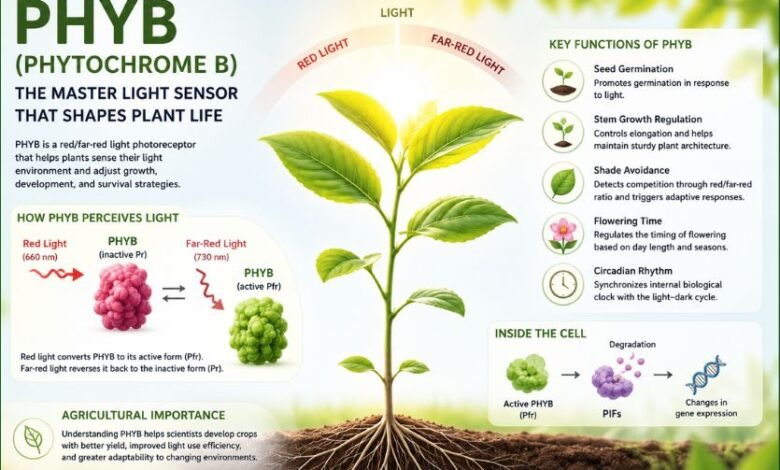
In darkness, PHYB primarily exists in an inactive form known as Pr. When exposed to red light, the chromophore absorbs energy and causes the protein to change its shape. This structural transformation converts PHYB into its active form, called Pfr.
The active Pfr form moves into the cell nucleus, where it interacts with regulatory proteins responsible for controlling gene expression. Through these interactions, PHYB influences hundreds of genes involved in plant development.
When far-red light becomes dominant or darkness returns, PHYB gradually converts back into the inactive Pr form. This reversible system enables plants to continuously monitor changing light conditions throughout the day.
Because sunlight naturally changes from sunrise to sunset and across different seasons, this dynamic switching mechanism allows plants to maintain highly accurate awareness of their environment.
PHYB and Cellular Communication
Although PHYB begins its work by detecting light, its influence extends deep into the plant’s cellular communication network.
After activation, PHYB enters the nucleus and interacts with proteins known as transcription factors. Among the most important are the Phytochrome Interacting Factors, commonly called PIFs.
Under dark conditions, PIF proteins promote stem elongation and other characteristics associated with rapid growth in search of light. When PHYB becomes activated by red light, it binds to these PIF proteins and marks them for degradation.
As PIF levels decline, the activity of numerous downstream genes changes. Growth slows, leaves expand, chlorophyll production increases, and photosynthesis becomes more efficient. This shift allows the plant to transition from searching for light to fully utilizing available sunlight for healthy development.
Scientists now recognize this signaling pathway as one of the central regulatory systems controlling plant architecture.
Why PHYB Matters in Modern Plant Science
The importance of PHYB extends far beyond academic research. Because this photoreceptor regulates so many aspects of plant growth, it has become a major focus for scientists working to improve agriculture.
Understanding how PHYB controls plant responses enables researchers to develop crop varieties that perform better under crowded planting conditions, changing climates, and variable light environments. Manipulating PHYB activity may help produce crops with improved yields, optimized flowering times, stronger resistance to environmental stress, and greater resource efficiency.
As global agriculture faces increasing challenges from population growth and climate change, PHYB represents one of the most promising molecular targets for future crop improvement. Continued research into its structure, signaling pathways, and interactions with other plant hormones is expanding our understanding of how plants adapt to their surroundings and how these natural processes can be harnessed to support sustainable food production.
The Role of PHYB in Seed Germination
The journey of every plant begins with a seed, and PHYB plays a vital role in determining when that seed should start growing. Germination is an energy-intensive process, so plants must ensure that environmental conditions are favorable before committing to development. Light serves as one of the most reliable environmental signals, and PHYB helps interpret that signal with remarkable precision.
When dormant seeds receive sufficient red light, PHYB becomes activated and initiates a cascade of genetic and hormonal changes that encourage germination. This process reduces the influence of growth-inhibiting hormones such as abscisic acid while promoting the production of gibberellins, hormones that stimulate cell expansion and embryo growth. As these hormonal balances shift, the seed absorbs water, activates metabolic pathways, and begins producing the enzymes needed to break down stored nutrients.
In natural ecosystems, this mechanism prevents seeds from germinating beneath dense layers of vegetation where sunlight is limited. Instead, seeds are more likely to sprout in open environments where young seedlings have a greater chance of survival. By carefully interpreting the balance between red and far-red light, PHYB ensures that germination occurs under conditions most likely to support successful growth.
PHYB and Plant Growth
One of the most significant responsibilities of PHYB is regulating plant architecture. Plant growth is not simply a matter of increasing in size; every organ must develop in harmony with environmental conditions. PHYB helps coordinate this balance by influencing how stems, leaves, roots, and branches develop throughout the plant’s life cycle.
In bright sunlight, activated PHYB suppresses excessive stem elongation. Rather than growing tall and weak, plants develop thicker stems, broader leaves, and a stronger overall structure. This balanced growth enables plants to maximize photosynthesis while maintaining mechanical stability.
When light conditions change, PHYB rapidly adjusts developmental programs. Plants exposed to reduced red light begin altering their growth patterns, allowing them to respond appropriately to increasing competition for sunlight. This dynamic regulation demonstrates the remarkable flexibility of plant development and highlights why PHYB is considered one of the central regulators of plant architecture.
Researchers have shown that plants lacking functional PHYB often exhibit elongated stems, smaller leaves, reduced branching, and abnormal growth patterns even under favorable light conditions. These observations emphasize the essential role of PHYB in maintaining healthy plant form.
Shade Avoidance Response
One of the most fascinating examples of PHYB function is its involvement in the shade avoidance response. In nature, plants rarely grow alone. They constantly compete with neighboring vegetation for access to sunlight, making early detection of competitors essential for survival.
As sunlight passes through leaves, much of the red light is absorbed during photosynthesis while far-red light continues through the canopy. Consequently, plants growing beneath other plants receive a lower ratio of red to far-red light. PHYB detects this change almost immediately.
When PHYB senses increased far-red light relative to red light, it becomes less active. This reduction signals that neighboring plants may be blocking sunlight. In response, plants initiate shade avoidance strategies that often include rapid stem elongation, upward leaf positioning, reduced branching, and accelerated flowering.
Although these adaptations improve the chances of reaching sunlight, they also require significant energy. Excessive shade avoidance can reduce crop yields because plants invest more resources into vertical growth rather than producing leaves, flowers, or fruits. Understanding this balance has become a major area of agricultural research, particularly in high-density farming systems where competition between plants is common.
Scientists are exploring methods to fine-tune PHYB activity so crops can maintain productivity even when planted closely together.
PHYB and Flowering Time
Flowering marks one of the most important transitions in a plant’s life cycle. Producing flowers too early or too late can dramatically reduce reproductive success. PHYB helps plants determine the optimal time for flowering by integrating information about light quality, day length, and seasonal changes.
Different plant species have evolved unique flowering strategies. Some flower during long summer days, while others bloom as days become shorter. PHYB interacts with internal biological clocks and other photoreceptors to measure these seasonal patterns.
Through complex genetic networks, PHYB influences flowering-related genes that determine when the plant shifts from vegetative growth to reproductive development. This careful timing ensures that flowering coincides with favorable environmental conditions, increasing the likelihood of successful pollination and seed production.
In agricultural crops, flowering time directly affects harvest schedules, yield potential, and adaptation to regional climates. Plant breeders are therefore highly interested in understanding how PHYB contributes to flowering regulation.
Interaction Between PHYB and Plant Hormones
Light alone does not control plant development. Instead, PHYB works alongside an intricate network of plant hormones that coordinate growth throughout the organism.
One important interaction occurs with auxins, hormones responsible for regulating cell elongation. Activated PHYB suppresses excessive auxin responses under bright light, preventing unnecessary stem elongation and encouraging balanced growth.
PHYB also influences gibberellins, which promote stem extension and seed germination. Under favorable lighting conditions, PHYB carefully regulates gibberellin activity to maintain healthy plant proportions.
Cytokinins, hormones involved in cell division and shoot development, also interact with PHYB signaling pathways. Together, these regulatory systems ensure that leaves, stems, roots, and reproductive organs develop in coordination rather than independently.
The hormone ethylene, known for its role in fruit ripening and stress responses, can also be affected by PHYB-mediated signaling under certain environmental conditions. These interconnected pathways illustrate that PHYB functions not as an isolated light sensor but as an important coordinator within the plant’s broader communication network.
PHYB and the Circadian Clock
Plants possess an internal biological clock known as the circadian rhythm, which enables them to anticipate regular daily changes rather than merely reacting to them. PHYB contributes significantly to synchronizing this internal clock with the external environment.
Every morning, sunlight activates PHYB, providing information that helps reset circadian timing mechanisms. Throughout the day, changing light conditions continuously refine this synchronization. As evening approaches and far-red light becomes more prominent, PHYB activity declines, allowing the plant to prepare for nighttime physiological processes.
The circadian clock regulates numerous biological activities, including photosynthesis, nutrient transport, hormone production, growth, and defense against pathogens. Accurate synchronization improves overall plant efficiency because metabolic activities occur at the most advantageous times of day.
Disruptions in PHYB signaling can interfere with circadian regulation, leading to reduced growth, altered flowering schedules, and decreased productivity.
Molecular Signaling Pathways Controlled by PHYB
The influence of PHYB extends deep into the genetic machinery of plant cells. Once activated, PHYB enters the nucleus and begins interacting with proteins that regulate gene expression.
Among its primary targets are the Phytochrome Interacting Factors, commonly abbreviated as PIFs. These transcription factors encourage elongation growth and other characteristics associated with darkness or shade. Activated PHYB binds directly to PIF proteins, triggering their degradation through the cell’s protein recycling system.
As PIF levels decline, hundreds of genes involved in photosynthesis, chlorophyll production, metabolism, and cell differentiation become activated or repressed. These widespread genetic adjustments enable plants to transition rapidly between developmental programs depending on environmental light conditions.
Researchers have identified thousands of genes that are directly or indirectly influenced by PHYB signaling. This extensive regulatory network explains why a single photoreceptor can affect nearly every stage of plant growth.
PHYB in Different Plant Species
Although much of the foundational research on PHYB has been conducted using Arabidopsis thaliana, scientists have confirmed its importance across a wide variety of plant species.
In cereal crops such as wheat, rice, barley, and maize, PHYB contributes to plant height, flowering time, and grain production. In legumes such as soybean, it influences branching patterns and reproductive development. Vegetable crops including tomatoes, cucumbers, peppers, and lettuce also rely on PHYB to regulate leaf expansion, stem growth, and fruit production.
Forest trees possess PHYB proteins that help coordinate seasonal growth cycles, enabling them to respond appropriately to changing day lengths and temperature conditions. Even ornamental plants utilize PHYB signaling to regulate flowering, leaf coloration, and overall appearance.
The widespread conservation of PHYB throughout the plant kingdom highlights its evolutionary importance. Despite differences among species, the fundamental role of PHYB as a light-sensitive regulator has remained remarkably consistent over millions of years.
Agricultural Importance of PHYB
Modern agriculture faces enormous challenges, including climate change, increasing global food demand, shrinking farmland, and unpredictable weather patterns. Scientists are constantly searching for ways to improve crop productivity without placing additional pressure on natural resources. Among the many discoveries in plant biology, PHYB has emerged as one of the most promising targets for agricultural innovation.
Because PHYB regulates plant height, flowering time, leaf development, and responses to shade, researchers believe it can be used to produce crops that perform better under diverse growing conditions. Farmers often plant crops at high densities to maximize yield per hectare, but crowded fields create intense competition for sunlight. As neighboring plants block red light, crops activate shade avoidance responses that cause excessive stem elongation instead of directing energy toward grain or fruit production.
By understanding how PHYB controls these responses, plant breeders aim to develop crop varieties that remain compact, efficient, and highly productive even in dense planting systems. Such improvements could increase agricultural output without expanding cultivated land.
PHYB also contributes to improved light-use efficiency, allowing plants to make better use of available sunlight throughout the growing season. Enhanced photosynthesis and optimized plant architecture ultimately support higher biomass production and improved harvest quality.
PHYB and Climate Change Adaptation
Climate change is altering environmental conditions across the globe, affecting temperature patterns, rainfall, sunlight availability, and growing seasons. Plants must continually adapt to these changing conditions if agricultural productivity is to remain stable.
PHYB plays an important role in helping plants respond to environmental fluctuations. Since it detects both light quality and seasonal changes, PHYB enables plants to adjust their developmental programs according to shifting environmental cues.
Scientists are investigating how PHYB interacts with temperature-sensitive signaling pathways. Recent research has shown that PHYB functions not only as a light receptor but also contributes to temperature perception in certain plant species. This dual role allows plants to integrate information from multiple environmental signals before making developmental decisions.
Understanding these mechanisms could lead to crops that flower at the correct time despite changing climates, maintain healthy growth under elevated temperatures, and adapt more effectively to unpredictable weather patterns. Such advancements are becoming increasingly valuable as agriculture confronts the realities of global climate change.
Genetic Engineering and PHYB
The rapid advancement of biotechnology has provided researchers with powerful tools for studying and modifying plant genes. PHYB has become one of the major targets for genetic engineering because of its widespread influence over plant development.
Using technologies such as CRISPR gene editing, scientists can precisely modify genes associated with PHYB signaling pathways. These modifications may produce crops with improved growth habits, optimized flowering schedules, enhanced tolerance to crowded planting conditions, and better adaptation to varying light environments.
Researchers are also exploring methods to alter the sensitivity of PHYB so plants can respond more efficiently to natural sunlight. Rather than dramatically changing plant characteristics, many of these approaches focus on fine-tuning existing biological systems to improve overall performance.
Although genetically modified crops remain subject to regulatory approval and public discussion, research involving PHYB continues to provide valuable insights into sustainable crop improvement strategies.
Current Scientific Research on PHYB
Research on PHYB continues to expand rapidly across universities and research institutions worldwide. Scientists are exploring not only how PHYB functions independently but also how it interacts with numerous other signaling networks inside plant cells.
Structural biologists are investigating the detailed three-dimensional organization of PHYB to understand precisely how light changes its molecular shape. Advances in cryo-electron microscopy have provided increasingly detailed images that reveal how activation occurs at the atomic level.
Geneticists are identifying new genes influenced by PHYB signaling, uncovering increasingly complex regulatory networks that govern plant development. These discoveries continue to reshape our understanding of how plants integrate environmental information into coordinated growth responses.
Plant physiologists are examining how PHYB interacts with hormones, sugars, nutrients, and stress-response pathways. Their findings suggest that PHYB serves as a central coordinator that connects multiple environmental signals into unified developmental decisions.
Agricultural researchers are conducting field experiments to determine how manipulating PHYB activity can improve crop performance under real farming conditions. These studies aim to bridge the gap between laboratory discoveries and practical agricultural applications.
Future Applications of PHYB Research
The future of PHYB research extends well beyond basic plant biology. As scientific knowledge continues to grow, numerous practical applications are becoming increasingly realistic.
One promising area involves vertical farming, where crops are grown indoors under carefully controlled LED lighting systems. Since PHYB directly responds to red and far-red light, growers can adjust lighting conditions to optimize plant growth, reduce energy consumption, and increase crop quality.
Greenhouse agriculture also stands to benefit from PHYB research. By modifying light spectra, growers may improve flowering, accelerate growth, or produce more compact ornamental plants without relying heavily on chemical growth regulators.
Space agriculture represents another exciting frontier. Future missions to the Moon or Mars will require highly efficient food production systems operating under artificial lighting. Understanding PHYB could help scientists design lighting strategies that maximize crop productivity in extraterrestrial environments.
In addition, forestry, ecological restoration, and conservation biology may all benefit from improved knowledge of how PHYB regulates plant adaptation to changing ecosystems.
Challenges in Understanding PHYB
Despite decades of research, many aspects of PHYB biology remain incompletely understood. Plant signaling networks are extraordinarily complex, and PHYB interacts with numerous proteins whose functions are still being investigated.
Different plant species may utilize PHYB signaling in slightly different ways, making it difficult to generalize findings across all crops. Environmental variables such as temperature, humidity, soil nutrients, and water availability also influence PHYB activity, creating additional layers of complexity.
Furthermore, PHYB rarely functions alone. It cooperates with other phytochromes, blue-light receptors, UV receptors, hormones, transcription factors, and metabolic pathways. Understanding these interconnected systems requires multidisciplinary collaboration among molecular biologists, geneticists, agronomists, computational scientists, and ecologists.
Continued technological advances, including artificial intelligence, machine learning, and systems biology, are expected to accelerate future discoveries in this rapidly evolving field.
Frequently Asked Questions About PHYB
What does PHYB stand for?
PHYB stands for Phytochrome B, a photoreceptor protein that detects red and far-red light in plants and regulates numerous developmental processes.
Where is PHYB found?
PHYB is found in many higher plants, including important agricultural crops such as wheat, rice, maize, soybean, tomato, and the model plant Arabidopsis thaliana.
What type of light does PHYB detect?
PHYB primarily detects red light and far-red light, enabling plants to monitor changes in sunlight and surrounding vegetation.
Why is PHYB important?
PHYB controls seed germination, stem growth, flowering time, shade avoidance, leaf development, chlorophyll production, and many other aspects of plant growth.
Can PHYB improve crop production?
Yes. Scientists believe that understanding and modifying PHYB signaling may help develop crops with higher yields, better stress tolerance, improved planting density, and greater adaptability to changing environmental conditions.
Conclusion
PHYB, or Phytochrome B, is one of the most influential photoreceptors in the plant kingdom, serving as a sophisticated environmental sensor that enables plants to interpret light and transform that information into coordinated growth responses. From the earliest stages of seed germination to the timing of flowering and the regulation of plant architecture, PHYB influences nearly every major aspect of plant development. Its ability to distinguish between red and far-red light allows plants to detect competition, adapt to seasonal changes, and optimize their growth according to surrounding conditions.
Beyond its biological significance, PHYB has become a cornerstone of modern agricultural research. As scientists continue to uncover the molecular mechanisms underlying its function, new opportunities are emerging to improve crop productivity, enhance resilience to climate change, and support sustainable farming practices. Advances in gene editing, controlled-environment agriculture, and plant biotechnology are expanding the practical applications of PHYB research, offering innovative solutions to some of the world’s most pressing food security challenges.
Although many questions remain, decades of scientific investigation have established PHYB as one of the most important regulators of plant life. Continued research promises not only to deepen our understanding of how plants interact with their environment but also to provide the knowledge needed to cultivate healthier, more productive, and more resilient crops for future generations.