The mystery surrounding the Ark of the Covenant has fascinated historians, archaeologists, theologians, and curious minds for thousands of years. Revered as one of the holiest objects described in the Bible, the Ark represents far more than an ancient religious artifact. It symbolizes a divine covenant between God and the Israelites, embodies faith and obedience, and remains at the center of one of history’s greatest unsolved mysteries. Despite centuries of exploration, countless theories, and modern archaeological investigations, no one has been able to conclusively determine what became of the Ark after it disappeared from the historical record. Its story continues to inspire religious devotion, scholarly debate, books, documentaries, and blockbuster films, making it one of the most captivating relics ever mentioned in ancient scripture.
The Ark of the Covenant: History, Meaning, Mystery, and Modern Theories
What Is the Ark of the Covenant?
The Ark of the Covenant is a sacred chest described in the Hebrew Bible, particularly in the Book of Exodus. According to biblical accounts, God instructed Moses to have the Ark constructed after the Israelites were freed from slavery in Egypt and after Moses received the Ten Commandments on Mount Sinai.
Unlike ordinary ceremonial objects, the Ark was regarded as the earthly symbol of God’s presence among His people. It served as the central element of worship during the Israelites’ journey through the wilderness and later occupied the most sacred room of Solomon’s Temple in Jerusalem, known as the Holy of Holies.
For believers, the Ark represented God’s covenant with Israel—a solemn agreement promising His guidance and protection if the people remained faithful to His commandments.
The Biblical Origins of the Ark
The origins of the Ark date back to one of the most significant events in biblical history: the Exodus. After leading the Israelites out of Egypt, Moses ascended Mount Sinai, where he received God’s laws engraved on two stone tablets. God also provided detailed instructions for constructing a sacred sanctuary and the Ark that would house these commandments.
The responsibility for building the Ark was given to Bezalel, a highly skilled craftsman chosen by God. Every measurement, material, and decorative feature was specified with remarkable precision, emphasizing the Ark’s extraordinary importance.
The Ark accompanied the Israelites throughout their forty years in the wilderness, serving as a visible reminder that God was present among them despite the hardships they faced.
How Was the Ark of the Covenant Built?
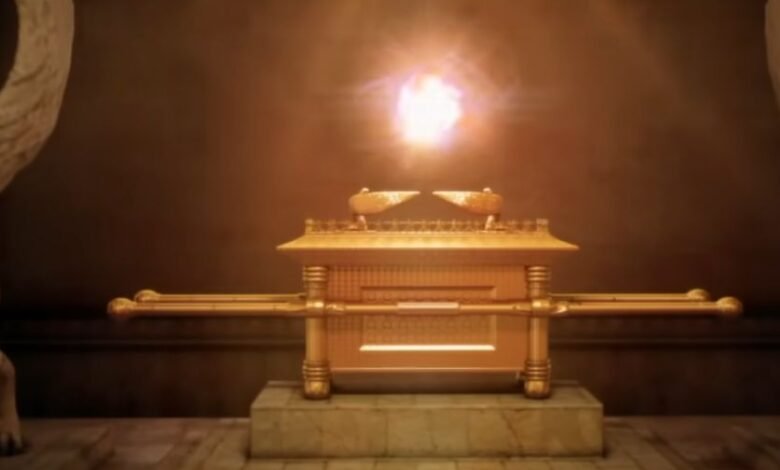
According to the Book of Exodus, the Ark was crafted from durable acacia wood and completely overlaid with pure gold inside and out. It measured approximately 52 inches in length and 31 inches in both width and height, although exact dimensions vary slightly depending on how scholars interpret the ancient cubit measurement.
A decorative gold molding surrounded the upper edge of the Ark, adding to its majestic appearance. Four gold rings were attached to its sides, allowing long acacia wood poles covered in gold to be inserted for transportation. These poles remained permanently in place because the Ark was never intended to be touched directly by human hands.
Perhaps the most striking feature was its golden cover, known as the Mercy Seat. Two golden cherubim stood upon this lid with their wings extended toward each other, symbolizing divine protection and God’s heavenly throne.
The elaborate craftsmanship reflected not only artistic excellence but also profound spiritual symbolism.
What Was Inside the Ark of the Covenant?
The Bible identifies three sacred objects that were associated with the Ark.
The most significant were the two stone tablets containing the Ten Commandments given to Moses on Mount Sinai. These commandments formed the foundation of Israel’s covenant relationship with God and represented His moral law.
The Ark was also said to contain a golden jar filled with manna, the miraculous food God provided during the Israelites’ journey through the wilderness. This reminded future generations of God’s faithful provision during times of need.
Another treasured item was Aaron’s staff, which had miraculously blossomed as a sign confirming his divinely appointed priesthood. The rod symbolized God’s authority and His chosen leadership for the nation.
Together, these sacred objects represented God’s law, His provision, and His divine authority.
The Spiritual Meaning of the Ark
Beyond its physical beauty, the Ark carried deep spiritual significance.
It represented God’s covenant with His people, reminding Israel of both divine promises and human responsibility. The Ark symbolized holiness, emphasizing that approaching God required reverence, purity, and obedience.
The Mercy Seat atop the Ark also carried profound meaning. Once each year, on the Day of Atonement, the High Priest sprinkled sacrificial blood upon it to symbolize the forgiveness of sins and the restoration of the relationship between God and His people.
For many Jewish and Christian scholars, the Ark ultimately points toward themes of redemption, mercy, justice, and divine presence.
The Ark During Israel’s Journey
Throughout the Israelites’ travels, the Ark occupied a central role in worship and national identity.
Whenever the camp moved, specially appointed Levite priests carried the Ark according to God’s instructions. The Ark often went before the people, symbolizing God’s leadership as they traveled through unknown lands.
One of the most remarkable biblical events occurred at the Jordan River. As the priests carrying the Ark stepped into the overflowing waters, the river miraculously stopped flowing upstream, allowing the Israelites to cross safely into the Promised Land on dry ground.
This miracle reinforced the belief that God’s power accompanied the Ark wherever it went.
The Battle of Jericho
Another famous episode involving the Ark took place during the conquest of Jericho.
God instructed Joshua to have the Israelites march around the fortified city once each day for six days while priests carried the Ark. On the seventh day, they circled the city seven times before blowing trumpets and shouting.
According to the biblical narrative, Jericho’s massive walls collapsed, allowing the Israelites to capture the city. The Ark’s presence emphasized that the victory resulted not from military strength alone but from faith and obedience to God’s commands.
The Ark and the Philistines
The Ark was not always associated with victory.
During one conflict, the Israelites brought the Ark into battle against the Philistines, believing its presence alone would guarantee success. Instead, they suffered defeat, and the Philistines captured the Ark.
However, according to biblical accounts, strange disasters soon struck Philistine cities wherever the Ark was kept. Plagues, illness, and destruction caused widespread fear, leading the Philistines to conclude that Israel’s God was responsible.
Eventually, they returned the Ark along with valuable offerings, acknowledging its extraordinary power.
This episode demonstrated that the Ark was never intended to function as a magical object but as a sacred symbol of God’s sovereign presence.
King David and the Ark
Centuries later, King David recognized the Ark’s spiritual importance and sought to bring it to Jerusalem, establishing the city as Israel’s religious center.
The first attempt ended tragically when a man named Uzzah reached out to steady the Ark after the oxen stumbled. Because God’s instructions prohibited anyone from touching the Ark directly, Uzzah died immediately according to the biblical account.
David later organized a second procession following the proper religious procedures. This celebration included music, dancing, sacrifices, and public worship as the Ark finally entered Jerusalem.
The event marked a defining moment in Israel’s religious history.
The Ark in Solomon’s Temple
David’s son, King Solomon, later constructed the magnificent First Temple in Jerusalem.
The Ark was placed within the Holy of Holies, the innermost chamber of the Temple accessible only to the High Priest once each year. This room represented the most sacred place in ancient Israelite worship.
For generations, the Ark remained the focal point of religious life, symbolizing God’s dwelling among His covenant people.
Its placement within the Temple fulfilled the long journey that had begun during the Exodus centuries earlier.
The Disappearance of the Ark
One of history’s greatest mysteries began during the Babylonian conquest of Jerusalem around 586 BCE.
When King Nebuchadnezzar’s forces destroyed Solomon’s Temple, biblical records become silent regarding the Ark’s fate. Although many Temple treasures were carried away to Babylon, the Ark is notably absent from surviving Babylonian inventories.
This absence has fueled centuries of speculation.
Some historians believe it was destroyed during the invasion. Others argue that faithful priests secretly removed and concealed it before the city fell. Because no definitive historical record confirms either theory, the Ark’s disappearance remains one of archaeology’s greatest unsolved puzzles.
Theories About the Ark’s Location
Numerous theories attempt to explain what happened to the Ark.
One of the oldest traditions claims the Ark was hidden beneath the Temple Mount in Jerusalem. According to this view, priests concealed it in underground chambers before the Babylonians arrived. Modern archaeological investigations beneath the Temple Mount remain extremely limited because of religious and political sensitivities.
Another famous tradition comes from Ethiopia. The Ethiopian Orthodox Tewahedo Church maintains that the original Ark resides within the Church of St. Mary of Zion in Axum. Church tradition states that Menelik I, believed to be the son of King Solomon and the Queen of Sheba, brought the Ark to Ethiopia thousands of years ago. Only one designated guardian may view it, and outside researchers have never been permitted to examine the object independently.
Other theories suggest the Ark was hidden in caves near Jerusalem, transported to Egypt, or secretly preserved by Jewish priests awaiting a future restoration of the Temple. While these ideas continue to attract public interest, none has been supported by conclusive archaeological evidence.
Archaeological Research
Archaeologists have spent decades investigating sites connected with ancient Israel in hopes of uncovering clues about the Ark.
Excavations at locations such as Shiloh, where the Tabernacle once stood, have revealed structures and artifacts consistent with ancient Israelite worship. Discoveries within Jerusalem have also expanded understanding of the First Temple period.
Despite these important findings, no excavation has produced verified evidence of the Ark itself.
Many experts believe that if the Ark still exists, it may remain hidden in an undiscovered location or may have been lost to history long ago.
The Ark in Judaism and Christianity
In Judaism, the Ark remains one of the most sacred symbols of God’s covenant with Israel. It represents obedience to divine law, God’s faithfulness, and the unique relationship between God and His chosen people.
In Christianity, many theologians interpret the Ark as a symbol foreshadowing Christ and God’s presence among humanity. The themes of mercy, sacrifice, and covenant associated with the Ark continue to influence Christian teaching and worship.
Although interpretations differ between religious traditions, the Ark occupies an honored place in both faiths.
The Ark in Popular Culture
The mystery surrounding the Ark has inspired generations of writers, filmmakers, and historians.
Perhaps the most famous modern portrayal appears in the 1981 film Raiders of the Lost Ark, where archaeologist Indiana Jones races to locate the legendary artifact before it falls into dangerous hands. While highly fictionalized, the movie introduced millions of people to the biblical story and renewed worldwide interest in the Ark.
Since then, countless documentaries, novels, television programs, and online discussions have explored theories about its disappearance and possible location.
Why the Ark Still Fascinates the World
The enduring fascination with the Ark of the Covenant stems from the unique combination of faith, history, archaeology, and mystery that surrounds it. Few ancient artifacts possess such profound religious significance while simultaneously remaining completely absent from the archaeological record.
Its story raises questions that continue to captivate scholars and believers alike. Was it hidden to protect it from destruction? Does it still exist somewhere, waiting to be discovered? Or was it simply lost during one of history’s most turbulent periods?
Because definitive answers remain elusive, the Ark continues to inspire research, debate, and exploration across the world.
Conclusion
The Ark of the Covenant stands as one of the most extraordinary symbols in biblical history. More than an ornate golden chest, it represented God’s covenant, His presence, and His relationship with the people of Israel. From its construction in the wilderness to its place within Solomon’s Temple, the Ark played a central role in the spiritual life of ancient Israel.
Its mysterious disappearance has transformed it into one of history’s greatest unsolved enigmas, inspiring centuries of investigation and speculation. Whether viewed through the lens of faith, history, or archaeology, the Ark remains a powerful reminder of humanity’s enduring search for the sacred and the unknown. Until compelling evidence emerges, the Ark of the Covenant will continue to occupy a unique place where religion, history, and mystery intersect, ensuring that its legacy endures for generations to come.