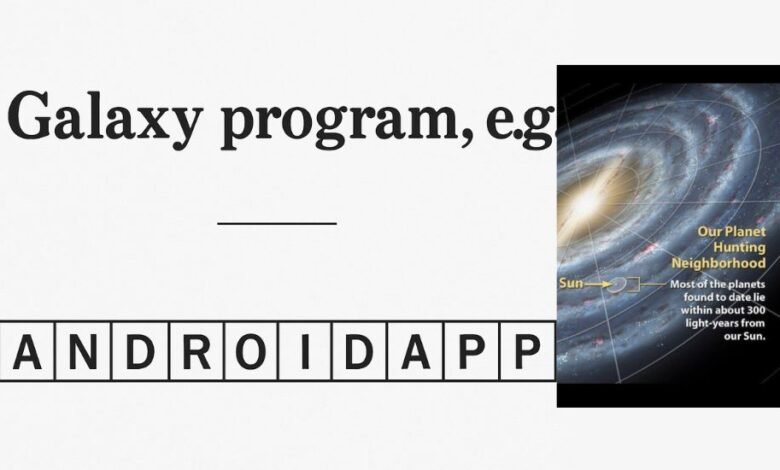
Crosswords have always reflected the times. From political leaders to pop culture references, from classical literature to cutting-edge science, each square of a crossword puzzle captures the essence of language in motion. In recent years, technology has become an increasingly common theme. Among these modern clues, one stands out as both clever and contemporary: “Galaxy program, e.g.”, which appeared in the New York Times crossword puzzle on August 23, 2025.
At first glance, this clue seems cryptic—perhaps it’s about astronomy, maybe the Milky Way or NASA’s galactic studies. But the true answer reveals a very 21st-century twist: ANDROID APP. It’s a delightful blend of logic, cultural awareness, and linguistic subtlety—everything that makes crosswords both challenging and rewarding.
Decoding the Clue: A Step-by-Step Breakdown
The New York Times crossword is known for its layered clues. “Galaxy program, e.g.” exemplifies this tradition of dual meaning. Let’s unpack it.
- Galaxy — The capital “G” is a clue in itself. While “galaxy” might refer to outer space, the capitalization suggests a brand name—specifically, the Samsung Galaxy, a line of Android smartphones and tablets.
- Program — In computing terms, a “program” is an application or software.
- e.g. — Short for exempli gratia (“for example”), it tells solvers that the answer will describe a type or example of a “Galaxy program.”
Put together: a Galaxy program (for example) is an ANDROID APP—a piece of software that runs on the Android operating system, used by Samsung Galaxy devices.
The clue’s beauty lies in its economy. Only three words and two punctuation marks, yet it requires both general knowledge and cultural awareness to decipher.
The Broader Trend: Technology in Crosswords
Crosswords mirror the language of their times. In the mid-20th century, crossword grids were filled with references to rotary phones, telegrams, and film reels. Today, clues about apps, streaming services, AI, and social media are ubiquitous.
Clues like “Galaxy program, e.g.” belong to this modern lexicon. Solvers must not only be linguistically adept but also technologically literate. Clues referencing Apple (“Safari feature?”), Microsoft (“Word, perhaps”), or Google (“Search result type”) are now commonplace.
The inclusion of brands like Samsung or Android shows how seamlessly technology has entered the cultural fabric. A crossword once filled with literary allusions now freely mixes Keats and Kickstarter—and no one bats an eye.
Why “ANDROID APP” Fits So Well
The term “ANDROID APP” perfectly matches the clue for several reasons:
- Accuracy: Every Samsung Galaxy device runs on the Android operating system, and all its programs are Android apps.
- Brevity and clarity: It fits the crossword’s character limit perfectly (10 letters, no spaces).
- Modern relevance: Crossword editors aim to keep puzzles fresh and reflective of contemporary life.
The wordplay also demonstrates linguistic economy—a hallmark of good crossword design. The clue leads solvers away from cosmic thinking (“Galaxy” → stars) and back to Earth (“Galaxy” → phone). It’s an elegant misdirection that rewards modern awareness.
A Reflection of Language Evolution
What makes this clue significant isn’t just its cleverness—it’s what it reveals about language evolution.
Just 30 years ago, a “program” would have conjured thoughts of television, theater, or maybe computer software in floppy-disk form. The idea that “program” could refer to a “mobile app” would have been alien. Today, that shift feels natural.
Language is dynamic. Technology introduces new meanings, and the crossword acts as a mirror, reflecting those linguistic shifts. When the New York Times includes “Galaxy program, e.g.” in a puzzle, it’s tacitly acknowledging that tech terminology has earned its place in our shared vocabulary.
Crossword Craftsmanship: Why This Clue Works
Every crossword clue follows a rhythm—definition, misdirection, and payoff. In this case:
- Definition: “Program” defines the category (software).
- Misdirection: “Galaxy” tempts solvers toward astronomy.
- Payoff: Recognizing that “Galaxy” is a phone brand yields “ANDROID APP.”
This structure is intentional. The NYT’s crossword editors, led by Will Shortz, aim for clues that challenge assumptions but feel fair once solved. The best clues spark a brief moment of aha!—and this one delivers exactly that.
Technology’s Deepening Footprint in Crossword Culture
The New York Times crossword has evolved dramatically over its 80-year history. Once dominated by classical references and academic language, it now features memes, tech lingo, and social media shorthand.
- From “Modem” to “App”: Early 2000s puzzles introduced “modem,” “email,” and “website.” By the 2010s, “app,” “hashtag,” and “emoji” became staples.
- From “Phone” to “iPhone”: Modern clues now name specific brands, recognizing their cultural weight.
- From “Program” to “App”: As devices evolved, so did the words describing them.
The “Galaxy program” clue sits at the intersection of these linguistic evolutions—a single clue that embodies the digital era’s integration into language and thought.
The Role of Branding and Cultural Literacy
Interestingly, crosswords often walk a fine line with brand names. Including “Samsung,” “Google,” or “iPhone” risks veering into advertising territory—but their ubiquity makes them unavoidable.
“Galaxy program, e.g.” cleverly avoids this problem by using “Galaxy” generically yet recognizably. It rewards solvers who understand cultural references but doesn’t alienate those who might not.
In essence, it’s a clue about cultural literacy—not just word knowledge, but world knowledge. Solvers are tested on how deeply they engage with contemporary culture.
The NYT Puzzle as a Cultural Time Capsule
Every crossword is a miniature time capsule. If you looked at NYT puzzles from the 1950s, you’d see clues about telegrams and LPs. In the 1980s, clues about typewriters and VCRs. In the 2000s, about email and Wi-Fi.
In 2025, clues like “Galaxy program, e.g.” reflect a smartphone-dominated world.
A future solver, decades from now, might stumble upon the same clue and smile—remembering when Android apps defined mobile technology, before AI assistants and neural interfaces became the norm. Crosswords thus preserve our linguistic and technological history in the most playful way possible.
Crossword Solving as a Study of Modern Lexicon
Solving a crossword like the NYT’s is more than a pastime—it’s an education in how language interacts with modern life.
For instance:
- A clue like “Tweet, perhaps” could mean “POST.”
- “Bit of code” could mean “APP.”
- “Apple program?” might lead to “IOS APP.”
“Galaxy program, e.g.” belongs to this same family—where the solver must navigate the modern meanings of traditional words. “Program” no longer lives in the realm of computer engineers alone; it’s part of daily vocabulary.
The Human Element: Why We Love These Clues
Part of the joy of solving the NYT crossword lies in its shared cultural experience. When solvers finally connect “Galaxy” to “Android,” they’re participating in a moment of recognition that feels both clever and communal.
It’s not just about filling squares—it’s about engaging with the world’s vocabulary. Crosswords like this one affirm that language is alive, adapting to reflect how we live, work, and communicate.
What This Says About Crossword Editors and Solvers
The inclusion of such clues reflects the editor’s trust in the audience. NYT solvers are expected to be:
- Culturally aware, recognizing major tech brands and trends.
- Linguistically agile, understanding wordplay and double meanings.
- Adaptable, shifting seamlessly between literal and figurative interpretations.
For editors, balancing nostalgia and novelty is key. Too many pop-culture clues risk alienating older solvers; too few make puzzles feel dated. “Galaxy program, e.g.” strikes the perfect middle ground—modern but accessible.
Behind the Scenes: Clue Construction
Crossword clues undergo multiple rounds of editing before publication. They’re tested for fairness, solvability, and tone. The “Galaxy program, e.g.” clue likely emerged from a constructor seeking to modernize their grid while maintaining wit and brevity.
Its elegance lies in how naturally it reads. Even without the crossword context, it feels like a plausible phrase. Yet, it hides a technological pun beneath an everyday word.
The Future of Crossword Technology References
As technology continues to evolve, expect more clues like this one. We may soon see:
- “Vision Pro program, e.g.” → IOS APP
- “ChatGPT prompt, e.g.” → AI QUERY
- “Tesla update, e.g.” → FIRMWARE
Crosswords evolve alongside us. As devices, apps, and AI become integral to our lives, crossword editors will continue weaving them into puzzles, ensuring that our lexicon—and our crosswords—remain living reflections of culture.
Why This Clue Resonates with a Modern Audience
Ultimately, “Galaxy program, e.g.” encapsulates the relationship between humans and technology. It’s not just about recognizing a phone brand; it’s about recognizing how language shifts when innovation becomes everyday life.
The clue asks solvers to think differently—to notice that a “Galaxy” isn’t just in the stars but also in their pockets. That kind of mental agility is what makes crosswords timeless.
Conclusion: The Genius of Simplicity
In three short words, the clue “Galaxy program, e.g.” manages to:
- Reflect technological change.
- Challenge solvers’ assumptions.
- Capture the evolving vocabulary of the digital age.
It’s both a puzzle and a linguistic snapshot—a reminder that words are living things, constantly adapting to the world around them.
For crossword lovers and language enthusiasts alike, clues like this are small masterpieces. They show that even in a grid of black and white squares, there’s room for the full spectrum of modern experience—from galaxies to smartphones.
And for readers and thinkers who appreciate such intersections of culture and language, we at Empire Magazine continue exploring how words, art, and technology shape our collective imagination.