Early Life and the Foundations of a Jackson Legacy
Rebbie Jackson was born Maureen Reillette Jackson on May 29, 1950, in Gary, Indiana, at a time when the Jackson family was still far from the global cultural institution it would later become. As the first child of Joseph and Katherine Jackson, Rebbie occupied a unique position within the family hierarchy, one that would shape both her personality and her life trajectory. Growing up in a modest working-class household, she experienced responsibility early, often helping care for her younger siblings while her parents navigated financial constraints and demanding work schedules. This early exposure to discipline, routine, and family cohesion created a temperament that differed markedly from the more publicly visible ambitions of her younger brothers and sisters. Rebbie’s upbringing was steeped in music through church, radio, and informal family performances, yet her early years were defined less by artistic aspiration and more by stability, maturity, and emotional grounding. These qualities would later become defining features of her public image and career choices, setting her apart within the famously competitive Jackson family environment.
Family Dynamics and the Role of the Eldest Daughter
As the eldest Jackson child, Rebbie played a stabilizing role within a household that would soon become increasingly complex as fame entered the picture. While her brothers were being groomed for performance under the strict guidance of their father, Rebbie’s role was quieter but no less essential. She functioned as a secondary caregiver, emotional anchor, and example of composure for her siblings, including Michael and Janet, whose later superstardom would reshape popular culture. This position fostered a strong sense of responsibility and self-containment, traits that would influence her later reluctance to chase celebrity aggressively. Unlike many artists who pursue fame from an early age, Rebbie approached music as an extension of family and personal expression rather than a vehicle for public validation. Her understanding of fame was informed not by aspiration but by proximity, having witnessed firsthand both the rewards and the pressures it placed on her younger siblings. This insider perspective cultivated a measured, almost cautious approach to her own career.
Marriage, Early Adulthood, and Life Beyond the Spotlight
Rebbie Jackson made a defining personal decision at the age of eighteen when she married her childhood sweetheart, Nathaniel Brown. At a time when her family was beginning its ascent into national attention, she chose domestic stability over public exposure, a choice that would significantly delay her entry into the music industry. The marriage marked a clear divergence from the typical narrative of celebrity ambition, positioning Rebbie as a figure grounded in family life rather than public performance. Together, Rebbie and Nathaniel built a household centered on privacy, faith, and long-term commitment, raising three children while maintaining close ties to the wider Jackson family. This period of her life is critical to understanding her later career because it explains both the timing and tone of her musical debut. When Rebbie eventually entered the recording world, she did so as a fully formed adult with lived experience, emotional maturity, and clearly defined boundaries, rather than as a young artist shaped by industry pressures.
Delayed Entry into Music and the Choice of Timing
Rebbie Jackson’s decision to postpone a professional music career until her thirties was highly unusual, particularly within a family where musical performance was both a livelihood and a legacy. This delay was not due to lack of talent or opportunity but rather a deliberate prioritization of family life and personal readiness. By the early 1980s, the Jackson name had become one of the most powerful brands in entertainment, and any musical release associated with it was guaranteed immediate attention. Rebbie’s entry into the industry during this period was therefore both strategically advantageous and personally risky, as expectations were inevitably shaped by the extraordinary success of her siblings. However, her mature age and emotional grounding allowed her to approach this moment with clarity and restraint. She entered the industry not as a competitor within the Jackson hierarchy but as an individual artist with her own voice, aesthetic, and pace.
The Creation of Centipede and a Landmark Debut
Rebbie Jackson’s debut album Centipede, released in 1984, represented both a personal milestone and a carefully curated artistic statement. Produced during the height of Michael Jackson’s global dominance, the album benefited from top-tier production resources while maintaining a distinct identity aligned with Rebbie’s personality. The title track, written and produced by Michael Jackson, became a commercial success, yet it did not overshadow Rebbie’s presence; instead, it functioned as a gateway that introduced her voice and style to a wide audience. The album blended contemporary R&B with pop sensibilities, reflecting the sonic trends of the era while avoiding excessive experimentation. Rebbie’s vocal delivery was smooth, controlled, and understated, contrasting with the high-energy performances associated with other Jackson releases. Centipede established her as a credible recording artist rather than a novelty act, a critical distinction that shaped the reception of her subsequent work.
Commercial Reception and Industry Expectations
Following the release of Centipede, Rebbie Jackson entered a phase of heightened visibility that tested both her artistic resolve and her personal boundaries. The album’s commercial performance confirmed that audiences were willing to accept her as a serious recording artist, yet it also placed her under a microscope shaped by expectations attached to the Jackson name. Industry observers frequently framed her success through comparison, often measuring her achievements against the unprecedented dominance of her siblings rather than evaluating her work on its own merits. This context created a paradoxical situation in which Rebbie benefited from familial association while simultaneously being constrained by it. Her commercial reception was solid rather than explosive, a result that aligned with her understated musical style but conflicted with external narratives of Jackson exceptionalism. Rather than attempting to recalibrate her image to chase chart dominance, Rebbie remained consistent in her presentation, reinforcing a career philosophy rooted in sustainability and personal authenticity rather than spectacle.
Establishing Artistic Identity Beyond the Jackson Brand
One of the defining challenges of Rebbie Jackson’s career was the necessity of articulating an artistic identity distinct from a globally dominant family brand. Unlike artists who emerge independently, Rebbie’s work was inevitably filtered through the cultural mythology surrounding her siblings, particularly Michael and Janet. Yet she navigated this environment with a notable absence of defensiveness or overcompensation. Her music avoided overt attempts to mimic prevailing pop trends or emulate the sonic signatures that defined her family’s most successful releases. Instead, she leaned into mid-tempo R&B arrangements and lyrical themes centered on emotional maturity, trust, and relational complexity. This approach positioned her work within a demographic space often overlooked by mainstream pop, appealing to listeners who valued refinement over excess. By choosing restraint over reinvention, Rebbie gradually carved out a lane that was recognizably her own, even as comparisons persisted.
Reaction and the Evolution of Musical Direction
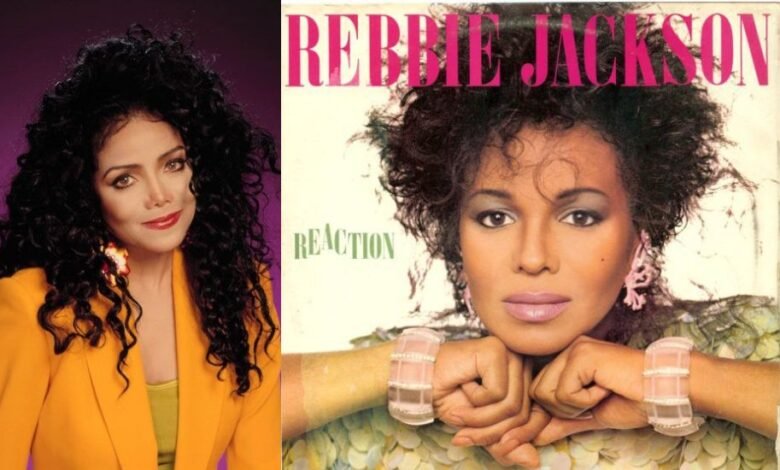
Rebbie Jackson’s second studio album, Reaction, released in 1986, represented a subtle but deliberate evolution in her musical direction. While retaining the polished R&B foundation established by her debut, the album introduced a slightly more assertive tone, both lyrically and sonically. This shift reflected growing confidence rather than a departure from her established aesthetic. The production leaned into contemporary textures of the mid-1980s without abandoning the controlled elegance that defined her vocal delivery. Collaborations on the album expanded her artistic circle beyond immediate family influence, signaling a willingness to engage more broadly with the industry while maintaining autonomy. Reaction did not dramatically alter her commercial standing, but it reinforced her credibility as an artist capable of growth and consistency, attributes often undervalued in an era driven by rapid reinvention.
Public Image, Media Framing, and Gendered Expectations
Throughout her career, Rebbie Jackson’s public image was shaped as much by media framing as by her own choices. Journalistic narratives frequently emphasized her role as the “quiet” Jackson, a descriptor that carried both admiration and limitation. While her composure and privacy were praised, they were also interpreted as a lack of ambition within a media culture that equated visibility with success. Gendered expectations further complicated this dynamic, as female artists were often expected to project either overt sensuality or overt rebellion to command attention. Rebbie’s refusal to conform to these archetypes positioned her outside dominant pop narratives, resulting in coverage that was respectful but restrained. This media posture mirrored her career itself: stable, dignified, and resistant to sensationalism. Over time, this consistency contributed to a reevaluation of her work, particularly among audiences seeking alternatives to hyper-commercialized pop identities.
Balancing Family Loyalty and Professional Independence
Navigating professional independence within a tightly knit and highly publicized family required careful calibration. Rebbie Jackson maintained close personal and professional relationships with her siblings while asserting boundaries that protected her individual trajectory. She neither rejected the Jackson legacy nor allowed it to subsume her identity, opting instead for a balanced coexistence that prioritized mutual respect. This balance was evident in her selective collaborations and measured public appearances, which reinforced her autonomy without signaling estrangement. Her approach contrasted sharply with more publicly turbulent family dynamics that periodically dominated headlines, positioning her as a stabilizing figure within the broader Jackson narrative. This role, though less visible, carried significant emotional labor and underscored her enduring commitment to family cohesion alongside personal fulfillment.
R U Tuff Enuff and Late-1980s Career Positioning
By the time Rebbie Jackson released her third studio album, R U Tuff Enuff, in 1988, the musical and cultural landscape of R&B had begun to shift noticeably. The late 1980s favored more aggressive production styles, sharper visual branding, and increasingly competitive chart dynamics, particularly for female artists. Against this backdrop, R U Tuff Enuff represented Rebbie’s most outward-facing attempt to engage with contemporary trends while remaining true to her established sensibilities. The album featured more rhythmic urgency and a slightly edgier tone, yet it never abandoned the vocal restraint and emotional clarity that defined her earlier work. Rather than reinventing herself, Rebbie adjusted her sound incrementally, signaling adaptability without compromise. The album’s reception reflected this balancing act, earning respect within R&B circles even as mainstream attention gravitated toward louder, more visually driven acts. In retrospect, R U Tuff Enuff stands as a document of an artist negotiating industry change on her own terms.
Motherhood, Privacy, and the Pace of a Different Career
One of the most distinctive elements of Rebbie Jackson’s professional life was her insistence on allowing personal priorities to dictate career pacing rather than the reverse. As a mother of three, she consistently framed her artistic output around family stability, resisting the industry norm that equated relevance with constant visibility. This decision had tangible consequences, including longer gaps between releases and fewer promotional appearances, but it also reinforced her commitment to authenticity. In an era when many artists were pressured to sacrifice personal boundaries for public momentum, Rebbie’s choices signaled an alternative model of success rooted in longevity rather than saturation. Her privacy was not defensive but deliberate, a means of preserving emotional equilibrium within a family that lived under extraordinary public scrutiny. This approach allowed her to sustain a creative presence without internalizing the volatility that often accompanies fame, particularly for women navigating both professional and domestic roles.
Industry Shifts and the Changing R&B Landscape
As the 1990s approached, the R&B genre underwent significant transformation, driven by the rise of new production aesthetics, hip-hop influences, and a younger generation of artists whose careers were shaped by evolving media ecosystems. For Rebbie Jackson, these changes posed structural challenges that went beyond individual artistic choice. The industry increasingly favored artists who embraced rapid reinvention, visually driven branding, and cross-genre experimentation, trends that did not align naturally with her measured approach. Rather than forcing adaptation, Rebbie chose selective engagement, appearing in performances and collaborative contexts that felt meaningful rather than obligatory. This strategic restraint effectively repositioned her from active chart competitor to respected legacy artist, a shift that preserved her catalog’s integrity while limiting commercial exposure. In doing so, she avoided the pitfalls of trend chasing and maintained coherence across her body of work, a rarity in a period defined by volatility and rapid turnover.
Resisting Reinvention and the Value of Consistency
Rebbie Jackson’s resistance to constant reinvention was not a product of stagnation but of philosophical clarity. She viewed artistic identity as cumulative rather than disposable, valuing continuity over novelty. This perspective stood in contrast to dominant industry narratives that framed reinvention as a prerequisite for relevance. By remaining consistent in tone, presentation, and musical focus, Rebbie cultivated a body of work that aged gracefully, unburdened by stylistic excess or forced transformation. Her career demonstrates that longevity does not require omnipresence, nor does influence demand constant reinvention. Instead, her trajectory underscores the value of coherence, emotional intelligence, and intentional pacing, qualities that resonate increasingly in retrospective assessments of late twentieth-century R&B artists.
The 1990s Hiatus and Reassessment of Creative Purpose
The extended gap between Rebbie Jackson’s late-1980s releases and her return in the late 1990s was less a retreat than a period of recalibration. During this time, she largely withdrew from the public eye, focusing on family life and reassessing the role of music within her broader identity. This hiatus occurred as the music industry underwent consolidation and commercialization at unprecedented levels, reinforcing her skepticism toward systems that prioritized volume over substance. When she re-emerged, it was with a clearer understanding of her creative priorities and a willingness to participate only under conditions that respected her autonomy. This period of distance ultimately strengthened her relationship with music, transforming it from a career imperative into a chosen form of expression grounded in purpose rather than expectation.
Yours Faithfully and a Return on Her Own Terms
When Rebbie Jackson released Yours Faithfully in 1998, the album marked a quiet but meaningful return after nearly a decade away from the recording spotlight. Rather than positioning the project as a comeback in the commercial sense, Rebbie framed it as a personal statement reflective of maturity, faith, and emotional clarity. Released through MJJ Music, the album benefited from family support while remaining firmly rooted in her own sensibilities. The sound leaned toward contemporary R&B with subtle gospel and soul influences, emphasizing warmth and introspection rather than trend alignment. Lyrically, the album explored themes of devotion, perseverance, and gratitude, signaling an artist more interested in resonance than reach. Yours Faithfully did not seek to redefine Rebbie’s public image; instead, it reaffirmed it, reinforcing her long-standing commitment to authenticity and restraint. The album functioned as both a continuation and a culmination of her artistic journey, integrating experience rather than chasing renewal.
Working Within a Family Label Structure
Rebbie Jackson’s collaboration with a family-led label structure presented a distinct creative environment compared to traditional industry frameworks. Operating under MJJ Music allowed her greater control over pacing, messaging, and artistic direction, mitigating many of the pressures that had previously defined major-label expectations. This arrangement was not without its complexities, as family dynamics inevitably intersected with professional decision-making. However, Rebbie navigated this space with characteristic discretion, maintaining clear boundaries that preserved both familial harmony and creative independence. The label context facilitated a supportive rather than extractive relationship with the industry, enabling her to release work aligned with her values rather than market imperatives. This model, though less commercially aggressive, exemplified an alternative approach to artistic production grounded in trust, respect, and long-term perspective.
Spirituality, Maturity, and Thematic Depth
A defining feature of Rebbie Jackson’s later work was the increased prominence of spiritual and reflective themes. These elements were not presented as overt declarations but woven organically into the emotional fabric of her music. Her songwriting and vocal interpretation conveyed lived experience rather than abstract aspiration, offering listeners a sense of grounded introspection. This thematic evolution mirrored her personal development, reflecting decades of family responsibility, public observation, and private resilience. In an industry often driven by immediacy, Rebbie’s emphasis on faith and inner stability positioned her music within a slower, more contemplative register. This approach resonated with audiences seeking depth and sincerity, reinforcing her reputation as an artist whose work matured alongside her life rather than attempting to outpace it.
Critical Reassessment and Shifting Perspectives
As time passed, critical perspectives on Rebbie Jackson’s career began to shift, particularly as retrospective evaluations of 1980s and 1990s R&B gained prominence. What was once perceived as a lack of ambition was increasingly understood as intentional selectivity. Critics and listeners alike began to recognize the coherence of her catalog, noting its resistance to stylistic excess and its emotional consistency. In this reassessment, Rebbie emerged as a counterpoint to dominant narratives of celebrity excess, representing an alternative model of artistic fulfillment. Her work was reevaluated not in terms of chart metrics but through its durability and emotional integrity. This reframing highlighted the long-term value of restraint, positioning her career as quietly influential rather than marginal.
Public Appearances and Selective Visibility
In the years following Yours Faithfully, Rebbie Jackson maintained a limited but meaningful public presence. She appeared at family tributes, commemorative events, and occasional performances, each chosen with deliberation rather than obligation. These appearances reinforced her role as a respected elder within the Jackson family while preserving the privacy that had always defined her relationship with fame. Rather than leveraging nostalgia for renewed exposure, she allowed her work and legacy to speak for themselves. This selective visibility aligned with her broader philosophy of engagement, prioritizing significance over frequency. Through this approach, Rebbie sustained relevance without surrendering autonomy, demonstrating that presence need not be constant to remain impactful.
A Stabilizing Presence Within the Jackson Family Narrative
Within the expansive and often turbulent history of the Jackson family, Rebbie Jackson has consistently occupied a role defined by stability rather than spectacle. As the eldest sibling, she has long functioned as an emotional constant, offering continuity across decades marked by extraordinary fame, intense scrutiny, and internal strain. While public attention frequently focused on the dramatic arcs of her younger siblings’ careers, Rebbie’s steadiness provided a counterbalance that rarely attracted headlines but proved essential to family cohesion. Her presence was neither passive nor performative; it was grounded in responsibility, perspective, and an unwavering commitment to familial integrity. This role became increasingly significant as the family navigated periods of controversy and loss, moments when public narratives often overshadowed private realities. Rebbie’s ability to remain composed without disengaging underscored a form of leadership rooted in empathy rather than authority, reinforcing her quiet influence within one of the most scrutinized families in modern cultural history.
Loss, Resilience, and Personal Transformation
The death of Rebbie Jackson’s husband, Nathaniel Brown, in 2013 marked a profound turning point in her personal life, introducing a period of grief that reshaped her sense of identity and purpose. Having shared decades of partnership grounded in mutual support and privacy, the loss represented not only emotional devastation but also the dissolution of a foundational structure that had anchored her adult life. Rebbie navigated this transition away from public dramatization, choosing instead to process grief within the protective boundaries she had long maintained. This period reinforced her resilience, a quality cultivated through years of balancing personal responsibility with public association. While she did not channel this experience into overt artistic output, its impact was evident in her reflective public demeanor and continued emphasis on family connection. Her response to loss further cemented her reputation as a figure defined by strength expressed through restraint rather than display.
Public Grief and the Burden of Collective Mourning
Rebbie Jackson’s experience of grief was compounded by the collective mourning that accompanied losses within the Jackson family, most notably the death of Michael Jackson in 2009. As both a sister and a public figure, she was required to navigate dual realities: private sorrow and public expectation. Her approach to this burden was consistent with her lifelong pattern of measured engagement, offering presence without spectacle and support without self-promotion. In moments when public discourse often demanded commentary or symbolic visibility, Rebbie’s silence carried its own weight, signaling respect for the depth of loss beyond words. This capacity to hold space for grief without commodifying it distinguished her response from broader media narratives, reinforcing her commitment to dignity even under extraordinary pressure. Through this lens, her restraint emerged not as absence but as a deliberate act of preservation.
Influence on Younger Generations Within the Family
Rebbie Jackson’s influence extended beyond her immediate siblings to younger generations of the Jackson family, including her own children and grandchildren. Her emphasis on balance, discretion, and personal grounding offered an alternative framework for navigating legacy and expectation. While the Jackson name carries inherent cultural weight, Rebbie consistently modeled a version of inheritance rooted in responsibility rather than entitlement. This influence was evident in the measured public presence of her children, who engaged with creative pursuits without aggressively leveraging family fame. By demonstrating that artistic expression could coexist with privacy and emotional health, Rebbie contributed to a broader redefinition of success within the family context. Her role as a mentor was informal yet impactful, shaping attitudes toward fame as something to be managed rather than pursued at all costs.
Endurance, Integrity, and the Shape of a Quiet Legacy
As the public narrative surrounding the Jackson family continues to evolve, Rebbie Jackson’s legacy stands apart as an example of endurance achieved through integrity. Her life and career challenge conventional metrics of success, emphasizing coherence, emotional intelligence, and intentional pacing over dominance and ubiquity. This legacy is not defined by chart positions or constant reinvention but by consistency across decades marked by extraordinary circumstance. In an industry that often rewards excess, Rebbie’s trajectory affirms the value of moderation and self-definition. Her influence, though understated, persists through the stability she provided, the work she released, and the model she embodied. In this sense, her legacy is not quiet because it lacks substance, but because it speaks most clearly through continuity rather than noise.
Cultural Context and the Reassessment of Fame
As cultural attitudes toward fame have evolved, Rebbie Jackson’s career has gained renewed relevance within broader conversations about celebrity, privacy, and sustainability. In earlier decades, success in popular music was often measured through visibility, chart dominance, and media saturation, metrics that tended to marginalize artists who chose restraint over exposure. Rebbie’s trajectory, once perceived as peripheral, now reads as prescient in an era increasingly attentive to the psychological costs of constant public performance. Her selective engagement with the industry aligns with contemporary reassessments that question whether perpetual visibility equates to fulfillment or artistic legitimacy. Within this context, her career offers a counter-narrative that reframes success as something internally defined rather than externally validated. This shift in cultural perspective has allowed audiences and critics to revisit her work with greater appreciation for its intentional pacing and emotional coherence.
Gender, Expectation, and the Limits of Pop Archetypes
Rebbie Jackson’s experience within the music industry was shaped by gendered expectations that constrained how female artists were expected to present themselves to achieve recognition. Throughout the 1980s and 1990s, women in popular music were often encouraged to adopt highly stylized personas that emphasized either overt sensuality or conspicuous rebellion, frameworks that left little room for artists whose expression centered on maturity and introspection. Rebbie’s refusal to conform to these archetypes positioned her outside dominant promotional narratives, limiting her visibility while preserving her authenticity. In retrospect, this resistance highlights the narrowness of industry standards rather than any deficiency in her artistic vision. Her career underscores the structural barriers faced by women who prioritize substance over spectacle, offering valuable insight into how cultural norms shape artistic opportunity and reception.
Age, Longevity, and Creative Authority
Unlike many artists whose careers peak early and decline rapidly, Rebbie Jackson entered the industry as a mature adult, bringing with her a sense of self that was not contingent on immediate validation. This late entry afforded her a degree of creative authority uncommon among debut artists, enabling her to make choices aligned with long-term well-being rather than short-term acclaim. Her sustained presence across multiple decades, though intermittent, challenges assumptions about age and relevance in popular music. By refusing to frame aging as a liability, Rebbie implicitly expanded the scope of who could occupy creative space within the industry. Her career suggests that longevity need not be measured by constant output, but by the ability to remain aligned with one’s values across time and change.
Why Her Career Resonates in the Present Moment
In the current cultural moment, characterized by increased awareness of mental health, work-life balance, and the pressures of public life, Rebbie Jackson’s career resonates with particular clarity. Her emphasis on boundaries, intentionality, and family-centered decision-making reflects priorities that have gained prominence across creative industries. Listeners revisiting her catalog often note its emotional steadiness and thematic maturity, qualities that feel increasingly rare in environments driven by algorithmic urgency. Rebbie’s work offers an example of how artistic expression can remain meaningful without being incessant, reinforcing the idea that relevance can be sustained through depth rather than volume. This resonance has contributed to a growing appreciation of her role within the broader Jackson legacy, not as a footnote, but as a distinct and instructive presence.
Reframing Success Through Personal Agency
Ultimately, Rebbie Jackson’s career invites a reframing of success grounded in personal agency rather than external benchmarks. Her choices reflect a consistent prioritization of self-determination, demonstrating that creative fulfillment does not require adherence to dominant industry scripts. By defining her own terms of engagement, she maintained ownership over her narrative in a context where many artists lose control to commercial imperatives. This agency, exercised quietly but persistently, constitutes one of her most enduring contributions. It positions her life and work as a case study in how artists can navigate fame without surrendering identity, offering lessons that extend beyond music into broader discussions of purpose and autonomy.
Legacy Within Music History and the Jackson Continuum
Within the broader history of American popular music, Rebbie Jackson occupies a space that resists easy categorization, existing neither at the margins nor at the commercial center. Her legacy is best understood as connective rather than competitive, shaped by continuity, emotional intelligence, and refusal to equate visibility with worth. While the Jackson family narrative is often told through extremes of fame, innovation, and controversy, Rebbie’s career offers a parallel history defined by balance and internal coherence. Her body of work does not attempt to rewrite genre conventions or dominate cultural moments, yet it contributes a sustained presence that enriches the family’s musical continuum. In this sense, her legacy is architectural rather than performative, providing structural stability across decades of rapid change. Music history frequently privileges disruption over durability, but Rebbie’s career challenges that bias, demonstrating that consistency itself can be historically meaningful when maintained with intention and integrity.
Public Memory Versus Private Impact
The distinction between public memory and private impact is central to understanding Rebbie Jackson’s enduring significance. Public narratives tend to privilege spectacle, chart success, and media saturation, often overlooking contributions that operate quietly and over extended periods. Rebbie’s influence, by contrast, is most evident in the lives she shaped, the family dynamics she stabilized, and the creative paths she modeled through example rather than assertion. Her approach to fame emphasized stewardship over ownership, reinforcing the idea that cultural participation does not require domination. As time creates distance from the peak intensity of the Jackson phenomenon, space has opened for more nuanced assessments that recognize the value of roles traditionally rendered invisible. In these reassessments, Rebbie emerges not as an absence but as a constant, a figure whose impact is measurable through endurance rather than amplification.
A Final Assessment of Rebbie Jackson’s Place in Culture
Rebbie Jackson’s life and career ultimately form a coherent narrative of self-definition within extraordinary circumstances. She entered an industry predisposed toward excess and remained measured, entered a famous family and preserved privacy, and participated in a cultural legacy without allowing it to eclipse personal agency. Her choices consistently favored alignment over ambition, coherence over competition, and longevity over immediacy. In doing so, she expanded the conceptual boundaries of what a successful music career can look like, particularly for women navigating overlapping expectations of family, artistry, and public life. Her place in culture is not secured through dominance but through example, offering an alternative framework for understanding success that continues to resonate as cultural values evolve. Rebbie Jackson’s story affirms that influence need not be loud to be lasting, and that dignity, when sustained across time, becomes its own form of legacy.
Closing Reflection
As contemporary audiences continue to revisit and reinterpret the Jackson family story, Rebbie Jackson’s journey stands as a reminder that not all meaningful cultural contributions announce themselves loudly. Her career reflects a deliberate resistance to distortion, an insistence on remaining whole within systems that often reward fragmentation. In telling her story, publications such as Empire Magazines, contribute to a more complete understanding of legacy, one that values continuity, care, and intentional presence alongside innovation and fame. Rebbie Jackson’s life does not conclude with a singular defining moment, but with a sustained pattern of choice, a legacy built not through spectacle, but through steadiness.
FAQs
Who is Rebbie Jackson?
Rebbie Jackson is an American singer and a member of the legendary Jackson family, best known as the eldest sibling of Michael and Janet Jackson. Unlike many of her famous relatives, she pursued music later in life, building a career defined by restraint, maturity, and artistic consistency rather than aggressive commercial ambition.
What is Rebbie Jackson best known for?
Rebbie Jackson is best known for her 1984 debut album Centipede, particularly the title track written and produced by Michael Jackson. The song became her biggest commercial success and established her reputation as a polished R&B artist with a calm, understated vocal style.
Why did Rebbie Jackson start her music career later than her siblings?
Rebbie Jackson chose to prioritize marriage and family life before pursuing a professional music career. She entered the industry in her thirties, a decision rooted in personal values rather than lack of opportunity, which allowed her to approach music with emotional maturity and clear boundaries.
How many albums has Rebbie Jackson released?
Rebbie Jackson released four studio albums: Centipede in 1984, Reaction in 1986, R U Tuff Enuff in 1988, and Yours Faithfully in 1998. Each album reflects a consistent R&B foundation while showing gradual thematic and stylistic maturity.
Was Rebbie Jackson as famous as Michael or Janet Jackson?
No, Rebbie Jackson did not achieve the same level of global fame as Michael or Janet Jackson. However, her career was intentionally different, focusing on artistic integrity, personal stability, and long-term consistency rather than mass celebrity and constant visibility.
Is Rebbie Jackson still active in music?
Rebbie Jackson does not regularly release new music, but she remains culturally relevant through her recorded work, selective public appearances, and role within the Jackson family legacy. Her career is often reassessed positively in discussions about sustainable and balanced artistic lives.
What makes Rebbie Jackson’s career unique?
Rebbie Jackson’s career is unique because it challenges traditional definitions of success in the music industry. She maintained privacy, resisted reinvention trends, and balanced fame with family life, creating a legacy based on dignity, endurance, and personal agency rather than spectacle.
How is Rebbie Jackson viewed today?
Today, Rebbie Jackson is increasingly viewed as an underrated and quietly influential figure within R&B and the Jackson family narrative. Critics and audiences alike recognize her as a stabilizing presence whose work has aged gracefully and gained relevance in modern conversations about mental health, boundaries, and sustainable fame.