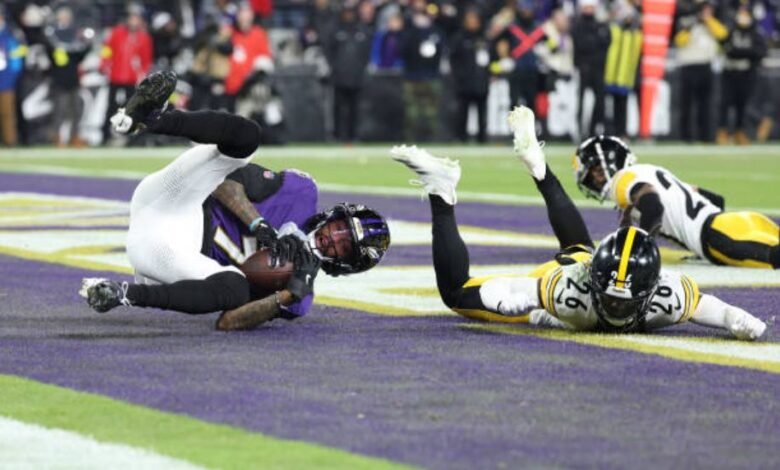
Few rivalries in the NFL carry the same weight, grit, and emotional fire as the Baltimore Ravens vs Pittsburgh Steelers. For over two decades, these two AFC North powerhouses have collided in some of the most physical, defensive, and high-stakes games in modern football history. Every meeting feels like a playoff matchup — every hit, a message; every stat, a story.
But the 2024–2025 clashes between these titans have been particularly telling. With Lamar Jackson at the peak of his dual-threat powers and Derrick Henry adding brute force to Baltimore’s backfield, the Ravens’ offense has evolved into a relentless machine. Meanwhile, the Steelers’ defense, traditionally among the most feared in football, has struggled to contain their rivals’ newfound rhythm.
This detailed analysis dives into player statistics, game performances, and tactical trends from their recent encounters — highlighting what truly separates these teams on paper and on the field.
1. Setting the Stage: A Rivalry Beyond Records
Before we dissect the numbers, it’s crucial to appreciate what this rivalry represents. Since the early 2000s, the Ravens and Steelers have defined AFC North football — physical, defensive, and emotionally charged. The matchups often end with bruises, game-winning field goals, and defensive touchdowns rather than offensive explosions.
However, the 2024–2025 season redefined that balance. The Ravens, once purely defensive-minded, have become an offensive juggernaut led by MVP-caliber quarterback Lamar Jackson and veteran running back Derrick Henry. The Steelers, rebuilding with young talent, are caught between tradition and transition — fighting to reassert their defensive dominance while seeking consistency at quarterback.
The result? A dramatic shift in the rivalry’s narrative: from defensive standoffs to stat-driven showcases of Baltimore’s offensive evolution.
2. The 2025 AFC Wild Card Showdown: Baltimore 28, Pittsburgh 14
The Game That Defined the Season
Played on January 11, 2025, this matchup felt like destiny. The Ravens stormed into the postseason with confidence, while the Steelers — scrappy but limited — relied heavily on defense and field goals to stay competitive.
Baltimore didn’t just win; they dominated.
- Total Yards: Ravens 464 – Steelers 280
- Rushing Yards: Ravens 299 – Steelers 88
- First Downs: Ravens 29 – Steelers 11
- Time of Possession: Ravens 36:41 – Steelers 23:19
Player Highlights
Lamar Jackson
- Passing: 16/21 (175 yards, 2 TDs)
- Rushing: 81 yards on 9 carries
Jackson’s efficiency was surgical. He attacked soft zones, extended plays with his legs, and kept the Steelers’ pass rush guessing.
Derrick Henry
- Rushing: 186 yards on 24 carries, 2 TDs
Henry bulldozed through Pittsburgh’s front, setting a franchise playoff record for rushing yards. His 73-yard touchdown run in the third quarter crushed the Steelers’ morale and symbolized the night: raw power overwhelming steel resistance.
Marlon Humphrey (CB)
- Defensive TD: 45-yard interception return
Humphrey’s pick-six sealed the victory and showcased Baltimore’s defensive opportunism.
Steelers’ Side of the Story
Pittsburgh quarterback Kenny Pickett posted 198 yards with one touchdown and an interception. Najee Harris managed only 62 rushing yards. Their offensive line struggled to protect, allowing multiple pressures and sacks.
Despite a valiant defensive stand early, the Steelers couldn’t stop Baltimore’s balanced attack. As Henry and Jackson took over, Pittsburgh’s defenders — particularly in the interior line — looked outmatched.
3. The December 2024 Regular-Season Meeting: Ravens 34, Steelers 17
The December 21 clash was the prelude to playoff domination. The Ravens clinched their postseason berth with a commanding victory built once again on rushing efficiency and defensive swagger.
- Total Yards: Ravens 418 – Steelers 315
- Rushing Yards: Ravens 220 – Steelers 117
- Passing: Jackson 23/30 (245 yards, 3 TDs)
Key Moments:
- Henry’s 112 yards on 18 carries kept drives alive and the clock running.
- Jackson threw touchdowns to Zay Flowers, Mark Andrews, and Rashod Bateman, showcasing passing versatility.
- Marlon Humphrey’s interception return TD early in the 2nd quarter changed momentum.
Steelers Offensive Leaders:
- George Pickens: 6 receptions, 97 yards, 1 TD
- Najee Harris: 17 carries, 68 yards, 1 TD
Even with flashes of brilliance from Pickens, the Steelers couldn’t sustain drives. Baltimore’s pass rush, led by Odafe Oweh and Justin Madubuike, consistently collapsed the pocket.
This game revealed the broader statistical trend: Baltimore averaged over 200 rushing yards per game vs. Pittsburgh in 2024 — a number unheard of in previous seasons dominated by defense.
4. The November 2024 Clash: Steelers 18, Ravens 16
No rivalry is complete without its twist. On November 17, Pittsburgh pulled off an upset at home, capitalizing on Baltimore’s red-zone inefficiency and strong defensive discipline.
- Steelers: 6 field goals and 1 defensive TD
- Ravens: 2 offensive TDs, 1 missed field goal, 2 turnovers
Player Stats Snapshot
Lamar Jackson: 19/33 (232 yards, 1 TD, 1 INT) + 57 rushing yards
Derrick Henry: 21 carries, 93 yards
T.J. Watt: 2 sacks, 4 tackles for loss
Chris Boswell: 6/6 field goals (54 longest)
Pittsburgh’s victory was less about offensive flair and more about defensive execution and special-teams precision. T.J. Watt led the charge, consistently forcing Jackson to scramble, while Minkah Fitzpatrick anchored the secondary.
This loss served as a crucial lesson for the Ravens: when Jackson’s timing is disrupted and Henry is limited, the entire offensive engine slows down. It also reminded fans why this rivalry is so revered — every game is earned in inches.
5. Breaking Down the Numbers: Trends That Tell the Tale
a. Lamar Jackson – The Dual-Threat Dynamo
Over their last three meetings, Lamar Jackson has averaged:
- 216 passing yards/game
- 74 rushing yards/game
- 2.3 total TDs/game
- Completion rate: 70%+
Statistically, Jackson is not only the Ravens’ offensive core — he’s the system itself. Against Pittsburgh, his unpredictability forces linebackers to hesitate, creating running lanes for Henry and openings for tight ends.
b. Derrick Henry – Ground Control Personified
Since joining Baltimore, Henry has averaged:
- 153 rushing yards/game vs. Steelers
- 6.1 yards per carry
- 4 rushing TDs in 3 games
In both the December and January games, Henry accounted for over 40% of the team’s total offensive output. His ability to sustain drives transformed the Ravens from a pass-centric attack into a balanced, clock-controlling powerhouse.
c. Steelers’ Defense – Cracks in the Steel Curtain
Historically ranked top-10 in rush defense, the Steelers have allowed:
- Average 247 rushing yards/game to Ravens in 2024–25
- 5.9 yards per carry
- 3 rushing TDs in Wild-Card game alone
This statistical collapse highlights the fatigue of an aging defensive front and lack of depth behind stars like Watt and Fitzpatrick.
d. Key Efficiency Stats
| Metric | Ravens | Steelers |
|---|---|---|
| 3rd Down Conversion Rate | 59% | 33% |
| Red Zone TD Rate | 77% | 42% |
| Turnovers Forced | 6 | 3 |
| Time of Possession (avg) | 34 min | 26 min |
Every metric tells the same story: Baltimore controls pace and execution, while Pittsburgh struggles to match their efficiency.
6. The Defensive Duel: Beyond Offense
Though offense grabs headlines, both defenses still define the tone. Baltimore’s secondary, anchored by Humphrey and Marcus Williams, limited deep passes and forced turnovers at crucial moments. Linebacker Roquan Smith averaged 10+ tackles per game against the Steelers, often neutralizing Najee Harris in open space.
For the Steelers, T.J. Watt remained a one-man wrecking crew — 4 sacks, 3 forced fumbles, and 10 QB pressures across the three games. However, without consistent interior support, his efforts often came too late to change outcomes.
7. Tactical Evolution: How Baltimore Won the Chess Match
a. Pre-Snap Motion and Play Action
Offensive coordinator Todd Monken exploited the Steelers’ aggressive front seven with constant motion and RPOs. Jackson frequently used play-action fakes that froze linebackers, opening lanes for Henry.
b. Tempo Control
The Ravens’ average drive lasted 7+ plays, nearly double the Steelers’ figure. Sustained drives kept the defense fresh and dictated tempo.
c. Defensive Pressure
Baltimore blitzed on 32% of snaps — their highest rate versus any opponent. The tactic disrupted Pickett’s rhythm, forcing quick throws and mistakes.
d. Special Teams Efficiency
Justin Tucker’s reliability (7/7 field goals in both games combined) contrasted sharply with Pittsburgh’s occasional misses, further extending Baltimore’s margin of control.
8. Historical Context: Rivalry by the Numbers
Since 2008, the series stands close — Pittsburgh leading 17-15 in regular season, but Baltimore edging playoff meetings 3-2. Yet recent trends favor the Ravens, who’ve won 4 of the last 5.
Average scoring margin (2024–25):
- Ravens 29.3 – Steelers 16.3
Total offensive yards differential: +573 in favor of Baltimore.
This statistical pivot symbolizes a generational shift. Where once defense decided outcomes, now Baltimore’s offensive innovation reigns supreme.
9. The Intangibles: Leadership, Momentum, and Identity
Statistics may measure performance, but identity wins championships. The Ravens’ locker room — led by Jackson, Henry, and Smith — exudes confidence and cohesion. The Steelers, while gritty, remain in search of that defining offensive leader.
Coach John Harbaugh’s experience also plays a role. His ability to adapt, trust analytics, and empower Jackson to call audibles mid-drive has paid massive dividends.
In contrast, Steelers coach Mike Tomlin faces the challenge of rebuilding a once-dominant unit around younger players without losing cultural edge. The numbers hint at transition, but the spirit of this rivalry ensures Pittsburgh will never stay down for long.
10. Looking Ahead: What the Stats Predict
If the Ravens’ trajectory continues, they could dominate the division for several more seasons. Their offensive balance, statistical efficiency, and star power create a high ceiling.
For Pittsburgh, improvement begins with strengthening the offensive line and modernizing play-calling. The stats show promise in their receiving corps, but execution remains inconsistent.
The next matchup could see a rejuvenated Steelers squad determined to reclaim its identity — but until then, Baltimore’s command of this rivalry is both statistical and psychological.
11. Final Thoughts — A Rivalry Forged in Fire and Figures
Every stat, touchdown, and tackle in the Baltimore Ravens vs Pittsburgh Steelers saga tells a story of two philosophies: one evolving, the other enduring. The Ravens’ combination of power and precision has ushered in a new era where the numbers no longer lie — Baltimore owns the advantage.
As fans look ahead to future battles, one thing remains certain: when these two meet, expect drama, strategy, and raw emotion measured not just by scoreboards, but by the very stats that define their legacy.
For readers who live and breathe this intensity, continue following deep-dive coverage and data-driven analysis on Empire Magazines, where football meets insight.