In the world of English football, few fixtures bridge the divide between the glamour of the Premier League and the grit of lower-league football like Grimsby Town vs Manchester United. Despite existing worlds apart in terms of resources, fame, and success, these two clubs share a fascinating and occasionally dramatic history. Their encounters span more than a century — from the humble beginnings of the Football League to the modern spectacle of the EFL Cup.
This article explores the timeline of meetings between Grimsby Town and Manchester United, tracing every key encounter, historic upset, and the significance behind their rivalry.
The Early Years: Foundations of a Fixture
The story begins in the late 19th century, when football in England was still finding its professional footing. Grimsby Town and Manchester United (then emerging from the shadow of their Newton Heath days) met for the first time in the 1890s.
Their first recorded meeting came in 1894, a modest affair that reflected two sides still shaping their identities. During these early years, both clubs competed in the lower divisions of the Football League. Manchester United was still a growing force, while Grimsby enjoyed moments of local pride and competitiveness.
By the early 1900s, the clubs had become familiar foes. In 1905, Manchester United edged a narrow victory over Grimsby Town, followed by a dominant 5–0 win in 1906. Yet, these early duels were more balanced than one might imagine today — both sides capable of upsetting the other depending on the day.
The Inter-War Era: Grimsby’s Golden Run
As football entered the inter-war period, Grimsby Town became one of England’s most unpredictable forces. Between 1929 and 1931, they enjoyed a remarkable spell against Manchester United that has since entered club folklore.
In October 1929, Grimsby stunned Manchester United with a 5–2 away win, one of the most impressive victories in their top-flight history. Just months later, the two sides drew 2–2 in another First Division clash, and by September 1930, Grimsby had triumphed again with a 2–0 victory at Old Trafford.
The crowning moment of this period came in January 1931, when Grimsby Town eliminated Manchester United from the FA Cup with a 1–0 home win. The result symbolized the magic of cup football — a theme that would return nearly a century later.
By the early 1930s, the Mariners had developed a reputation as a giant-killer, and their fearless style often troubled United’s defenses. The 1933 Christmas fixtures were especially memorable — Grimsby won 3–1 away on Christmas Day and demolished United 7–3 at home just 24 hours later.
For a club of Grimsby’s size, these victories cemented their status as one of Manchester United’s trickiest opponents of the era.
Post-War Football and Diverging Paths
The two clubs continued to meet in the 1930s and 1940s, though the outbreak of World War II temporarily halted professional football. Their post-war meeting in 1946 ended with a narrow United win, and their 1947–48 clashes marked the last regular league encounters between them for decades.
After this period, their destinies diverged. Manchester United rose to global prominence — winning league titles, European Cups, and building a brand that stretched across continents. Grimsby Town, while maintaining a proud local identity, settled into the lower leagues, often battling financial challenges but never losing its passionate supporter base.
For nearly eight decades, the two clubs would not meet in competitive football again. Their story seemed frozen in history — until fate intervened in 2025.
The Modern Miracle: Grimsby’s 2025 EFL Cup Triumph
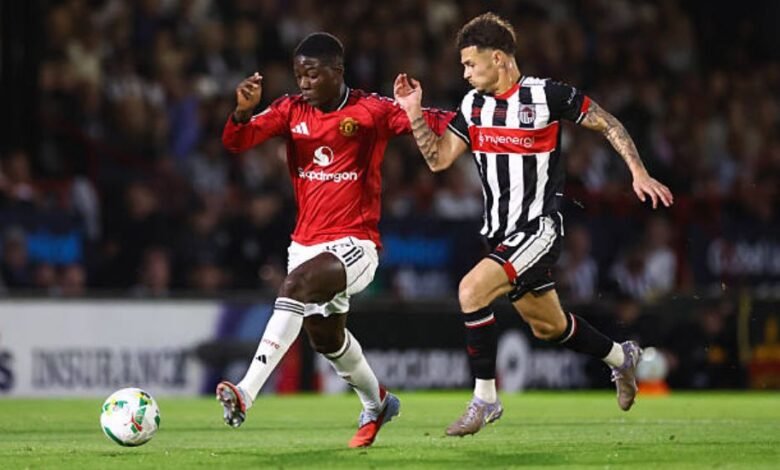
Football, however, has a way of revisiting its old stories. On 27 August 2025, Grimsby Town and Manchester United met once more — this time in the EFL Cup Second Round. The tie took place at Blundell Park, and few could have predicted what was about to unfold.
Grimsby started fearlessly, taking the game to their Premier League opponents. Two quick goals in the first half sent the home crowd into disbelief and delight. Manchester United, rattled but resilient, fought back with goals late in the match — one in the 75th minute and another dramatic equalizer in the 89th to force penalties.
Then came one of the longest and most thrilling shootouts in modern English football. Each side traded perfect penalties deep into sudden death before Grimsby finally prevailed 12–11 on penalties after a 2–2 draw in regular time.
It was a seismic moment — a night when a club from the lower leagues humbled one of football’s greatest names. For Grimsby, it was their most famous victory in generations. For Manchester United, it was a bitter reminder that football’s magic lies in its unpredictability.
The upset was not only celebrated by Grimsby fans but also resonated with football lovers everywhere — proof that the romance of the cup is alive and well.
A Timeline of Key Encounters
| Date | Competition | Result | Venue |
|---|---|---|---|
| 17 Nov 1894 | League | Grimsby Town 2–1 Manchester United | Grimsby |
| 9 Sep 1905 | Division Two | Grimsby Town 0–1 Manchester United | Grimsby |
| 6 Jan 1906 | Division Two | Manchester United 5–0 Grimsby Town | Manchester |
| 12 Oct 1929 | First Division | Manchester United 2–5 Grimsby Town | Manchester |
| 15 Feb 1930 | First Division | Grimsby Town 2–2 Manchester United | Grimsby |
| 27 Sep 1930 | First Division | Manchester United 0–2 Grimsby Town | Manchester |
| 24 Jan 1931 | FA Cup | Grimsby Town 1–0 Manchester United | Grimsby |
| 25–26 Dec 1933 | Division Two | 3–1 (A), 7–3 (H) Grimsby Town wins | Both |
| 14 Nov 1936 | First Division | Grimsby Town 6–2 Manchester United | Grimsby |
| 14 Jan 1939 | First Division | Manchester United 3–1 Grimsby Town | Manchester |
| 27 Aug 2025 | EFL Cup | Grimsby Town 2–2 Manchester United (Grimsby won 12–11 pens) | Grimsby |
This sequence highlights the fascinating balance between the two clubs. Out of approximately 38 competitive meetings, each side has claimed 16 wins, with a handful of draws — a near-perfect equilibrium despite the enormous difference in their footballing stature.
The Numbers Behind the Narrative
Statistically, the fixture defies expectations. Manchester United — England’s most decorated club — and Grimsby Town — a modest side from Lincolnshire — have identical records in head-to-head meetings. Across all competitions, both clubs have scored and conceded roughly the same number of goals.
This symmetry adds charm to the timeline. For every era of United dominance, there exists a counterpoint in Grimsby’s defiant victories. Their story encapsulates the core of English football: that on any given day, belief, hard work, and spirit can level the playing field.
Why This Fixture Still Matters
Though the two teams occupy different worlds, the Grimsby vs Manchester United timeline remains a testament to football’s unpredictability.
For Grimsby Town, every clash with a club of United’s stature is a chance to etch history — moments that echo across generations. For Manchester United, it’s a reminder that every opponent, no matter their league, deserves respect.
These meetings tell a story of English football’s evolution — from muddy pitches and modest crowds to global broadcasting and billion-pound squads — and yet, the essence of competition remains unchanged.
Conclusion
The timeline between Grimsby Town and Manchester United F.C. is more than a record of results — it’s a reflection of football’s enduring drama. From the early 1900s league battles to the astonishing 2025 cup upset, their shared history embodies the beauty of the game: unpredictability, passion, and the possibility that any team, on its day, can make history.
For Grimsby Town, these matches symbolize their proudest moments. For Manchester United, they stand as reminders of football’s humbling nature. Together, their story bridges past and present — an unlikely rivalry that continues to inspire fans across generations.
For more stories that dive deep into the heart of football and beyond, visit Empire Magazines — your hub for sports history, culture, and timeless moments.