Introduction
Winter brings beauty, quiet landscapes, and cozy moments by the fire — but it can also bring some of nature’s most severe and dangerous weather: blizzards. When a winter storm escalates to a certain level of intensity, meteorological agencies issue what is called a “Blizzard Warning.” This alert signals that life‑threatening winter weather conditions are either occurring or imminently expected.
In this article, we explain what a blizzard warning means, the conditions that define it, how it’s used in weather forecasting around the world — especially in North America — and we explore some legendary historical blizzards. We’ll also explain common public search intents such as blizzard warning today, near me, and location‑specific warnings for places like NYC, Minnesota, New Jersey, North Dakota, and Canada.
You May Also Read About: Salem
🌨️ What is the Meaning of a Blizzard Warning?
A Blizzard Warning is an official alert issued by a national weather agency — such as the National Weather Service (NWS) in the United States or Environment and Climate Change Canada in Canada — when wintry weather meets specific thresholds of wind, snowfall, and low visibility that can make travel extremely dangerous or life‑threatening.
In simple terms:
➡️ A Blizzard Warning means dangerous blizzard conditions are happening or expected within the next 12–24 hours, and people should take immediate actions to ensure safety.
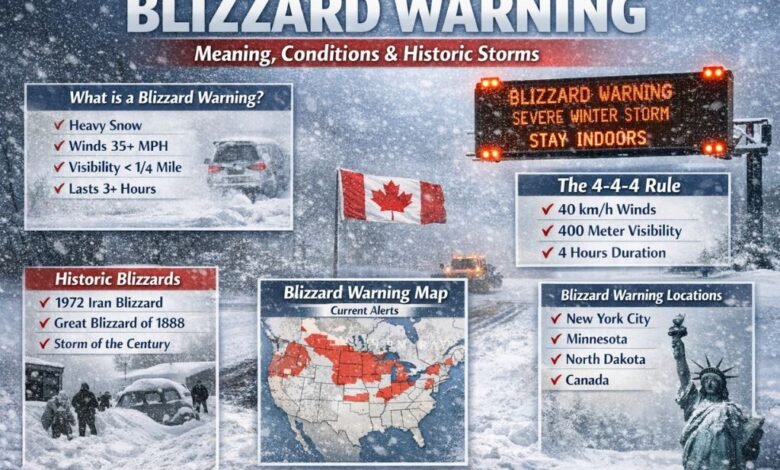
Key criteria generally include:
-
Sustained winds or frequent gusts of 35 miles per hour (mph) or more
-
Visibility reduced to ¼ mile (about 400 meters) or less because of falling and/or blowing snow
-
These conditions lasting for at least 3 hours (or longer, depending on the regional warning criteria)
When a Blizzard Warning is issued, it is stronger than a regular Winter Storm Warning or Snow Advisory — it specifically indicates blizzard conditions that are likely to immobilize travel and create white‑out situations.
🧊 What Are Blizzard Conditions?
A blizzard is more than just heavy snow. The defining features are:
❄️ 1. Strong Winds
Winds must reach at least 35 mph (about 56 kilometers per hour) or higher. These winds blow snow around so rapidly that it becomes difficult to see.
👁️ 2. Low Visibility
Due to blowing and drifting snow, visibility can drop to ¼ mile or less — sometimes even near zero — creating dangerous “whiteout” conditions where the horizon disappears entirely.
⏳ 3. Duration Requirement
To qualify as a true blizzard, these conditions typically must continue for at least 3 hours (USA) or 4 hours (Canada’s traditional guideline).
These criteria are standardized by weather agencies so the public can understand when conditions become life threatening — not just cold or snowy.
In short, blizzard conditions combine wind, snow, and persistence in a way that can overwhelm travel infrastructure and severely reduce situational awareness for anyone on the road.
📏 What Is the 444 Rule for Blizzards?
Meteorologists often use a mnemonic called the “444 Rule” to help remember the key criteria for identifying a blizzard — especially in Canada:
The 444 Rule
✔️ Winds ≥ 40 km/h
✔️ Visibility ≤ 400 m
✔️ Duration ≥ 4 hours
This rule is widely cited in Canadian forecasting to distinguish ordinary winter storms from true blizzards. Some agencies adjust the duration based on latitude, but the core idea remains: wind, low visibility, and sustained conditions.
The 444 rule is especially useful for public awareness and for local forecast offices when issuing blizzard warnings.
📊 Historical Context — What Was the Worst Blizzard in History?
Blizzards have struck many parts of the world over the centuries, but a few stand out due to their intensity and profound impacts:
🥇 Deadliest Blizzard on Record
-
1972 Iran Blizzard – This is widely considered the deadliest blizzard in history. A massive storm buried entire villages and mountainsides under enormous snow depths — reportedly up to 8 meters (26 feet). Thousands of people were killed, livestock perished in large numbers, and communication networks were lost for extended periods.
🏆 Most Famous North American Blizzards
North America has a long list of historic blizzards that are often used as benchmarks in winter weather studies:
-
Great Blizzard of 1888 (USA/Canada) – One of the most severe recorded blizzards in northeastern North America, with hurricane‑force winds and snowdrifts exceeding 50 feet in places.
-
Blizzard of 1978 (USA) – A powerful storm that paralyzed much of the Midwest and Northeast, closing highways for days.
-
Storm of the Century (1993) – One of the most expansive winter systems in record, producing snow from Canada to the Gulf of Mexico.
-
Schoolhouse Blizzard of 1888 (USA) – A sudden, late‑season storm that caused many fatalities because it struck during school hours in rural areas.
These storms are studied not only for their historic significance but for understanding the human, logistical, and economic impact of extreme winter conditions.
📍 Blizzard Warning Today — Understanding Real‑Time Alerts
When people search for “blizzard warning today” or “blizzard warning near me,” they are usually looking for current or forecast emergency alerts in their area. National weather agencies continually update warnings based on live radar, satellite imagery, and ground observations.
To see if a blizzard warning is active today, you would typically check:
-
The official weather service website for your country
-
A local weather app with alert capabilities
-
Emergency broadcast notifications or cultural weather alerts
Blizzard warnings are time‑sensitive and location‑specific — which means they can be issued or canceled as conditions change hour by hour.
📍 Location‑Specific Blizzard Warnings
Here’s how the concept of a blizzard warning applies in regions where people commonly search for localized alerts:
❄️ Blizzard Warning NYC (New York City)
Urban centers like NYC may experience blizzard warnings when a nor’easter or major winter storm brings heavy snow and strong coastal winds. Transport systems shut down, airports close, and emergency services activate snow removal and safety operations.
❄️ Blizzard Warning MN (Minnesota)
In the Upper Midwest, especially in states like Minnesota, blizzard warnings often occur when lake‑effect snow bands combine with Arctic air and strong winds — a classic winter weather scenario.
❄️ Blizzard Warning NJ (New Jersey)
New Jersey, particularly northern parts, is vulnerable to heavy coastal snowstorms with high winds — classic conditions for a blizzard warning that can topple tree limbs and knock out power.
❄️ Blizzard Warning ND (North Dakota)
North Dakota’s open terrain allows winds to whip freely — when snow falls, that terrain promotes blowing snow and whiteouts, frequently triggering blizzard warnings in winter.
❄️ Blizzard Warning Canada
Canada issues blizzard warnings through Environment Canada. Canadian blizzard warning criteria may vary slightly from U.S. definitions, but the fundamental idea of strong winds, poor visibility, and sustained conditions remains the same.
In Canadian regions such as the Prairies and northern territories, blizzard conditions are part of seasonal weather patterns and warning systems are well developed to ensure community safety.
🗺️ Blizzard Warning Map — Visualizing Alerts
A blizzard warning map is a geographic display (often color‑coded) showing which areas are under a current blizzard warning. These maps are published by national weather agencies and include counties or provinces with active alerts.
For example:
-
The U.S. National Weather Service shows shaded areas on regional maps where a blizzard warning is in effect.
-
Environment Canada does the same for provinces and territories under blizzard alerts.
Blizzard warning maps help people easily visualize the extent and location of dangerous winter weather.
You May Also Read About: Salem
🌨️ Blizzard Warning vs. Other Winter Weather Alerts
It’s important to understand how a Blizzard Warning compares with other winter alerts:
| Alert Type | Meaning |
|---|---|
| Winter Storm Watch | Conditions may develop that would qualify as a warning — prepare now. |
| Winter Storm Warning | Significant snow/ice/combination event expected — hazardous conditions. |
| Blizzard Warning | Extreme wind and snow reducing visibility — life‑threatening conditions. |
| Snow Advisory | Snowfall of notable accumulation, but not hazardous enough for a warning. |
A Blizzard Warning is the most serious of these because it combines snow, visibility loss, and wind, creating hazardous conditions that don’t just inconvenience travel — they make it dangerous or impossible.
📌 Conclusion
A Blizzard Warning is more than just a weather forecast — it is a public safety alert that means dangerous winter conditions are imminent or occurring. Defined by strong winds, low visibility, and sustained snow, blizzard conditions can immobilize communities, disrupt travel, and threaten lives.
Whether someone is searching for blizzard warning today, wants to see the blizzard warning map, or is tracking conditions in NYC, Minnesota, New Jersey, North Dakota, or Canada, the core message is the same: when a blizzard warning is in effect, caution is essential. Understanding the warning, the science behind blizzards, and the historical context can help individuals and communities prepare and respond safely.
If you’d like, I can also help you fetch current blizzard warnings and live forecast maps for any location you choose — just tell me the city or region.