Introduction to Barnacle Arthropods
Barnacles are among the most fascinating and unusual of all marine animals. At first glance, they may look like simple shells stuck to rocks or the underside of boats, but in reality, barnacles are highly specialized arthropods—a diverse and successful group of animals that includes insects, spiders, crustaceans, and more. Specifically, barnacles belong to the class Thecostraca within the subphylum Crustacea, making them close relatives of crabs, lobsters, and shrimp. Despite their hard, immobile appearance, barnacles have a complex life history that includes a free‑swimming larval stage and an adult stage where they cement themselves permanently to a surface. For many people, the discovery that barnacles are animals—not plants, barnacles, or simple shells—is surprising. Their unique evolutionary path shows how life adapts to every ecological niche on Earth’s oceans. In this article, we explore what barnacle arthropods are, how they live, how they feed, and why they matter in marine ecosystems and human industry. By the end, you’ll understand not just what barnacles are biologically, but why they are important to scientists, sailors, and environmental studies. We begin with their basic definition and classification, then move into anatomy, lifecycle, behavior, ecological roles, and human impact. This comprehensive guide is designed for both students and curious readers who want a deep understanding of one of the ocean’s most overlooked inhabitants.
Classification and Evolution
Barnacles are classified within the broader group of crustaceans, which also contains shrimp, crabs, and krill. However, barnacles are placed in a distinctive class known as Thecostraca, and more specifically in the subclass Cirripedia. The name Cirripedia comes from Latin roots meaning “curl‑foot,” which refers to the specialized appendages barnacles use to feed. Within Cirripedia, there are several orders, including Thoracica (the typical acorn and gooseneck barnacles) and Rhizocephala (parasitic barnacles). The evolutionary history of barnacles is remarkable: they evolved from free‑swimming crustaceans, but over millions of years they adapted to a sessile (permanently attached) lifestyle. Their closest relatives among crustaceans are believed to be certain types of shrimp‑like animals, and molecular studies have shown that the barnacle’s sedentary nature is a derived trait—meaning their ancestors didn’t live this way. Fossil evidence indicates barnacles have existed for at least 400 million years, long before the age of dinosaurs. Their distinctive shells and attachment strategies allowed them to colonize a variety of marine environments. Over evolutionary time, barnacles developed rigid calcium carbonate plates for protection, and their larvae evolved sensitive settlement cues to choose good places to attach. Understanding their classification and evolution helps explain why barnacles are so different from other crustaceans, yet still share key arthropod characteristics like jointed limbs and segmented bodies in their larval stages.
Anatomy and Physical Features
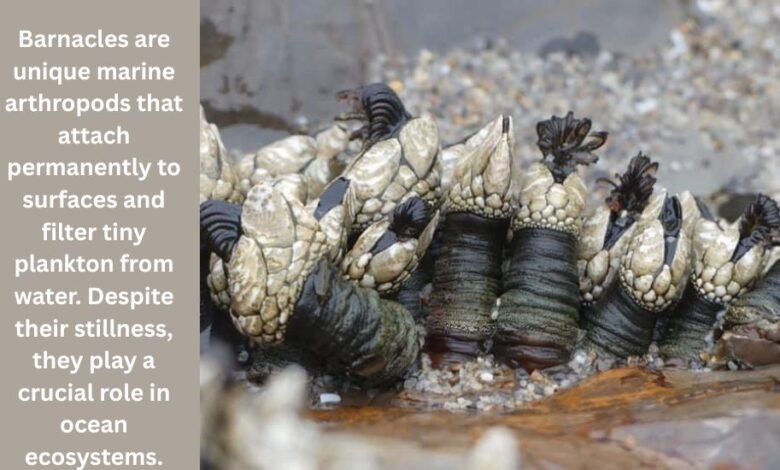
The anatomy of a barnacle is highly specialized for a life attached to hard surfaces in the ocean. Unlike most animals, adult barnacles do not move; they live inside a hard shell composed of multiple interlocking plates made of calcium carbonate. These plates protect the soft body inside and can vary in shape—some are shaped like cones (acorn barnacles), while others have flexible stalks (gooseneck barnacles). The main body of a barnacle consists of a mantle cavity that houses the feeding and reproductive organs. Inside this cavity, barnacles have pairs of feather‑like appendages called cirri. These cirri are actually modified legs that extend out of the shell to capture plankton and organic particles from the water. When food is detected, the barnacle rapidly sweeps its cirri in and out of the shell opening, filtering food with remarkable efficiency. Barnacles lack obvious eyes, antennae, or large sensory organs as adults, but during their larval stage they have structures used for swimming and finding a suitable place to settle. Internally, they possess a digestive system, nervous system, and reproductive organs like other crustaceans. One fascinating aspect of barnacle anatomy is their attachment organ, a specialized gland that secretes a powerful natural adhesive. This biological glue can stick to virtually any surface underwater and is a subject of intense research for applications in medicine and engineering. The unique combination of protective plates, feeding cirri, and adhesive capabilities makes barnacles one of the most uniquely adapted arthropods in the ocean.
Lifecycle and Reproduction
Barnacles have a complex and remarkable lifecycle that begins with free‑swimming larvae and ends with a permanently attached adult. Their reproductive strategy is adapted to their sessile lifestyle. Most barnacles are hermaphrodites, meaning each individual has both male and female reproductive organs, but they typically cross‑fertilize rather than self‑fertilize. During spawning, barnacles release sperm into the water column, which can enter neighboring individuals to fertilize eggs. The fertilized eggs develop into tiny nauplius larvae, which are planktonic and drift with currents for days to weeks. During this time, they feed and grow through several molts. After the nauplius stage, they transform into a cyprid larva, which does not feed but searches actively for a suitable surface to settle. Cyprids use sensory cues like texture, chemicals, and even the presence of other barnacles to choose a spot. Once a cyprid finds a suitable site, it cements its head permanently using its adhesive gland and undergoes metamorphosis into the adult form. This transition involves reorganizing its body and forming the hard shell plates. The entire lifecycle—from egg to settled adult—demonstrates a remarkable balance between dispersal and attachment. It allows barnacles to spread over wide areas while ensuring adults secure prime real estate in nutrient‑rich zones. Understanding this lifecycle is essential for marine biologists and ecologists studying population dynamics and species distribution in coastal ecosystems.
Habitat and Distribution
Barnacles are found in oceans around the world, from the icy waters of polar regions to tropical coral reefs. They are most commonly observed in the intertidal zone, the area between the high and low tide marks, where waves regularly wash over rocks and other surfaces. In these zones, barnacles experience dramatic changes in temperature, salinity, and moisture, yet they thrive due to their tough shells and efficient feeding mechanism. Some species prefer calm waters, attaching to shaded or protected surfaces, while others inhabit wave‑splashed cliffs where food delivery is constant. Beyond natural surfaces, barnacles readily attach to man‑made structures such as ship hulls, piers, buoys, and offshore platforms. This ability has made them highly successful colonizers in both natural and artificial environments. Gooseneck barnacles, for example, often attach to floating debris or driftwood, enabling them to travel vast distances across oceans. Cold‑water species can dominate rocky shorelines in northern seas, whereas warm‑water species may be more common on tropical coastlines and coral formations. Deep‑sea barnacles also exist, living near hydrothermal vents or cold seeps. Though each species has its own preferences, the unifying theme is that barnacles need access to flowing water rich in plankton and organic particles for feeding. Their global distribution is a testament to their adaptability and resilience in diverse marine environments.
Feeding Behavior and Diet
Barnacles are filter feeders, meaning they capture food particles suspended in the water. They lack jaws and teeth, but make up for this with highly specialized feeding appendages called cirri. These long, feathery legs extend out of the barnacle’s shell opening and sweep through the water in a rhythmic pattern. Tiny plankton, detritus, and organic particles stick to the cirri and are transported back into the mouth. Feeding activity is strongly influenced by water movement; barnacles feed most actively when currents bring abundant food. Because of this, they are often found in areas with strong tidal flows or wave action. Unlike many crustaceans that hunt or scavenge actively, barnacles remain stationary and rely entirely on the water column to deliver their food. This passive feeding strategy is highly efficient in nutrient‑rich coastal waters, where plankton concentrations can be high. Some research has shown that barnacles can adjust the beating frequency of their cirri based on food availability. During times of scarcity, they conserve energy by reducing activity, whereas when food is plentiful, they increase cirri movement to maximize intake. This feeding adaptation is one reason barnacles are successful in varied environments. Their diet primarily consists of microscopic organisms and organic matter, making them important links in the food web. Through their filter feeding, barnacles help transfer energy from tiny plankton up to larger predators like fish, sea stars, and grazing birds.
Ecological Roles and Importance
Though small and often overlooked, barnacles play significant ecological roles in marine ecosystems. As filter feeders, they help clean and clarify water by removing plankton and particulate matter. This process can influence nutrient cycles and water quality, particularly along crowded shorelines. Barnacles also form dense aggregations that provide habitat for other small marine organisms like limpets, small snails, and juvenile crustaceans. These communities create microhabitats that enhance local biodiversity. Furthermore, barnacles serve as a food source for a variety of predators. Sea stars, fish, whelks, and certain shorebirds feed on barnacles, especially during low tide. In this way, barnacles are integral parts of coastal food webs, influencing populations of both prey and predator species. Their shells also contribute to the physical structure of rocky shores. Over long periods, large barnacle colonies can affect wave energy and sediment deposition. In areas where barnacles dominate, they help stabilize substrates and may even facilitate the settlement of other organisms such as algae and mussels. Researchers study barnacles as indicators of environmental change because their presence, absence, or health can reflect water conditions, pollution levels, and temperature shifts. Thus, barnacles are not just passive residents of the shore; they actively shape and reflect the health of their marine environments.
Human Interactions and Impact
Barnacles interact with humans in ways that are both practical and problematic. One of the most‑known issues is biofouling—the accumulation of barnacles and other organisms on ship hulls, piers, and marine infrastructure. Attachments increase drag on vessels, reducing fuel efficiency and increasing operating costs. Shipowners and naval engineers invest heavily in anti‑fouling coatings designed to prevent barnacle settlement. Despite advances in marine paints and coatings, barnacles continue to pose significant maintenance challenges worldwide. Beyond shipping, barnacles affect aquaculture by attaching to cages, nets, and equipment. They can also colonize recreational equipment such as diving gear and kayak hulls. On a positive note, barnacles have inspired scientific research, especially in the field of adhesives. Their natural ability to stick underwater with extraordinary strength has led scientists to explore biomimetic glues for medical and industrial applications. Researchers study barnacle adhesion to develop surgical adhesives, protective coatings, and even new materials for underwater construction. Additionally, barnacles serve educational purposes; they are used in biology classes to teach about life cycles, adaptations, and marine ecology. Despite the challenges they pose, barnacles have prompted innovation and deeper understanding of marine biology and engineering.
Unique Adaptations and Survival Strategies
Barnacles exhibit remarkable adaptations that allow them to thrive in harsh and dynamic marine environments. Their hard shells protect them from predators, desiccation during low tide, and strong wave forces. The ability to attach permanently to almost any hard surface gives them a competitive advantage in crowded coastal habitats. Their feeding cirri are finely tuned to capture even the smallest food particles from flowing water. Some species can alter the orientation and movement of their cirri to optimize feeding under varying current conditions. Barnacles also have fascinating reproductive adaptations. Their hermaphroditic nature allows flexibility in reproduction, and their extended penises—the longest relative to body size in the animal kingdom—enable them to fertilize neighbors even when crowded. Certain parasitic barnacles (rhizocephalans) display radical biological specialization, invading host crustaceans and manipulating their physiology for their own reproductive benefit. These adaptations show how barnacles have evolved not just to survive but to exploit ecological opportunities in ways that other animals cannot. Their success across diverse habitats—from Arctic shores to tropical reefs—illustrates the evolutionary power of their specialized traits.
Barnacles in Science, Culture, and Future Research
Understanding barnacles extends beyond biology into fields such as material science, environmental monitoring, and even culture. Scientists study barnacles to learn how organisms communicate settlement cues, resist harsh conditions, and evolve specialized morphologies. Barnacles have appeared in literature and naturalist writings as symbols of stubbornness and permanence, often used metaphorically to describe things that cling relentlessly. In scientific research, barnacles continue to be models for studying developmental biology and ecology. Modern techniques like genetic analysis are uncovering deeper insights into their evolution and adaptation mechanisms. Efforts to manage biofouling are ongoing, with research focusing on environmentally friendly coatings and surfaces that deter settlement without harming marine life. Barnacles also have a role in citizen science and beach education—helping people connect with marine life through tidepool exploration and shoreline studies. As climate change alters ocean temperatures and chemistry, researchers are monitoring barnacle populations to understand how these environmental shifts affect species distribution and coastal ecosystems. The future of barnacle research holds potential for breakthroughs in sustainable engineering, ecological conservation, and education. For more insights on fascinating marine life and ecological discoveries, stay connected with Empire Magazines—your source for deep, engaging scientific stories that bring the ocean’s wonders to readers everywhere.