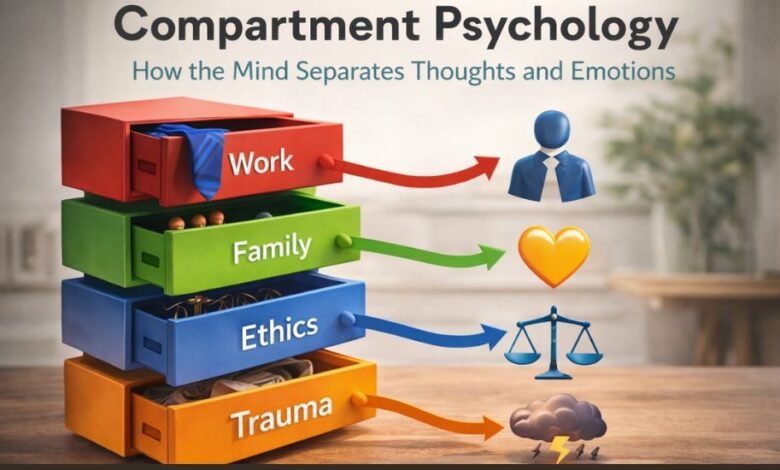
Compartment psychology is a concept many people recognize instinctively, even if they’ve never heard the term before. It describes the way the human mind separates thoughts, emotions, roles, or experiences into distinct mental “boxes.” These compartments help people function in complex environments, manage emotional pressure, and maintain focus across very different areas of life.
Most people use compartment psychology every day without realizing it. A person might be calm and professional at work, emotionally expressive at home, and cautious in financial matters — each mindset activated in a different context. This mental separation often feels automatic, practical, and even necessary. But like many psychological processes, it can be both helpful and limiting, depending on how it’s used.
This piece explores compartment psychology in a balanced, fact-based way: what it is, why the mind does it, how it shows up in daily life, when it helps, and when it quietly creates internal conflict. The goal is clarity rather than judgment, using everyday language and relatable comparisons rather than technical jargon.
What Compartment Psychology Means in Simple Terms
At its core, compartment psychology refers to the mental habit of keeping different thoughts, emotions, values, or behaviors separate from one another. Instead of integrating everything into a single, unified perspective, the mind places certain experiences into mental compartments that are activated only in specific situations.
Think of it like a filing cabinet. Each drawer holds a different category of information. When one drawer is open, the others remain closed. This allows the mind to focus on what’s immediately relevant without being overwhelmed by everything else at once.
Why the Mind Uses Compartmentalization
The human brain evolved to prioritize survival, efficiency, and emotional regulation. Processing everything at once would be exhausting and often paralyzing. Compartment psychology offers several practical advantages:
-
It reduces mental overload by narrowing focus
-
It limits emotional spillover between unrelated situations
-
It allows people to perform roles that require emotional control
-
It helps individuals function during stress or crisis
For example, someone dealing with a family problem may still need to perform effectively at work. Compartmentalizing allows that person to temporarily set aside personal emotions to meet professional demands.
Compartmentalization vs. Suppression
It’s important to distinguish compartment psychology from emotional suppression. Suppression involves pushing feelings away entirely or denying their existence. Compartmentalization, by contrast, doesn’t erase emotions or thoughts — it simply delays or contains them within a mental boundary.
A person who compartmentalizes might say internally, “I’ll deal with this later,” rather than “This doesn’t matter” or “I don’t feel anything.” That distinction matters because suppressed emotions tend to resurface in unpredictable ways, while compartmentalized emotions can be revisited more intentionally.
How Compartment Psychology Shows Up in Everyday Life
Compartment psychology isn’t limited to extreme situations or clinical settings. It appears in ordinary routines, personal decisions, and social roles. Many people rely on it to balance competing responsibilities without constant emotional conflict.
Role-Based Compartmentalization
One of the most common forms involves separating life roles. A person might think and behave differently depending on whether they are acting as:
-
A professional
-
A parent or caregiver
-
A friend or partner
-
A decision-maker handling finances
-
An individual processing personal emotions
Each role carries its own expectations, emotional tone, and priorities. Compartment psychology helps keep these roles from interfering with one another.
For instance, someone managing investments may rely on logic and risk analysis, while the same person in a family setting may lead with empathy and emotional sensitivity. Keeping these approaches separate allows smoother functioning across contexts.
Emotional Compartmentalization
People also compartmentalize emotions. This often happens during stressful or high-pressure moments. A person may temporarily set aside fear, grief, or frustration to complete a task that demands focus.
Conceptually, this is similar to placing an emotion on a shelf rather than throwing it away. The emotion still exists, but it isn’t allowed to dominate the present moment.
This can be helpful during emergencies, negotiations, or time-sensitive decisions. However, if emotions are never revisited, unresolved stress can quietly accumulate.
Moral and Value-Based Separation
Another form involves separating values or beliefs across contexts. A person might hold one set of ethical standards in personal relationships and a more pragmatic set in professional or financial situations.
This doesn’t necessarily mean hypocrisy. Often, it reflects the reality that different environments impose different pressures and incentives. The mind adapts by creating distinct mental frameworks for each situation.
When Compartment Psychology Helps and When It Becomes Risky
Compartment psychology is not inherently good or bad. Its impact depends on frequency, awareness, and flexibility. Used consciously and temporarily, it can support mental resilience. Used rigidly or unconsciously, it can create internal tension.
Healthy Uses of Compartmentalization
In balanced form, compartment psychology can:
-
Improve focus during demanding tasks
-
Protect emotional well-being during short-term stress
-
Support professional performance
-
Prevent unnecessary emotional spillover
-
Help people meet responsibilities during difficult periods
For example, someone dealing with uncertainty may compartmentalize worries during work hours and reflect on them later in a calmer setting. This allows productivity without denying emotional reality.
Signs of Overuse or Imbalance
Problems tend to arise when compartmentalization becomes a default response rather than a situational tool. Warning signs may include:
-
Feeling disconnected from one’s emotions
-
Sudden emotional reactions that feel disproportionate
-
Difficulty integrating personal values across life areas
-
A sense of living “separate lives” mentally
-
Avoidance of reflection or meaningful conversations
In these cases, the compartments become rigid walls instead of flexible boundaries. Information, emotions, or insights from one area of life fail to inform others, limiting growth and self-awareness.
The Long-Term Cost of Rigid Separation
Over time, excessive compartmentalization can reduce emotional integration. This doesn’t necessarily lead to dramatic breakdowns, but it can result in chronic stress, confusion, or dissatisfaction.
For example, someone might achieve professional success while feeling emotionally unfulfilled, without fully recognizing the connection between the two. The mental compartments prevent cross-communication that could otherwise prompt adjustment or change.
Compartment Psychology in Decision-Making and High-Stakes Environments
Compartment psychology plays a noticeable role in financial, legal, and organizational decision-making. These environments often demand emotional restraint, delayed gratification, and tolerance for ambiguity.
Cognitive Focus Under Pressure
In high-stakes situations, emotional reactions can interfere with reasoning. Compartmentalization helps individuals isolate emotional responses long enough to analyze facts, weigh options, and act deliberately.
This is similar to turning down background noise to hear a single voice clearly. The mind prioritizes relevant information while muting distractions.
Ethical Tension and Mental Separation
Complex systems sometimes create ethical gray areas. Compartment psychology allows people to function within these systems without constantly confronting internal conflict.
For example, a person might separate personal moral discomfort from procedural responsibility, focusing on defined rules rather than emotional responses. This can preserve functionality, but it also carries responsibility: unexamined separation can weaken ethical reflection over time.
Organizational Culture and Compartmentalization
Within large organizations, compartment psychology can be reinforced structurally. Different departments, roles, and incentives encourage people to focus narrowly on assigned responsibilities.
This can improve efficiency, but it also increases the importance of communication and oversight. When compartments become isolated at a systemic level, blind spots can emerge.
Balancing Mental Separation and Integration
The goal is not to eliminate compartment psychology, but to use it consciously and flexibly. Healthy mental functioning involves both separation and integration — knowing when to focus narrowly and when to step back and connect the dots.
Practical Ways to Maintain Balance
Some approaches that support healthy use include:
-
Regular reflection on emotional experiences
-
Allowing time to revisit delayed feelings
-
Journaling to connect thoughts across contexts
-
Discussing conflicts with trusted people
-
Checking whether values align across roles
These practices help prevent compartments from becoming isolated silos.
Integration Without Overload
Integration doesn’t mean feeling everything all the time. It means allowing information to move between compartments when appropriate. For example, insights gained in personal life may inform professional priorities, and vice versa.
This gradual integration supports coherence — a sense that different parts of life belong to the same person rather than separate versions of the self.
Why Awareness Matters
Compartment psychology becomes most helpful when it’s recognized rather than automatic. Awareness allows choice. A person can decide when to compartmentalize and when to integrate, rather than being driven by habit.
At Empire Magazines, topics like this resonate because they sit at the intersection of psychology, decision-making, and real-world complexity — areas where nuance matters more than absolutes.
Conclusion: The Quiet Power of Mental Compartments
Compartment psychology reflects the mind’s remarkable ability to adapt. By separating thoughts, emotions, and roles, people navigate complex demands with resilience and focus. This mental structure is neither a flaw nor a virtue on its own — it’s a tool.
Used thoughtfully, compartmentalization protects mental energy and supports performance. Used rigidly or unconsciously, it can limit emotional awareness and long-term fulfillment. The difference lies in balance, reflection, and flexibility.
Recognizing compartment psychology in everyday life offers a chance to work with the mind rather than against it. By allowing separation when needed and integration when helpful, people can move through complexity with greater clarity and self-trust.
Frequently Asked Questions About Compartment Psychology
What is compartment psychology in simple terms?
Compartment psychology refers to the way the mind separates thoughts, emotions, or roles into mental “boxes” so they don’t interfere with one another. This helps people focus, manage stress, and function in different situations without feeling overwhelmed.
Is compartment psychology the same as ignoring emotions?
No. Compartmentalization does not mean emotions are ignored or erased. Instead, emotions are temporarily set aside so a person can focus on something else. The key difference is whether those emotions are eventually acknowledged and processed.
Is compartmentalization healthy or unhealthy?
It can be both. Compartment psychology is healthy when used consciously and temporarily, such as focusing on work during work hours. It can become unhealthy when it turns into chronic avoidance and prevents emotional integration over time.
Why do people compartmentalize without realizing it?
The brain naturally looks for efficiency and emotional balance. Compartmentalization often develops automatically as a coping response to complexity, stress, or conflicting demands. Many people use it daily without labeling it as a psychological process.
Can compartment psychology affect decision-making?
Yes. Compartmentalization can improve decision-making by reducing emotional interference in high-pressure situations. However, if overused, it may limit reflection and prevent lessons from one area of life from informing another.
Does compartment psychology mean someone is being dishonest?
Not necessarily. Compartmentalization is usually about managing internal conflict, not deceiving others. A person may genuinely operate with different mindsets in different contexts without intending to mislead or act inconsistently.
How does compartment psychology differ from dissociation?
Compartmentalization involves conscious or semi-conscious mental separation, while dissociation typically involves a stronger sense of detachment from reality or self. Compartment psychology is far more common and often part of everyday functioning.
Can compartmentalization cause emotional burnout?
If emotions are repeatedly postponed and never revisited, stress can build quietly. Over time, this may contribute to emotional fatigue or sudden reactions. Balanced reflection helps prevent this outcome.
How can someone tell if they are over-compartmentalizing?
Common signs include feeling disconnected from emotions, difficulty explaining personal motivations, or feeling like different parts of life don’t belong together. Awareness is usually the first step toward balance.
Is compartment psychology linked to personality type?
It’s not limited to any one personality type. People across temperaments and backgrounds use compartmentalization, though structured or analytical thinkers may rely on it more frequently in professional settings.
Can compartment psychology change over time?
Yes. Life experiences, stress levels, and self-awareness all influence how often and how rigidly someone compartmentalizes. With reflection, people often learn to use it more intentionally and flexibly.