If you’ve ever paused mid-puzzle over the phrase “surrounding or background crossword clue,” you’re not alone. It’s one of those clues that feels simple at first glance, yet opens the door to several possible answers depending on context. Crossword clues often rely on flexible language, and words like surrounding and background are broad by design.
In everyday use, surrounding points to what’s around something—its environment, setting, or outer context. Background, meanwhile, suggests what sits behind the main focus, either visually or conceptually. Crossword constructors love pairing these ideas because they overlap but aren’t identical. That overlap gives them room to challenge solvers without being unfair.
In puzzles, this clue usually signals that the answer won’t be something literal like “wall” or “sky.” Instead, it points toward an abstract or descriptive word that captures the idea of context. Think of it like describing a scene in a story. The characters matter, but so does where everything takes place and what frames the action. That framing is what this clue is after.
Another important detail is that crossword clues often change meaning slightly based on tense, length, or placement in the puzzle. A short answer might lean toward a compact synonym, while a longer one allows for more nuance. That’s why solvers often check the letter count before locking anything in.
At its core, the clue asks you to step back and think: What word best describes the overall environment or setting around something? Once you shift into that mindset, the possibilities become much clearer.
The Most Common Answers Solvers Encounter
While many words can relate to surroundings or background, crossword puzzles tend to favor a small group of dependable answers. These show up again and again because they’re versatile, clear, and widely understood.
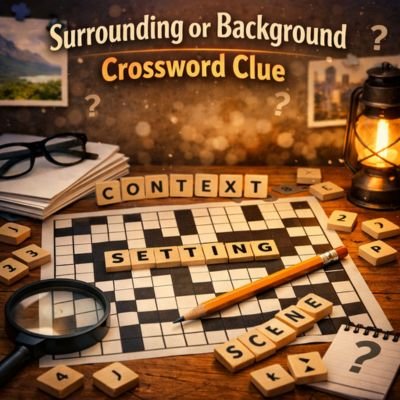
One of the most frequent answers is “setting.” This word neatly bridges both parts of the clue. A setting is the surrounding environment of a story, event, or object, and it also serves as the background against which something happens. Because it works in both directions, constructors rely on it often.
Other common answers include:
- Context – Focuses more on circumstances or conditions than physical space
- Scene – Suggests a visual or situational backdrop
- Milieu – Often used for social or cultural surroundings
- Environment – Broader, sometimes physical, sometimes conceptual
- Backdrop – More visual, but still fits many puzzles
Each of these words has a slightly different flavor. For example, scene might feel more immediate and visual, while context leans toward explanation and meaning. Crossword creators choose based on the puzzle’s tone and difficulty level.
Letter count matters a lot here. A seven-letter space strongly hints at setting, while a shorter slot might suggest scene or context. Long answers allow for more descriptive terms, but daily puzzles often stick to the simpler choices.
It’s also worth noting that crossword clues sometimes use or to indicate equivalence, not a choice. In this case, “surrounding or background” doesn’t mean one or the other—it means a word that can reasonably match both ideas. Keeping that in mind can prevent overthinking.
How Crossword Logic Shapes This Clue
Crossword puzzles follow their own internal logic, and understanding that logic can make clues like this far less intimidating. Constructors aim for fairness, which means that even vague-sounding clues usually have a clear answer once you see how the puzzle works.
One helpful way to think about it is to treat the clue as a definition rather than a question. Instead of asking, What surrounds something? ask, What word describes the surrounding or background of something? That subtle shift often leads straight to the right answer.
Crosswords also rely heavily on shared language habits. Words like setting and context are commonly used in books, films, and everyday conversation. Because solvers recognize them quickly, they make good crossword entries. Less common words appear too, but usually in harder puzzles with more crossing letters to help.
Another factor is neutrality. The best crossword answers are words that don’t require specialized knowledge. You don’t need to be an expert in architecture, science, or finance to solve this clue. The answer lives in general vocabulary, which keeps the puzzle accessible.
Interestingly, this clue can be used metaphorically as well. Background doesn’t always mean something you can see. It might refer to social conditions, historical circumstances, or even emotional tone. Crossword answers often capture that broader sense rather than a literal image.
This idea of context shows up far beyond puzzles. In business writing, for example, explaining the background of a decision helps readers see why it was made. In storytelling, the surrounding details make characters feel real. Even in financial discussions—say, when analyzing a company like Ashcroft Capital—the surrounding market conditions form the background that shapes outcomes. The crossword clue taps into that same universal concept.
Why This Clue Keeps Appearing in Puzzles
So why does the “surrounding or background crossword clue” show up so often? The short answer is flexibility. It allows constructors to reuse a reliable idea while still keeping puzzles fresh.
First, the clue is adaptable. It fits a range of answers and difficulty levels. A beginner puzzle might go with an obvious solution, while a tougher one might choose a less common synonym. The clue stays the same, but the challenge changes.
Second, it connects to how people naturally think. Humans are good at understanding context, even when it’s not spelled out. That makes the clue feel intuitive, which is exactly what puzzle designers want. A good crossword should challenge you without feeling random or unfair.
Third, it plays well with crossing words. Answers like setting or context have a mix of common letters, making them easier to intersect with other clues. This helps the puzzle flow and reduces frustration.
For solvers, recognizing repeat clues is a quiet advantage. The more puzzles you do, the more patterns you notice. Seeing this clue again can feel like running into an old acquaintance—you might not know the answer instantly, but you know where to start looking.
At Empire Magazines, puzzles are often discussed not just as entertainment but as a way to sharpen thinking. Clues like this one reward patience and perspective. They remind solvers that stepping back and looking at the bigger picture is often the smartest move.
Conclusion: A Small Clue With a Big Idea
The phrase “surrounding or background crossword clue” may seem modest, but it reflects one of the most important ideas in language: context matters. Whether the answer turns out to be setting, context, or another close synonym, the clue invites solvers to think beyond the main subject and consider what frames it.
By paying attention to letter count, puzzle difficulty, and the broader meaning of the words involved, solvers can approach this clue with confidence rather than guesswork. Over time, it becomes one of those familiar signposts that guide you through a puzzle instead of slowing you down.
In the end, that’s what makes crosswords so satisfying. Even a simple-sounding clue can connect language, logic, and everyday experience in a neat little package. Once you see how it works, you’ll spot it instantly the next time it appears.
FAQs: Surrounding or Background Crossword Clue
What does “surrounding or background” usually point to in a crossword?
It usually points to a word that describes the overall environment, context, or setting around something. The clue isn’t literal; it’s about the bigger picture framing the main subject.
What is the most common answer to this clue?
One of the most common answers is setting, especially when the answer length is seven letters. It fits both “surrounding” and “background” neatly.
Can this clue have more than one correct answer?
Yes. Depending on letter count and crossing words, answers like context, scene, milieu, or environment may also work. Crosswords rely heavily on length and intersecting clues.
Does “or” mean I should choose one meaning over the other?
No. In crossword language, “or” often means the answer can match either definition. The correct answer usually fits both ideas at once.
Is this clue more common in easy or difficult puzzles?
It appears in puzzles of all difficulty levels. Easier puzzles tend to use familiar answers, while harder ones may choose less common synonyms.
Why do crossword creators reuse clues like this?
Because the concept is flexible and fair. It allows multiple valid answers and works well with crossing words, making it useful across many puzzles.
Does “background” always mean something visual?
Not necessarily. It can refer to circumstances, conditions, or context, not just what you see behind something.
How can I solve this clue faster next time?
Check the letter count first, think in terms of context rather than physical objects, and consider common crossword-friendly words like setting or context.
Is this clue connected to real-world usage of the words?
Yes. In writing, storytelling, business, and even financial discussions, “surroundings” and “background” often describe the conditions shaping an event or decision.
Why does this clue feel vague compared to others?
Because it’s meant to test conceptual thinking rather than factual knowledge. Once you shift your thinking to “overall context,” it usually becomes much clearer.