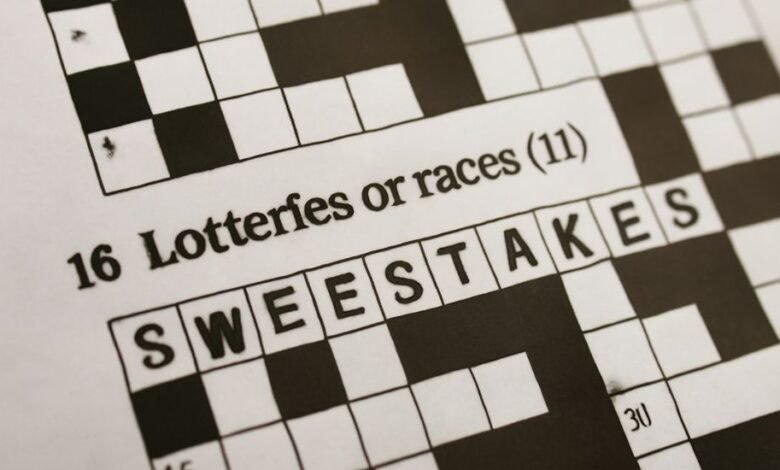
Crossword clues can be intriguing little puzzles that test both our vocabulary and our lateral thinking. Among the countless clues that have stumped solvers around the world, one that often appears in quick and general knowledge crosswords is the clue “Lotteries or races (11)”. At first glance, it looks straightforward — but as any seasoned crossword enthusiast knows, such clues often hold a clever twist.
The correct answer to this clue is SWEEPSTAKES, an eleven-letter word that perfectly fits both halves of the clue. In this article, we’ll explore why that answer works, the reasoning behind it, the word’s fascinating history, and how clues like this teach us how to think like a crossword setter.
Understanding the Clue
Let’s start with the clue itself: “Lotteries or races (11)”.
In crosswords, the number in parentheses — here, (11) — indicates the number of letters in the answer. So we know immediately that we’re looking for an eleven-letter word that could relate both to “lotteries” and to “races.”
The key connector here is the word “or.” In crossword construction, “or” often signals that a single word can describe both definitions — not one or the other, but a word that unites both ideas. This means we’re searching for a term that somehow refers to both lotteries and races.
When you think about lotteries, words like raffle, drawing, or contest might come to mind. For races, we might think of derby, marathon, or competition. Yet none of these overlap in meaning — except for one: sweepstakes.
Why “Sweepstakes” Is the Correct Answer
The beauty of the clue lies in the dual meaning of the word sweepstakes.
- In the context of lotteries:
A sweepstake (or sweepstakes, in plural form) refers to a competition or prize draw in which participants enter, often by chance, to win money or other prizes. It’s a type of lottery, where luck is the deciding factor rather than skill or effort. The word appears frequently in marketing promotions, charity fundraisers, and even major global contests like national sweepstakes or online giveaways. - In the context of races:
Historically, sweepstakes referred to a kind of race — particularly a horse race — where each competitor paid a stake into a pool, and the winner took all. In this sense, the “stakes” were literally “swept up” by the victor. Over time, this meaning broadened to represent any contest where the entire pool of entries or bets goes to the winner.
This duality is what makes sweepstakes such an elegant answer. It satisfies both “lotteries” and “races” — two seemingly different ideas that meet perfectly in one word.
Breaking Down the Word
Let’s look a bit closer at the construction of the word itself.
- The root “stake” refers to the money, bet, or investment placed at risk in a competition or wager.
- The verb “to sweep” means to take or win everything.
Combine the two and you get “sweepstake,” which literally means a race or competition where the winner sweeps all the stakes. Over time, the plural “sweepstakes” became the standard term, not only for races but also for chance-based lotteries.
This linguistic evolution perfectly embodies how English adapts — and why crosswords love words like this. They carry layers of meaning, often historical, that make them ripe for clever clues.
Crossword Craft: The Role of “Or”
One of the most instructive aspects of this clue is how it uses the simple word “or.” In crossword puzzles, or is sometimes deceptive. Many solvers initially assume it offers two separate definitions — as if the clue means “lotteries” or “races” could lead to two different words. But in this clue, the word serves a different function.
The setter is inviting you to find a single term that embodies both definitions. So the “or” is not separating alternatives but highlighting a shared meaning. Recognizing this subtle technique can make a big difference for solvers.
A useful tip: when you encounter clues with “or” in the middle, ask yourself whether the word might apply to both parts of the clue. If so, that’s a strong indicator of the type of answer you’re looking for.
Plural Form Matters
Another small but vital clue lies in the plural wording — “lotteries or races.” That ending “-s” is a hint that the answer should also be plural. So rather than “sweepstake,” which would be singular, “sweepstakes” (plural) fits both the definition and the word count.
Crossword setters love such details. Paying attention to plurality, verb tense, and even punctuation can provide subtle nudges toward the right answer.
Historical Background of the Term “Sweepstakes”
The term sweepstake dates back to the early 16th century. It originated in the context of gambling and racing, especially horse racing in England. Participants would each put up a stake, and the winner would sweep (that is, collect) the total amount. Hence, a sweepstake was literally the person who swept the stakes.
By the 18th and 19th centuries, the word was being used to describe the race itself and later any lottery-like competition. The phrase became deeply ingrained in popular culture — so much so that by the 20th century, it had become the standard word for major promotional contests.
Notably, large-scale national sweepstakes once played a significant role in raising funds for hospitals and charities. They combined the thrill of competition with the element of luck — precisely the blend that made them so appealing.
The word’s endurance in modern language is a testament to its versatility: it’s still used today for online giveaways, sports betting pools, and contests, while also retaining its old association with horse races.
The Intellectual Appeal of the Clue
From a crossword perspective, “lotteries or races” is an excellent example of a double-definition clue — a type of clue where both halves point to the same answer but in different contexts.
This format tests your ability to think flexibly about words and their meanings. Instead of focusing on wordplay (like anagrams or hidden words), double-definition clues rely on semantic variety. You’re being asked to connect two seemingly unrelated ideas through one shared term.
In this case:
- “Lotteries” leads you to think of games of chance.
- “Races” makes you think of competitions or betting.
Only when you recognize that sweepstakes can describe both do you see how neatly the clue fits together.
That moment of realization — the small “aha!” when everything clicks — is what makes crosswords so rewarding.
How to Approach Similar Crossword Clues
To improve your crossword-solving technique, especially with clues like this, here are some practical tips:
- Study the connector words: Words like or, and, for, or of often signal the structure of the clue. They tell you whether the clue offers synonyms, wordplay, or combined meanings.
- Mind the grammar: If the clue is plural, the answer probably is too.
- Use the letter count wisely: Knowing it’s an 11-letter answer narrows down possibilities dramatically.
- Think laterally: Don’t limit yourself to the literal meaning of words. Ask: could this term also apply metaphorically or historically?
- Practice with double-definition clues: These rely less on complicated mechanics and more on your vocabulary depth — ideal practice for both beginners and veterans.
The more you work with clues like “lotteries or races,” the better you’ll get at spotting the subtle patterns that setters use to challenge and delight solvers.
Why This Clue Resonates with Solvers
There’s a certain elegance in a clue that is both fair and clever. “Lotteries or races (11)” doesn’t require obscure trivia or wordplay gymnastics — it rewards knowledge of language. It feels balanced: challenging but solvable, concise yet meaningful.
It’s also a reminder of how English words evolve and overlap. A single term like sweepstakes can hold centuries of cultural meaning, stretching from the racetracks of 16th-century England to the online competitions of today. That depth gives clues like this a satisfying sense of history and discovery.
A Word on the Joy of Crosswords
Crosswords have endured for over a century because they combine entertainment, education, and challenge. They’re a form of linguistic play that sharpens the mind, improves recall, and deepens our appreciation for words.
Clues such as “lotteries or races” capture everything that makes the pastime so addictive — they test logic, vocabulary, and intuition all at once. The solver’s journey from confusion to comprehension is small but immensely gratifying.
When you finally write in SWEEPSTAKES, every letter feels earned. And even if you’ve never entered a sweepstakes yourself, you’ve just experienced a small victory of your own.
Final Thoughts
The clue “lotteries or races (11)” is more than just a simple puzzle entry — it’s a miniature lesson in word history, logic, and creativity. Its answer, SWEEPSTAKES, bridges two worlds: the world of chance and the world of competition. It reminds us how words evolve, how meanings overlap, and how crossword setters play with those connections to keep us engaged.
Whether you’re a casual solver or a dedicated cruciverbalist, clues like this teach you to see language differently. They sharpen your instincts and invite you to think in patterns — to see not just what a word means, but what else it could mean.
So the next time you encounter a similar clue, pause for a moment before diving in. Look for the hidden link, the word that connects both sides of the definition. You might just find yourself “sweeping the stakes” — in both the crossword and the race to mastery.
Written and published by Empire Magazines.
FAQs — Lotteries or Races Crossword Clue
1. What is the answer to the clue “Lotteries or races (11)”?
The answer is SWEEPSTAKES. It’s an eleven-letter word that perfectly fits both meanings — referring to a lottery-style draw and a type of race where the winner takes all the stakes.
2. Why does “SWEEPSTAKES” mean both lotteries and races?
Historically, “sweepstake” referred to a race where participants each contributed money to a prize pool, and the winner “swept” all the stakes. Over time, the term came to describe lotteries or contests of chance as well.
3. What kind of crossword clue is “Lotteries or races”?
It’s a double-definition clue, where both parts of the clue point to the same answer in different contexts. “Lotteries” and “races” each define “sweepstakes” in their own way.
4. How can I identify a double-definition clue in crosswords?
Look for short clues with two distinct meanings separated by words like or, and, or commas. Both parts will usually be synonyms for the same answer rather than a play on letters.
5. Are there similar clues to “Lotteries or races”?
Yes. Examples include:
- “Competitions or drawings (11)” → SWEEPSTAKES
- “Contests of chance (11)” → SWEEPSTAKES
- “Prize draws (11)” → SWEEPSTAKES
6. What does the number in parentheses mean in crossword clues?
The number in parentheses indicates the length of the answer. For example, (11) means the solution is an eleven-letter word.
7. Why is the clue written in plural form (“lotteries or races”)?
Crossword setters often use plural forms to guide you to the correct version of the word. Since the clue uses plurals, the plural answer “sweepstakes” (not “sweepstake”) fits perfectly.
8. How do sweepstakes differ from a standard lottery?
In a lottery, participants buy tickets for a chance to win random prizes. In a sweepstakes, participants may enter freely or by purchase, and winners are chosen by luck — but both share the element of chance.
9. What is the origin of the word “sweepstakes”?
The term dates back to 16th-century England. In horse racing, the winner was said to “sweep the stakes,” meaning they took all the money bet by the competitors. The phrase later evolved to mean any prize competition based on chance.
10. Why is this crossword clue popular?
It’s concise, clever, and fair — two short definitions leading to one elegant word. Clues like this are loved by solvers because they teach you how a single word can bridge two ideas, combining knowledge with a little wordplay magic.