If you’re a crossword enthusiast, you’ve almost certainly encountered the clue “method of starting play in ice hockey.” It’s a deceptively simple phrase that appears in puzzles of all difficulty levels, instantly connecting the worlds of wordplay and sport. The answer most solvers arrive at—FACE-OFF—fits neatly into the grid, but there’s far more depth behind those seven letters. Beyond being a crossword staple, the face-off is a defining feature of ice hockey itself, symbolising the moment when anticipation turns into action and control of the game is decided in a split second.
But while crossword solvers might be satisfied to fill in those seven squares, the real story behind this term runs deeper. In ice hockey, the “face-off” isn’t just a way to begin play — it’s a critical ritual of control, competition, and precision. Understanding how this term functions in the game itself reveals why it has become such a favourite of crossword makers everywhere.
The Crossword Clue Explained
When you encounter the clue “method of starting play in ice hockey,” the first instinct is to think of what actually begins the action on the rink. Unlike in many other sports — where a kick-off, tip-off, or serve starts play — ice hockey begins with something unique. The face-off.
Crossword setters love this clue for its simplicity and clarity. It asks for a method, and in hockey there is only one correct answer that fits both the literal and technical definition. The structure is predictable: often appearing as “(4,3)” or “(7)” in the grid, which represents FACE-OFF or FACEOFF.
For solvers, it’s an accessible clue. Even those who don’t follow ice hockey might have heard the term through sports broadcasts, video games, or even everyday metaphors. That familiarity makes the clue rewarding — it’s not too obscure, not too obvious, and sits perfectly in the sweet spot crossword compilers look for.
The Origin and Meaning of the Face-Off
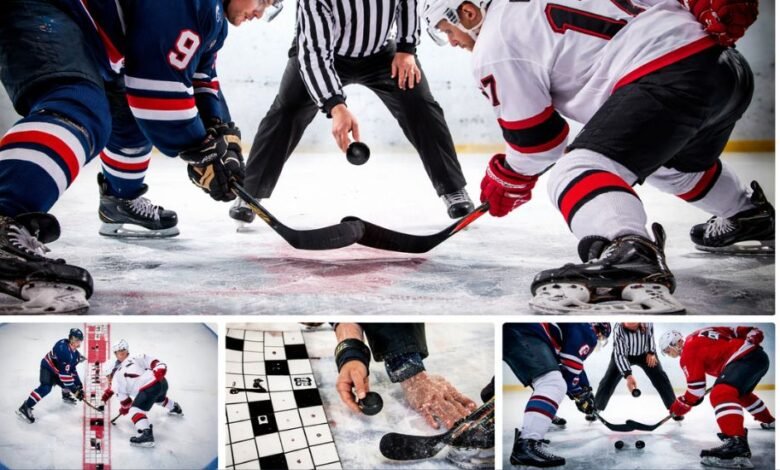
A face-off is the official method used in ice hockey to start play at the beginning of a game, at the start of each period, and after any stoppage in play such as a goal, off-side, or icing.
Two opposing players, usually the team centres, crouch low and face each other. Between them stands an official, puck in hand. The players wait for the moment when the puck drops to the ice — that’s the instant when both attempt to gain possession for their team.
What follows in that split-second is one of the purest expressions of competition in sport. Each player’s reaction, timing, stick control, and body positioning determine whether the puck goes their way or not. For a moment, the entire game pivots on reflex and skill — all symbolized by the face-off.
The Procedure: How a Face-Off Works
In professional ice hockey, the rink contains nine designated face-off spots. One sits at centre ice, where play begins each period and after goals, while the other eight are distributed across the neutral and attacking zones.
Positioning the Players
Two players face each other with sticks on the ice, blades touching the surface. The rest of their teammates line up outside the face-off circle, waiting for the puck to drop.
The Drop
The official drops the puck straight down between the two opposing sticks. Timing is everything — the puck must hit the ice cleanly for play to begin fairly.
The Contest
Both players attempt to direct the puck to a teammate. Some try to push it backward for a controlled play, others swipe it forward to create quick offence.
Restarting Play
This process is used not just to start the game, but also to restart it after any stoppage — when the puck leaves the rink, a penalty is called, or a goal is scored.
The rules surrounding the face-off are surprisingly strict. A player who moves too early or fails to follow the correct stance can be ejected from the circle, replaced by a teammate. Officials pay close attention to ensure the face-off is fair and properly executed.
The Strategic Importance of the Face-Off
At first glance, the face-off may appear as a simple puck drop. But in reality, it’s a cornerstone of hockey strategy.
Winning a face-off means gaining immediate control of the puck. In the defensive zone, this can prevent a dangerous scoring chance. In the attacking zone, a won face-off can lead to a direct shot on goal within seconds. Teams even design specific plays around face-off situations — short, rehearsed maneuvers where players know exactly where the puck will go if their teammate wins it.
Great centres spend countless hours mastering the art of the face-off. They practice hand speed, reaction time, stick positioning, and body leverage. Some players become so skilled at it that they are subbed in specifically to take crucial draws in the final minutes of a close game.
This blend of physical skill, anticipation, and strategy makes the face-off more than just a restart. It’s an opening gambit — the chess move that dictates the flow of the next few seconds.
Why the Face-Off Matters to Crossword Solvers
From a crossword-solving perspective, the face-off occupies a rare position where technical accuracy and common knowledge overlap. Many sports terms are too obscure for casual solvers, while others are too vague to clue cleanly. “Face-off,” however, strikes the perfect balance. It is specific enough to point clearly to ice hockey, yet familiar enough to feel fair even to non-fans.
The clue “method of starting play in ice hockey” works because it mirrors the sport’s structure: there is only one correct answer, and it never changes. This consistency is invaluable in crossword construction. Solvers can rely on it, and setters can deploy it confidently, knowing it won’t feel outdated or ambiguous years later.
Additionally, the letter structure of FACE-OFF makes it grid-friendly. Whether clued as seven letters or split into a (4,3) format, it interlocks easily with surrounding answers. That practicality, combined with its recognisable meaning, explains why this clue appears so frequently across newspapers, magazines, and online puzzles. For crossword enthusiasts, remembering this answer isn’t just helpful—it’s essential.
The Linguistic Appeal in Crosswords
The reason “FACE-OFF” works so beautifully as a crossword answer lies not only in its relevance to hockey, but also in its language. The phrase itself is vivid and active — two opponents “facing off” conjures instant imagery of confrontation and readiness.
Crossword setters love such compound words because they’re memorable, visually strong, and concise. They also work on multiple levels: while the literal meaning is tied to hockey, “face-off” has entered general English vocabulary to mean a confrontation or direct contest.
That linguistic versatility allows the clue to appear in different thematic puzzles — sometimes in a pure sports context, other times in a general puzzle with broader references to conflict or competition. It’s rare for a term to carry such clear meaning in both the specialized and general lexicon, which is why crossword creators return to it again and again.
How Sports Enrich Crossword Vocabulary
Crosswords have long borrowed from the world of sports. Terms like “kick-off,” “serve,” “goalie,” and “power play” frequently make appearances, not because solvers are expected to be athletes, but because sports provide rich, active verbs and nouns.
Sports language often captures the essence of action — short, sharp, and evocative. That’s gold for crossword compilers, who seek terms that are easy to clue and instantly recognizable.
In this way, “FACE-OFF” fits into a proud tradition of sports-derived crossword vocabulary. It’s precise, common, and unmistakably energetic. The clue “method of starting play in ice hockey” doesn’t need clever wordplay or misleading hints — its charm lies in its directness and accuracy.
Why This Clue Has Staying Power
There are many clues that come and go, but “method of starting play in ice hockey” has endured for decades. It persists because of three major factors:
Consistency
The answer never changes. Unlike pop-culture references or slang, the face-off remains the official and only method for starting play in hockey.
Universality
While hockey may be most popular in certain regions, the sport has a global audience. The term has become part of mainstream vocabulary even in countries without professional leagues.
Simplicity
Crosswords thrive on clarity. The clue asks a straightforward question and the answer delivers an equally clear response. There’s elegance in that simplicity — a kind of linguistic balance that keeps it timeless.
Every great crossword clue has that mix of specificity and approachability. “Method of starting play in ice hockey” checks every box.
The Face-Off Beyond the Rink
Interestingly, “face-off” has evolved beyond the sport itself. In everyday speech, we use it to describe debates, rivalries, or competitions — a political face-off, a business face-off, or even a friendly challenge. This linguistic migration underscores the term’s power: it captures confrontation without hostility, structure without chaos.
That makes it appealing not just in sports writing, but in broader communication. It conveys both fairness and tension — the moment before the first move, when potential energy is at its highest.
Crossword creators, knowingly or not, tap into this same energy. By using “face-off,” they inject a sense of action and drama into their puzzles — even if only for a fleeting moment while you fill in those letters.
How to Remember It: A Solver’s Tip
If you’re an avid crossword solver, here’s an easy memory cue: whenever you see “method of starting play” tied to ice hockey, think of confrontation. Two players, one puck, and the moment that defines who controls the game. That mental image leads you straight to the right answer — FACE-OFF.
It’s also helpful to remember that this answer can appear in different formats depending on the crossword’s layout:
- FACEOFF (7 letters)
- FACE-OFF (with hyphen)
- FACE OFF (as 4,3 word pattern)
Recognizing those variations can save precious seconds in competitive solving.
Why Writers and Bloggers Love This Topic
For writers and bloggers, especially those covering language, sports, or entertainment, this clue offers an ideal intersection of two engaging worlds. It invites discussion not only about hockey but about how language from one field permeates another.
You can explore how sports shape everyday speech, how terms migrate into idioms, and how cultural familiarity influences what crossword clues feel “fair.” It’s also a great example of how a single phrase can connect two audiences — sports fans and puzzle enthusiasts — in a shared vocabulary.
That’s why writing about “method of starting play in ice hockey” isn’t just about explaining a crossword answer; it’s about celebrating how language travels, adapts, and unites different passions.
Conclusion
In the end, the crossword clue “method of starting play in ice hockey” captures more than a simple answer — it encapsulates a miniature world of sport, skill, and language. The solution FACE-OFF represents both the literal beginning of a hockey game and the metaphorical spark of competition.
It’s concise, dynamic, and enduring — everything a perfect crossword entry should be. And in understanding its meaning on the rink, we gain a richer appreciation for how everyday language, sports culture, and puzzles intertwine.
So the next time you encounter that clue, you won’t just write the answer — you’ll know the story behind it.
Written and published by Empire Magazines — where words, culture, and sport meet.
FAQs About the Ice Hockey Face-Off
What is the most common crossword answer for starting play in ice hockey?
The most common answer is FACE-OFF, which directly describes how play begins and restarts during a hockey game.
Is “face-off” always clued with ice hockey in crosswords?
Not always. While ice hockey is the most common context, “face-off” can also be clued as a confrontation or showdown in non-sports puzzles.
Can “FACEOFF” be written without a hyphen in crosswords?
Yes. Many puzzles accept FACEOFF as a single seven-letter entry, depending on grid design.
Why is this clue considered beginner-friendly?
Because it’s direct, logical, and widely known, making it approachable even for solvers with limited sports knowledge.