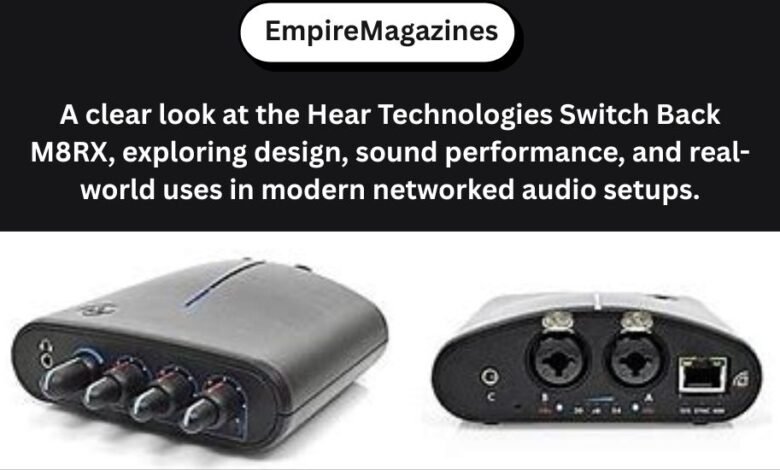
The Hear Technologies Switch Back M8RX Dante audio interface sits in a very specific space within modern audio workflows. It is not trying to replace large-format mixers, full recording consoles, or multi-user monitoring systems. Instead, it focuses on a growing need in both live sound and studio environments: giving individual performers or operators a compact, network-based way to listen, send, and manage audio with confidence and minimal complexity.
At its core, the Switch Back M8RX is designed by Hear Technologies as a personal audio interface that connects directly to a networked audio system. Rather than relying on traditional analog snakes or bulky personal monitor mixers, it allows audio to travel over a single network cable while still offering familiar physical controls for gain, volume, and monitoring. This blend of modern infrastructure and hands-on usability is what makes the M8RX appealing to many engineers and musicians.
The unit supports networked audio channels for both input and output, while also providing local analog inputs for microphones, instruments, and auxiliary sources. That means a performer can plug in a vocal mic or instrument locally, send that signal into the network, and at the same time monitor a custom mix coming back through headphones or in-ear monitors. The idea is to keep latency low, setup fast, and control intuitive, even in environments where time and space are limited.
From a practical standpoint, the Switch Back M8RX is often described as a “personal listening and send-back box.” It allows users to hear what they need, contribute their own signals to the wider system, and do so without depending entirely on a front-of-house engineer for every adjustment. In real-world terms, that can reduce stress on stage, simplify rehearsals, and streamline complex audio setups where multiple people need reliable monitoring.
For readers of Empire Magazines who are interested in how audio technology continues to shift toward network-based systems, the M8RX is a good example of how manufacturers are adapting traditional monitoring concepts to newer infrastructures without losing the tactile feel that many users still value.
Design Philosophy and Everyday Workflow
The physical design of the Switch Back M8RX reflects its intended role as a personal, close-at-hand device. It is compact enough to sit on a small table, attach to a mic stand, or clip to a belt, depending on the setup. This flexibility matters in environments like live stages, broadcast booths, rehearsal rooms, and even mobile recording rigs, where space is often at a premium and equipment needs to move quickly.
On the front panel, the controls are laid out in a way that feels immediately familiar. Gain knobs for microphone inputs, a dedicated headphone volume control, and clearly labeled indicators help users make quick adjustments without digging through menus or software. This is an intentional choice. While networked audio systems can offer powerful routing and configuration options, they often rely heavily on computers or tablets. The M8RX aims to reduce that dependency for everyday use.
From a workflow perspective, the unit typically connects to a network switch using a single Ethernet cable. That same cable can supply power and carry audio data, which simplifies cabling and reduces clutter. Once connected, audio channels can be assigned through network audio software, but after that initial setup, most users interact only with the physical controls on the device itself. This separation between configuration and daily operation can make life easier for both engineers and performers.
The inclusion of multiple analog inputs allows for a range of scenarios. For example, a singer might connect a microphone directly to the M8RX, while a keyboard player might feed a stereo line signal. An auxiliary input can handle playback devices or click tracks. All of these signals can be routed into the network, mixed elsewhere, or monitored locally. The key point is flexibility without overwhelming complexity.
Conceptually, you can think of the Switch Back M8RX like a personal checkpoint in a larger audio system. It sits between the individual and the network, translating hands-on actions into digital signals and bringing digital audio back into a form that feels immediate and controllable. This approach can be especially helpful for users who want the benefits of networked audio but are not interested in managing every technical detail themselves.
Audio Performance and Monitoring Experience
Sound quality is, naturally, a major concern with any audio interface, and the Switch Back M8RX is built with that expectation in mind. The microphone preamps are designed to be clean and quiet, suitable for vocals, spoken word, and a variety of instruments. While it is not marketed as a boutique studio preamp, it aims to deliver consistent, transparent performance that works reliably across many applications.
One of the more important aspects of the M8RX is how it handles monitoring. The headphone amplifier is capable of driving common studio headphones and in-ear monitors with enough headroom to remain clear and controlled, even in loud environments. This is particularly relevant on stage, where performers often need strong, distortion-free monitoring to hear themselves over ambient noise.
Latency is another critical factor. Because the device supports local monitoring of analog inputs alongside networked audio returns, users can hear their own signals without noticeable delay. In practice, this means a vocalist does not experience the disorienting effect of hearing their voice slightly late, which can happen in purely software-based monitoring setups. For musicians, this immediacy can make a real difference in comfort and performance.
The balance between local and networked audio is also worth noting. Users can blend what they are sending into the system with what they are receiving, creating a personalized mix that suits their needs. This is not the same as a full multi-channel personal mixing console, but it covers the most common requirements in a simpler package. In many cases, less complexity translates into fewer mistakes and faster problem solving.
From an engineering perspective, the Switch Back M8RX is designed to be predictable. Levels behave as expected, controls respond smoothly, and the unit does not introduce unnecessary coloration. For live sound professionals, predictability is often more valuable than flashy features. Knowing that a device will behave the same way every night reduces risk and builds trust in the system as a whole.
Practical Use Cases, Comparisons, and Considerations
The real value of the Hear Technologies Switch Back M8RX Dante audio interface becomes clearer when looking at how it fits into different environments. In a live performance setting, it can serve as a personal monitor station for a vocalist or instrumentalist. Instead of relying entirely on a shared monitor mix, the performer gains direct control over their listening level and can contribute their signal to the network without extra cabling.
In broadcast or streaming scenarios, the M8RX can act as a compact interface for hosts or commentators. Each person can have a microphone and headphones connected locally, while audio is routed through a central system for recording or transmission. This setup helps maintain consistency and reduces the need for large desks in small studios or remote locations.
Studio environments can also benefit, particularly for cue mixes. Musicians in separate rooms can have their own monitoring points without running long analog cables. Each unit becomes a node in the system, simplifying routing and reducing the physical complexity of the studio layout. Over time, this can make studios more adaptable as needs change.
When comparing the M8RX conceptually to traditional analog solutions, the difference is similar to comparing a shared office printer to individual networked workstations. With older approaches, everything flows through a central point, and changes often require assistance from a technician. With a networked personal interface, control is distributed, and individuals can manage their own experience within defined limits.
There are, however, considerations to keep in mind. Networked audio systems require planning and basic familiarity with digital routing concepts. While daily operation of the M8RX is straightforward, initial setup may still require someone comfortable with network configuration. Additionally, users who expect advanced personal mixing features with many channels and presets may find the M8RX intentionally streamlined.
Another consideration is scale. The Switch Back M8RX excels as a personal interface, but it is not meant to replace larger monitoring systems when many channels and complex mixes are needed at once. Its strength lies in focused functionality rather than all-in-one solutions. For many users, that focus is exactly what makes it appealing.
For Empire Magazines readers who follow trends in audio production and live sound, the M8RX illustrates how the industry is moving toward modular, network-friendly tools. Instead of one massive system doing everything, smaller devices handle specific tasks well and integrate into a larger whole.
Conclusion: Key Takeaways on the Switch Back M8RX
The Hear Technologies Switch Back M8RX Dante audio interface represents a practical response to modern audio challenges. It combines networked audio connectivity with hands-on controls, offering individuals a reliable way to send and monitor sound without unnecessary complexity. Its design favors clarity, predictability, and flexibility, making it suitable for live stages, studios, and broadcast environments alike.
Rather than trying to be everything at once, the M8RX focuses on doing a few things well: providing clean inputs, strong headphone monitoring, and seamless integration into networked systems. For users who value control over their own audio experience and want to reduce dependence on bulky analog setups, it offers a compelling option.
In a landscape where audio technology continues to evolve, devices like the Switch Back M8RX show how thoughtful design can bridge the gap between traditional workflows and modern infrastructure. The result is a tool that feels familiar, works efficiently, and supports the collaborative nature of today’s audio environments.
Frequently Asked Questions (FAQs)
What is the Hear Technologies Switch Back M8RX?
The Switch Back M8RX is a compact personal audio interface designed for network-based audio systems. Made by Hear Technologies, it allows users to send local audio sources, such as microphones or instruments, into a network while also receiving audio back for headphone monitoring.
What does “Dante audio interface” mean in simple terms?
A Dante audio interface sends and receives sound over standard network cables instead of traditional analog audio cables. This makes it easier to move multiple audio channels over long distances with less clutter, while keeping sound quality consistent.
Who typically uses the Switch Back M8RX?
The M8RX is commonly used by musicians, performers, audio engineers, and broadcast professionals who need personal monitoring and local audio input within a larger networked system. It’s especially useful when each person needs control over their own listening without managing a full mixer.
Is the Switch Back M8RX meant for studio recording or live sound?
It can be used in both settings. In live sound, it often functions as a personal monitoring station. In studio or broadcast environments, it can serve as a compact interface for headphones and microphones, especially where space is limited or remote setups are involved.
Does the M8RX replace a mixing console?
No. The Switch Back M8RX is not a replacement for a full mixing console. Instead, it works alongside a central system by giving individuals local control over monitoring and audio input. Think of it as a personal access point rather than a control hub for everyone.
How many audio signals can it handle?
The device supports multiple audio channels over the network and includes local analog inputs for microphones, instruments, and auxiliary sources. The exact routing depends on how the larger system is configured, but it is designed to handle common personal monitoring and input needs efficiently.
Is latency a concern when using this device?
Latency is generally minimal in typical setups. The M8RX allows for local monitoring of connected analog sources, which helps users hear themselves without noticeable delay. This is particularly important for vocalists and instrumentalists.
Does it require special technical knowledge to use?
Daily use is straightforward, with physical knobs and controls that behave as expected. Initial setup within a networked audio system may require some familiarity with digital audio routing, but once configured, most users operate it without needing technical adjustments.
Can it be powered without an external power supply?
Yes. The Switch Back M8RX is designed to receive power through its network connection, which reduces the need for additional cables and power adapters. This helps keep setups clean and portable.
Is it suitable for permanent installations?
It can be used in both permanent and temporary setups. Its small size and flexible mounting options make it suitable for fixed installations, while its portability also works well for touring or mobile systems.
What kind of headphones work best with the M8RX?
The device is designed to work with common studio headphones and in-ear monitors. Users typically choose headphones based on comfort and isolation needs rather than compatibility concerns.
What should someone consider before choosing the Switch Back M8RX?
It’s important to consider whether a personal interface fits your workflow. If you need simple, reliable monitoring and local audio input within a networked system, the M8RX makes sense. If you need advanced mixing features or control over many channels at once, a different type of device may be more appropriate.