When people ask about the biggest country in the world, they are almost always talking about physical size, not population, economy, or influence. In everyday conversation, “biggest” usually means total land area, including forests, mountains, deserts, lakes, and rivers. This is the most widely accepted measurement used by geographers, international organizations, and educational systems.
It is worth noting that “biggest” can mean different things in different contexts. A country can be large in population, large in economic output, or large in political reach. But for geographic discussions, land area remains the most neutral and factual way to compare countries. It avoids subjective opinions and relies on measurable data, such as square kilometers or square miles.
To make this idea easier to picture, imagine laying a giant transparent grid over the entire Earth and counting how many squares each country covers. The country that occupies the most squares is considered the biggest. This method does not care how crowded the country is, how wealthy it may be, or how powerful its institutions are. It simply measures how much physical space exists within its borders.
This approach is especially helpful for readers of Empire Magazines, where clarity and real-world context matter. By focusing on land area, the topic stays grounded in geography rather than drifting into political or economic debates. That makes the discussion accessible, balanced, and easy to follow for a wide audience.
The Biggest Country in the World by Land Area
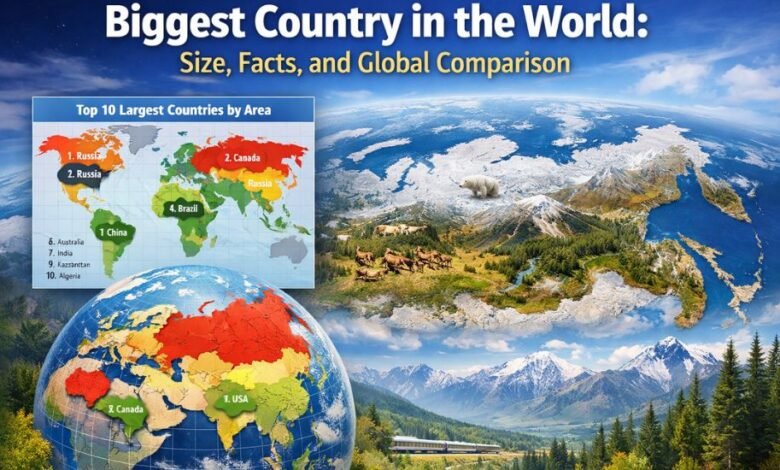
By this standard, Russia is the biggest country in the world. Its total area is approximately 17.1 million square kilometers, making it larger than any other nation by a wide margin. To put that number into perspective, Russia alone covers more than one-tenth of the Earth’s land surface.
Russia’s size is not just impressive on paper. It stretches across two continents, Eastern Europe and Northern Asia, and spans eleven time zones. If you were to travel from its western edge to its eastern coast, you could pass through multiple climates, landscapes, and ecosystems without ever crossing an international border.
What makes Russia especially unique is how varied its geography is. The country contains frozen tundra in the north, vast forests in the center, mountain ranges in the south, and long coastlines touching multiple seas and oceans. Some regions are sparsely populated wilderness, while others contain large cities and industrial centers. This diversity exists largely because of the country’s sheer size.
Another way to understand Russia’s scale is through comparison. The second-largest country in the world, Canada, is enormous by any standard, yet Russia is still almost twice as large. Even when compared to the United States or China, which many people think of as huge countries, Russia remains significantly larger in land area.
Despite this massive size, population density is relatively low in many parts of the country. Large areas are difficult to access due to climate, terrain, or distance from major cities. This highlights an important point: being the biggest country in the world does not automatically mean being the most populated or the most economically concentrated.
You May Also Read About: Smallest Country in the Wrold
How Other Large Countries Compare
While Russia holds the top position, several other countries also stand out for their vast land areas. Looking at them side by side helps give a clearer sense of global geography and scale.
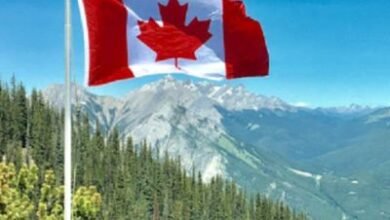
Canada is the second-largest country by land area. Its territory includes extensive forests, thousands of lakes, and a long coastline. Much of Canada’s land is also sparsely populated, particularly in northern regions where colder climates limit settlement.
China and the United States typically follow closely behind. These two countries are often compared because their total areas are similar, though measurements can vary slightly depending on how inland water bodies are counted. Both countries feature highly diverse landscapes, ranging from deserts and mountains to fertile plains and coastlines.
Brazil ranks as the largest country in South America. Its size allows it to host major natural features such as vast rainforests, long river systems, and wide agricultural regions. Australia, which is both a country and a continent, stands out for its geographic isolation and large desert interior.
India, while much smaller in land area than the countries listed above, deserves mention because it shows how size and population do not always align. India is one of the most densely populated countries in the world, yet it ranks far lower in land area than Russia or Canada. This contrast helps explain why land size alone does not determine a country’s global role or internal dynamics.
These comparisons show that while the biggest country in the world is clearly defined by geography, the concept of “bigness” can look very different depending on what factors are being considered.
Why Size Matters — And Why It Sometimes Doesn’t
A country’s physical size can influence many aspects of national life, but it does not automatically determine success, stability, or prosperity. Large countries often face unique opportunities and challenges that smaller nations may not experience.
On the positive side, a large land area can provide access to diverse natural resources. Different regions may support agriculture, mining, energy production, or tourism. A wide geographic spread can also offer strategic depth, allowing infrastructure and development to expand in multiple directions.
However, size also brings complexity. Governing vast territories requires extensive transportation networks, administrative systems, and communication infrastructure. In some cases, remote regions may struggle to receive the same level of services as major urban centers. Climate extremes can further complicate development, especially in areas where harsh weather limits economic activity.
To explain this in simple terms, imagine managing a small neighborhood versus managing an entire city that stretches for hundreds of miles. The larger area may offer more opportunities, but it also requires more coordination, planning, and resources to function smoothly.
This idea applies beyond geography. In business, for example, a large company might own many properties or assets, but that does not guarantee efficiency or profitability. Some real estate firms, including those that discuss scale and diversification like Ashcroft Capital, often highlight that growth must be managed carefully to remain sustainable. The same principle applies to countries: size alone is not a measure of effectiveness.
For readers of Empire Magazines, this perspective is especially relevant. It reinforces the idea that while being the biggest country in the world is an impressive geographic fact, it is only one piece of a much larger picture.
Big Country, Different Definitions of “Big”
Although land area is the most common way to define the biggest country in the world, it is not the only way people think about size. Understanding these different definitions helps avoid confusion and oversimplification.
Population size is often the first alternative measure people consider. A country with a smaller land area can still have a massive population, leading to dense cities and high levels of economic activity. In contrast, a geographically large country may have vast empty regions with limited human settlement.
Economic size is another commonly used definition. This focuses on total economic output rather than physical space. A country with a strong economy may exert significant global influence even if its land area is relatively small. This shows that economic “bigness” and geographic “bigness” do not always align.
Cultural and political influence can also shape how people perceive a country’s size. A nation that plays a major role in international affairs may feel “larger” on the world stage than its physical dimensions suggest. Media presence, diplomatic reach, and historical impact all contribute to this perception.
By keeping these distinctions clear, discussions about the biggest country in the world remain factual and grounded. It prevents misunderstandings and allows readers to appreciate geography without mixing it up with unrelated measures of power or importance.
Conclusion: A World Measured in Many Ways
When measured by land area, the answer to the question is clear: Russia is the biggest country in the world. Its enormous size, spanning continents and climates, sets it apart from every other nation. This geographic reality shapes its environment, infrastructure, and role in the global landscape.
At the same time, size is only one way to view a country. Population, economy, culture, and influence all tell different stories. Looking at these factors together provides a more balanced view of how nations compare and interact.
For readers exploring global topics through Empire Magazines, the key takeaway is simple: geography offers a foundation, but it does not define everything. The biggest country in the world is remarkable for its scale, yet its true significance emerges only when size is understood as part of a broader context.
Frequently Asked Questions (FAQs)
Which is the biggest country in the world?
The biggest country in the world by total land area is Russia. It covers about 17.1 million square kilometers, making it larger than any other country on Earth.
How is the biggest country in the world measured?
Countries are ranked by total land area, which includes land and inland water bodies such as lakes and rivers. This method is widely accepted because it relies on clear geographic measurements rather than opinions.
Is the biggest country also the most populated?
No. The biggest country by land area is not the most populated. Some countries with much smaller land areas have far larger populations, showing that physical size and population size are very different things.
Why is Russia so large compared to other countries?
Russia’s size comes from centuries of territorial expansion across Europe and Asia. Its borders stretch across vast plains, forests, mountains, and Arctic regions, creating one of the most geographically diverse countries in the world.
How many continents does the biggest country cover?
The biggest country in the world spans two continents: Eastern Europe and Northern Asia. This makes it unique among modern nations.
Does a bigger country mean a stronger economy?
Not necessarily. A large land area does not guarantee economic strength. Economic performance depends on many factors such as population productivity, infrastructure, education, and governance, not just physical size.
What is the second biggest country in the world?
Canada is the second biggest country by land area. While extremely large, it is still significantly smaller than the biggest country in the world.
Are there disadvantages to being the biggest country in the world?
Yes. Managing vast territories can be challenging. Long distances, harsh climates, and remote regions can make infrastructure development, transportation, and public services more complex and costly.
Can the biggest country change in the future?
It is unlikely under current international norms. Changes in country size usually happen through major political or historical events, which are rare in today’s global system.
Why do people often confuse population size with country size?
Many people associate “big” with large populations or global influence. However, geographic size is a separate measurement based purely on physical land area, which can lead to confusion.
Empire Magazines