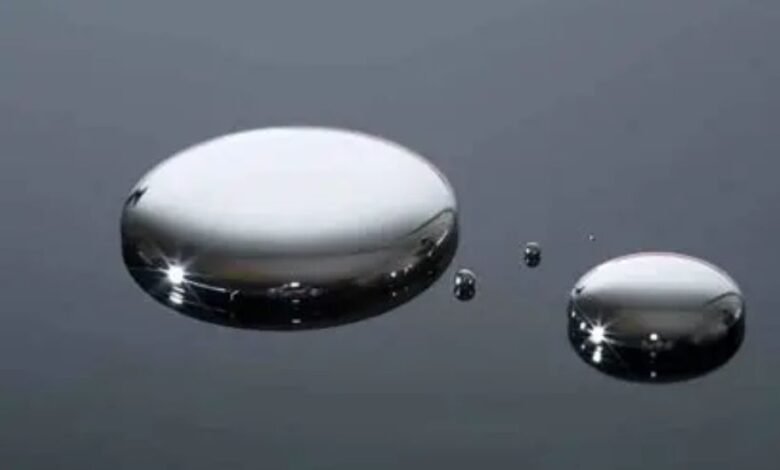
If you were asked this question in a classroom or a casual science conversation, the answer would be surprisingly short. Mercury is the only metal that naturally stays in a liquid state at typical room temperature. While many materials soften or deform when warmed, mercury is unique because it does not need heat to melt under normal indoor conditions. At around 20–25°C (68–77°F), mercury is already fully liquid, flowing smoothly with a silvery shine that almost looks alive.
What makes this topic interesting is not just the answer itself, but why mercury behaves this way, and why most other metals do not. Metals are usually associated with hardness, strength, and solidity. We imagine iron beams, aluminum sheets, or copper wires, not shimmering pools of liquid. Mercury challenges that assumption, making it a favorite example in basic science education and curiosity-driven discussions.
In everyday life, mercury was once commonly seen in thermometers and certain electrical devices. Over time, safety concerns reduced its everyday use, but its unusual physical behavior still makes it one of the most talked-about elements when people ask which metal is found in liquid state at room temperature. At Empire Magazines, questions like this come up often because they sit right at the intersection of everyday curiosity and solid scientific explanation.
To appreciate why mercury stands alone, it helps to first understand what “room temperature” actually means and how metals typically behave when exposed to it.
What “room temperature” really means in science
The phrase “room temperature” sounds casual, but in science it has a fairly consistent meaning. It usually refers to a temperature range between 20°C and 25°C. This is the range most indoor environments naturally fall into without heating or cooling. It is also the benchmark scientists use when describing how substances behave under ordinary conditions.
Most metals have melting points far above this range. Iron, for example, does not melt until temperatures exceed 1,500°C. Aluminum melts at over 600°C. Even metals considered relatively soft, such as lead or tin, remain solid well above room temperature. This is why metal furniture, tools, and appliances hold their shape no matter how warm a room becomes.
The melting point of a metal depends on how tightly its atoms are held together. Strong atomic bonds require more energy to break, meaning higher temperatures are needed to turn a solid into a liquid. Mercury’s atomic structure is different. Its electrons interact in a way that weakens these bonds, allowing its atoms to move freely at much lower temperatures.
This difference explains why mercury is liquid while other metals remain solid, even though they all belong to the same broad category of elements. It also explains why only one metal qualifies as being liquid at room temperature in the strict scientific sense.
Mercury: the only true liquid metal at room temperature
Mercury is a heavy, silver-colored metal that flows like water but shines like polished chrome. Its melting point is approximately –39°C, far below freezing. This means that even in cold environments, mercury often remains liquid, and at normal indoor temperatures, there is no question about its state.
One reason mercury stands out is how it behaves physically. Unlike water, it does not wet surfaces easily. Instead, it forms rounded beads that roll across a surface. This happens because mercury has high surface tension, another unusual property that adds to its mystique. People who have seen mercury spill often remember the way it breaks into dozens of tiny spheres, each reflecting light like a miniature mirror.
Historically, mercury’s liquid state made it incredibly useful. It was ideal for measuring temperature because it expands and contracts evenly. It also conducted electricity well and was used in switches and industrial equipment. However, over time, it became clear that mercury exposure poses health risks. As a result, many of its traditional uses were phased out or strictly regulated.
Despite these safety considerations, mercury remains the clearest and most accurate answer to the question of which metal is found in liquid state at room temperature. No other metal consistently shares this property under normal conditions.
Metals that almost qualify, but don’t quite
When people explore this topic further, they often encounter other metals that seem to blur the line. These metals are solid at room temperature but melt with just a little added warmth. This leads to confusion, especially in casual explanations or simplified lists.
Gallium is one of the most commonly mentioned examples. It melts at about 30°C, which is just slightly above typical room temperature. In a warm room or in the palm of your hand, gallium can slowly liquefy. This makes it popular in demonstrations, where it appears to “defy” expectations by melting without visible heat. Still, under standard room conditions, gallium remains solid, which disqualifies it from being the correct answer.
Cesium is another metal often mentioned in discussions. It melts at roughly 28–29°C, meaning it can liquefy in very warm environments. However, cesium is extremely reactive and must be stored carefully, usually submerged in oil. Its reactivity, combined with the fact that it is not liquid at typical room temperature, keeps it firmly in the “almost, but not quite” category.
Rubidium falls into a similar group. It melts at around 39°C, well above room temperature, and is also highly reactive. While interesting from a chemical standpoint, it does not change the core answer.
There is also francium, a metal often described as theoretically liquid near room temperature. However, francium is incredibly rare and highly radioactive. Because it exists only briefly and in extremely small amounts, its properties are mostly predicted rather than directly observed. For practical and educational purposes, francium is not treated as a real-world example of a liquid metal at room temperature.
These near-misses are fascinating, but they actually reinforce how special mercury is. It is the only metal that naturally stays liquid without extra heat, special conditions, or theoretical assumptions.
Why mercury behaves differently from other metals
To understand why mercury alone stays liquid, it helps to look at how metals bond at the atomic level. In most metals, atoms share electrons in a way that creates a strong, stable lattice. This structure gives metals their familiar hardness and strength. Breaking that lattice requires significant energy, which usually means high heat.
Mercury’s electrons behave differently because of a phenomenon related to its heavy atomic mass. The inner electrons move at speeds where relativistic effects come into play, subtly altering how they interact with the outer electrons. This reduces the strength of the bonds between mercury atoms, making it easier for them to slide past one another even at low temperatures.
An everyday comparison can help make this clearer. Imagine bricks stacked tightly and cemented together. That structure represents a solid metal like iron. Now imagine marbles resting in a shallow tray. They still cluster together, but they move easily when nudged. Mercury is closer to the marbles than the bricks.
This atomic behavior explains not only mercury’s low melting point, but also its high density and unique surface tension. These characteristics all stem from the same underlying electronic structure.
Common misconceptions about liquid metals
Because mercury is so unusual, it often leads to misunderstandings. One common misconception is that mercury is the only liquid element. In reality, several elements are liquid at room temperature, but most of them are not metals. Bromine, for example, is a liquid non-metal, but it does not belong in discussions about metallic behavior.
Another misconception is that any metal that melts in your hand qualifies as being liquid at room temperature. This idea often comes from demonstrations involving gallium. While visually impressive, these demonstrations rely on body heat, not room temperature itself. The distinction may seem small, but it matters in scientific classification.
Some people also assume that mercury’s liquid state means it is unstable or constantly changing. In fact, mercury is quite stable in its liquid form. It does not evaporate quickly, and it maintains consistent volume changes with temperature, which is why it was once so useful in measurement devices.
Clarifying these points helps keep discussions accurate and prevents the spread of oversimplified explanations that blur important scientific distinctions.
Real-world relevance of liquid metals
Although mercury is no longer as common in households, the idea of liquid metals remains important in science and engineering. Researchers study liquid metals for use in advanced cooling systems, flexible electronics, and specialized manufacturing processes. These applications often rely on alloys or controlled environments rather than naturally liquid metals.
The fascination with liquid metals also shows up in popular culture, where they are sometimes portrayed as futuristic or almost magical substances. While these portrayals exaggerate reality, they are rooted in the genuine surprise people feel when encountering a metal that behaves like a liquid.
From an educational standpoint, mercury serves as a reminder that categories we take for granted can have exceptions. Metals are not always solid, and rules often come with interesting outliers. This is one reason topics like this continue to attract readers and learners, including those who follow science-related discussions on Empire Magazines.
Why the answer stays the same
Despite ongoing research and new materials being developed, the answer to which metal is found in liquid state at room temperature has not changed. Mercury remains the only metal that naturally meets this criterion without special conditions.
This consistency is important. It means educators, writers, and curious readers can rely on a clear, well-supported answer. While it is always good to stay open to new discoveries, fundamental properties like melting points are unlikely to shift dramatically for known elements.
The presence of near-room-temperature metals adds nuance, but not confusion, when explained properly. They highlight how close science can come to exceptions without fully crossing the line.
Final thoughts
So, which metal is found in liquid state at room temperature? The answer is mercury, and it stands alone for clear scientific reasons. Its unique atomic structure allows it to remain liquid under conditions where all other metals stay solid. While metals like gallium and cesium come close, they require extra warmth and do not truly qualify.
This topic may seem simple at first, but it opens the door to deeper questions about atomic behavior, material science, and how exceptions shape our understanding of the natural world. Whether you encountered this question out of curiosity or research, it offers a great example of how one unusual element can challenge common assumptions and spark lasting interest.