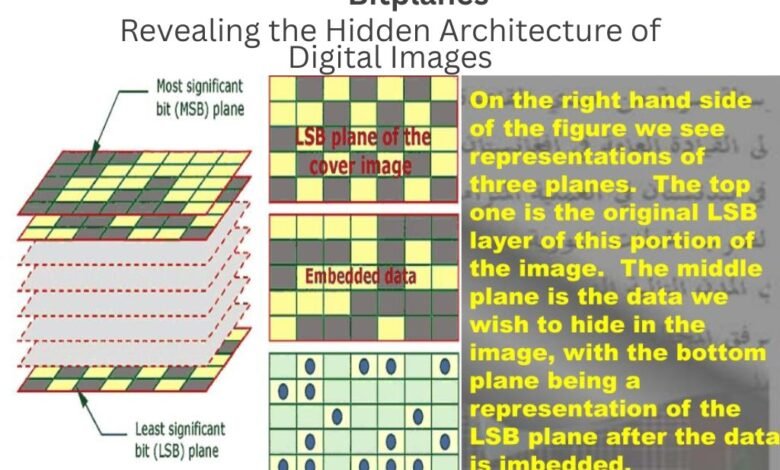
In an age where images dominate communication—from social media feeds to medical diagnostics—understanding how digital images are structured has never been more important. While most users interact with images at a surface level, engineers, researchers, and computer scientists often explore them at a far deeper level. One of the most elegant and insightful ways to examine digital images is through the concept of bitplanes.
Bitplanes offer a unique lens into the binary composition of images, allowing us to dissect and analyze visual data layer by layer. Though rooted in fundamental digital logic, the concept continues to play a role in modern applications such as image compression, steganography, and computer vision. This article explores bitplanes in depth, uncovering how they work, why they matter, and where they are used today.
The Binary Foundation of Images
To understand bitplanes, it is essential to begin with how digital images are represented. Every digital image is composed of pixels, and each pixel carries intensity or color information. In a grayscale image, this information is typically stored as an 8-bit number, meaning each pixel can have a value between 0 and 255.
These values are not arbitrary—they are binary numbers made up of bits (0s and 1s). For example, a pixel value of 150 is represented in binary as 10010110. Each of these bits contributes differently to the overall value, depending on its position. The leftmost bit, known as the most significant bit (MSB), carries the greatest weight, while the rightmost bit, the least significant bit (LSB), carries the smallest.
Bitplanes emerge directly from this structure. Instead of viewing each pixel as a whole number, we can separate the image into layers based on the position of each bit. Each layer, or bitplane, contains all the bits from a specific position across every pixel in the image.
What Are Bitplanes?
A bitplane is essentially a binary image derived from a specific bit position in the pixel values of a digital image. For an 8-bit grayscale image, there are eight bitplanes, each corresponding to one bit position.
The highest bitplane (bit 7) contains the most significant bits of all pixels, while the lowest bitplane (bit 0) contains the least significant bits. Each bitplane is itself a binary image, where pixels are either 0 or 1, depending on whether that bit is set in the original image.
This decomposition transforms a single image into multiple layers of information, each revealing a different aspect of the image’s structure.
Visualizing Bitplanes
When bitplanes are visualized, their significance becomes immediately apparent. The higher-order bitplanes—especially the top two or three—tend to resemble the original image quite closely. They capture the major shapes, edges, and intensity variations that define the image.
As we move toward the lower-order bitplanes, the visual coherence diminishes. These layers often appear noisy or random, with little recognizable structure. However, they still contain subtle details and fine variations that contribute to the overall image when combined with higher planes.
This layered representation highlights an important principle: not all bits contribute equally to visual perception. The human eye is far more sensitive to changes in higher-order bits than in lower-order ones.
Bitplane Slicing: A Tool for Analysis
The process of separating an image into its individual bitplanes is known as bitplane slicing. This technique is widely used in digital image processing to analyze the contribution of each bit level.
Bitplane slicing can be used to reconstruct images using only selected bitplanes. For instance, reconstructing an image using only the top four bitplanes often produces a result that is still recognizable, albeit with reduced detail. This demonstrates how much visual information is concentrated in the higher bits.
Conversely, reconstructing an image using only the lower bitplanes results in a largely unrecognizable image, dominated by noise-like patterns. Despite this, these lower layers can still hold valuable information in specific contexts.
The Mathematics Behind Bitplanes
At its core, the concept of bitplanes is mathematically straightforward. Each pixel value in an image can be expressed as the sum of its bits multiplied by their respective weights. For an 8-bit image, this can be written as:
I(x, y) = b₀(x, y)·2⁰ + b₁(x, y)·2¹ + … + b₇(x, y)·2⁷
Here, each bₖ(x, y) represents the value of the k-th bit at position (x, y). Each bitplane corresponds to one of these terms, isolating a specific layer of the image.
This mathematical formulation makes it easy to manipulate images at the bit level, enabling a wide range of processing techniques.
Applications of Bitplanes in Modern Technology
Although bitplanes are conceptually simple, their applications are both diverse and impactful. They serve as a foundation for several important techniques in digital image processing and beyond.
Image Compression
One of the most significant applications of bitplanes is in image compression. Since higher-order bitplanes carry most of the perceptual information, lower-order planes can sometimes be discarded or compressed more aggressively without significantly affecting image quality.
This principle is used in various compression algorithms, where preserving essential visual information while reducing file size is critical. By prioritizing the most significant bits, efficient storage and transmission of images become possible.
Steganography and Data Hiding
Bitplanes play a crucial role in steganography, the practice of hiding information within digital media. The least significant bitplanes are particularly useful for this purpose because changes in these bits are typically imperceptible to the human eye.
By embedding secret data into the LSBs of an image, it is possible to conceal information without visibly altering the image. This technique is widely used in secure communication and digital watermarking.
Image Enhancement
Bitplane analysis can also be used to enhance images. By focusing on higher-order bitplanes, it is possible to emphasize important structures and reduce noise. In some cases, selectively modifying or combining bitplanes can improve contrast and clarity.
This approach is particularly useful in fields such as medical imaging, where subtle differences in intensity can be critical for diagnosis.
Computer Vision and Pattern Recognition
In computer vision, bitplanes can be used for feature extraction and pattern analysis. By isolating specific layers of information, algorithms can focus on structural elements that are relevant for tasks such as object detection and recognition.
Bitplane-based techniques are often computationally efficient, making them suitable for real-time applications and embedded systems.
Bitplanes in Color Imaging
While the concept of bitplanes is often introduced using grayscale images, it extends naturally to color images. In a typical RGB image, each pixel consists of three color channels—red, green, and blue—each represented by 8 bits.
This means that a color image contains 24 bitplanes in total. Each channel can be decomposed into its own set of bitplanes, allowing for detailed analysis and manipulation of color information.
Working with color bitplanes adds complexity but also increases flexibility. For example, data can be hidden in specific channels or bit positions, and image enhancements can be applied selectively to different colors.
Historical Context and Evolution
The concept of bitplanes is not new. In fact, it played a significant role in early computer graphics systems. Older hardware often used bitplane-based framebuffers, where each bitplane was stored separately in memory.
This architecture allowed for efficient manipulation of individual bits and supported operations such as masking and layering. While modern graphics systems use more advanced techniques, the principles of bitplane organization still influence how images are processed and stored.
Advantages of Bitplane Representation
Bitplanes offer several advantages that make them valuable in both theoretical and practical contexts. They provide a clear and intuitive way to understand how images are constructed from binary data. By separating information into layers, they enable targeted processing and analysis.
Additionally, bitplane techniques are often computationally simple, making them suitable for systems with limited resources. Their flexibility allows them to be adapted for a wide range of applications, from compression to security.
Limitations and Challenges
Despite their usefulness, bitplanes also have limitations. Discarding lower-order bitplanes can lead to loss of fine details, which may be important in certain applications. Furthermore, bitplane-based methods alone are not sufficient for achieving high levels of compression compared to more advanced techniques.
Another challenge is that lower bitplanes are often highly sensitive to noise. This can make it difficult to distinguish between meaningful information and random variations, particularly in real-world images.
The Continuing Relevance of Bitplanes
In today’s era of deep learning and high-resolution imaging, one might assume that simple concepts like bitplanes have become obsolete. However, this is not the case. Bitplanes continue to serve as a foundational concept in image processing education and research.
They are also relevant in specialized applications, such as embedded systems, where efficiency and simplicity are critical. In security-related fields, bitplane manipulation remains a key technique for data hiding and watermarking.
Moreover, understanding bitplanes provides valuable insight into how more complex image processing methods work. Even advanced algorithms ultimately rely on the same underlying binary representations.
Conclusion
Bitplanes reveal the hidden structure of digital images, breaking them down into layers of binary significance. By examining these layers, we gain a deeper understanding of how images are formed, how information is distributed, and how visual data can be manipulated.
From compression and enhancement to steganography and computer vision, bitplanes play a subtle yet important role in modern technology. They remind us that even the most complex visual systems are built upon simple binary foundations.
In a world increasingly driven by digital imagery, the ability to look beneath the surface—to see not just pixels, but the bits that define them—is both powerful and essential.