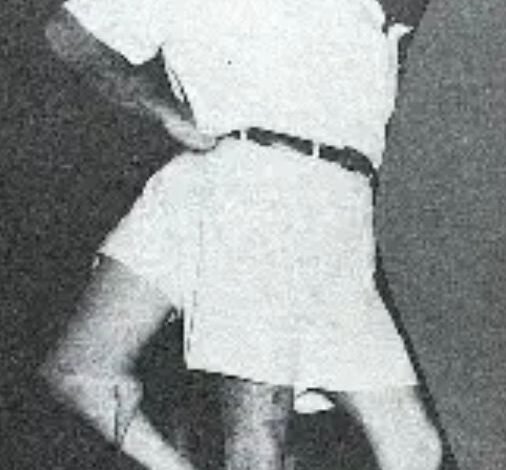
Origins of a Remarkable Life: Childhood, Family, and the Burden of Difference
Francesco A. Lentini—known to the world as Frank Lentini, The Three-Legged Man—was born on May 18, 1889, in the small Sicilian town of Rosolini, Italy. The Lentini family was large, working-class, and deeply rooted in the traditional values of their community. Frank, one of twelve children, entered the world under circumstances so medically rare that physicians and villagers alike struggled to understand what they were witnessing. Attached to Frank’s lower spine was the partially developed form of a parasitic twin. The result was an extraordinary physical composition: three legs, four feet, sixteen toes, and two sets of fully developed male genitalia. In later years, doctors would explain that the twin had begun to form in utero but stopped developing, leaving nonfunctional but fully visible anatomical structures fused to Frank’s body.
This condition, known as parasitic twinning, occurs in only a tiny fraction of births worldwide. In the late 19th century—decades before advanced surgical techniques, prenatal imaging, or genetic understanding—such a birth was not just a biological anomaly but a source of fear, superstition, and social stigma. For the Lentini family, already struggling with limited resources, Frank’s condition brought confusion and heartbreak. His parents, overwhelmed and unsure how to care for such a unique child, initially placed him in the care of an aunt. Stories from his early childhood describe Frank as a sensitive and observant boy who quickly realized he was not like other children, yet he displayed an unusual resilience that eventually became the defining feature of his public and private life.
Medical professionals at the time could offer little guidance. A surgical attempt to remove the additional limb and foot was dismissed as far too dangerous; the parasitic twin was fused near the spinal cord, where even minor damage could result in lifelong paralysis or death. With surgery ruled out, Frank had no choice but to accept his physical form—something he would later transform into a source of empowerment rather than shame. But acceptance did not come easily.
When Frank’s family enrolled him in a school for disabled children, hoping he would receive appropriate care, the opposite happened. Instead of pitying others with disabilities, young Frank was moved by both compassion and determination. He saw children who lacked mobility or fundamental abilities that he himself possessed. Despite having three legs, he could walk, run, play, climb, and even jump. In interviews later in life, Frank would reflect on this experience as a pivotal turning point: it taught him gratitude, humility, and perspective. He realized that his condition, while extraordinary, did not limit his ability to live a full life. In fact, it was the beginning of understanding that he possessed not just a unique body, but a unique destiny.
As Frank grew older, his physical coordination and remarkable control over his limbs—all of them—became evident. His extra leg, though shorter and not entirely functional, could move rhythmically with the others. He learned to skate, swim, ride a bicycle, and even kick a football using his third leg, a feat that would later become one of his signature acts. What could have been a life of isolation gradually unfolded into one of possibility.
Opportunity arrived in the form of Vincenzo Magnano, an Italian showman who had heard rumors of a remarkable child living in Sicily. When Magnano met Frank and witnessed his abilities, he immediately recognized the boy’s potential—not merely as a curiosity, but as a star performer. With the permission of Frank’s family, Magnano arranged for them to travel to the United States, where theatrical sideshows, circuses, and wonder exhibitions were thriving. In 1898, at only eight years old, Frank Lentini crossed the Atlantic to begin a new life—one that would propel him from a small Sicilian village to the grand stages of American entertainment.
This transition was not without cultural and emotional challenges. The immigrant experience alone was difficult, especially for a child who stood out so dramatically. Yet Frank adapted quickly. America, with its fascination for the unusual and its bustling entertainment scene, offered him something Italy never could: a stage on which to redefine his identity. For the first time, Frank saw that his difference could be transformed into a profession, even a form of art. And in the United States, he would become not merely a spectacle but a celebrated symbol of strength, confidence, and identity embraced without apology.
Entering the Spotlight: The Making of a Circus Icon
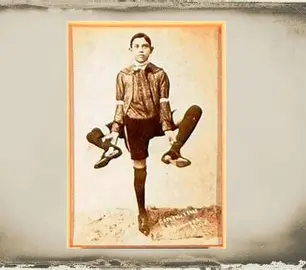
The early 20th century was the golden age of American circus culture. Sideshows, traveling carnivals, and variety acts attracted massive audiences eager to witness extraordinary individuals from around the world. It was into this vibrant and competitive environment that Frank Lentini stepped as a young performer. But unlike many who were exploited or mistreated in such industries, Frank’s career trajectory was notably different: he commanded respect, admiration, and agency in shaping his public image.
He began performing under names such as “The Three-Legged Sicilian,” “The Wonder of the World,” and “The Human Tripod.” But the nickname that would follow him for decades was simple and unforgettable: “The Three-Legged Man.”
Frank joined some of the most prestigious circus companies of the era, including:
- Ringling Brothers Circus
- Barnum & Bailey
- Buffalo Bill’s Wild West Show
These were not small or obscure troupes—they were the giants of circus entertainment, where performers competed fiercely for attention and reputation. That Frank was welcomed and celebrated says everything about his presence and talent.
On stage, Frank did more than simply stand and allow audiences to marvel at his appearance. He performed. He kicked soccer balls with his third leg, rode bicycles, danced, and executed comedic sketches that highlighted both his personality and his physical uniqueness. His confidence made him magnetic. Audiences did not merely stare at Frank—they laughed with him, cheered for him, and left feeling inspired.
A frequently retold story from his performances involves an interview question about buying shoes. When asked whether having three legs made it difficult, Frank quipped, “Not at all—I always get them two pairs at a time, and then I have a spare!” In another instance, he joked, “Even with three legs, I still don’t have a matching pair.” His ability to wield humor to disarm discomfort made him beloved not just by audiences but also by fellow performers.
Frank’s career spanned more than four decades, an extraordinary length of time for any entertainer. He became one of the highest-paid sideshow performers of his era and was admired by peers, who affectionately referred to him as “The King.” Unlike many performers with physical differences who were exploited or marginalized, Frank gained financial independence, social respect, and personal stability.
Part of this stability was found in his personal life. In 1907, Frank married Theresa Murray, a woman who admired his confidence and character. The couple went on to have four children: Josephine, Natale, Frank Jr., and James. His family life demonstrated what Frank had insisted all along—that he was not defined by his condition or his career, but by his choices and his ability to live a fulfilling, ordinary life infused with extraordinary circumstances.
Living proof that difference need not be a barrier to love, success, or dignity, Frank became a symbol of human possibility. He often spoke to young performers and aspiring entertainers about embracing rather than hiding their uniqueness. His philosophy centered on self-acceptance and the belief that one’s limitations often exist only in the mind.
As the circus world evolved and modern forms of entertainment emerged, Frank adapted, performing well into his later years. He continued touring until shortly before his death in 1966 at age 77, leaving behind a legacy unmatched in the history of sideshow performance. His story endures not as a tale of exploitation but of triumph—an individual who took what life had given him and transformed it into something remarkable.
Legacy and Cultural Impact: From Circus Stages to Modern Pop Culture
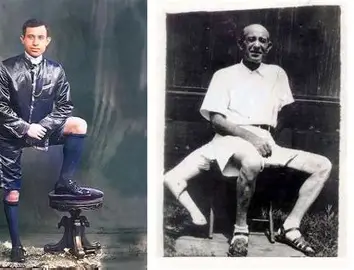
Frank Lentini’s life story has persisted long after his passing, embedded in the cultural imagination as one of the most astonishing examples of human uniqueness and resilience. While sideshows and circus acts have dramatically declined in popularity, Frank’s legend lives on, resurfacing across documentaries, historical essays, medical studies, and popular media.
One of the most striking modern references to Frank came in 1995, when the rock band Alice in Chains used an iconic image of Lentini on the back cover of their self-titled album. The black-and-white photograph shows Frank standing confidently, his three legs clearly visible—as though daring viewers to confront their discomfort and rethink their perceptions of physical difference. The image became one of the band’s most widely recognized visuals, ensuring Frank’s presence in the memories of an entirely new generation.
Historians of circus culture often refer to Frank as a prime example of how individuals with extraordinary anatomy embraced public performance not out of desperation but out of agency and ambition. His career contradicts the stereotype that sideshows were exclusively places of tragedy and exploitation. In Frank’s case, the sideshow became a platform—not one that belittled him, but one he used for empowerment.
Modern discussions of disability representation often highlight Frank as someone who navigated a world filled with misunderstanding yet emerged with dignity, humor, and a sense of control over his narrative. His life provides an important counterbalance to sensationalism. Though he was undeniably celebrated because of his physical difference, the broader message of his career is not about shock—it’s about identity, self-worth, and the capacity to transform adversity into purpose.
His story also remains relevant within medical and scientific communities. Cases of parasitic twinning are studied extensively, yet very few documented examples show an individual living a fully functioning adult life, let alone building a public career. Frank Lentini therefore serves not only as a cultural figure but also as a historical medical case, illustrating how the human body can adapt beyond expected limitations.
In addition to medical and cultural influence, Frank’s life frequently appears in motivational contexts. Educators, psychologists, and motivational speakers reference him when discussing self-acceptance, confidence, and overcoming societal stigma. His humor, charm, and refusal to let others define him have made him a symbol of perseverance.
Most importantly, Frank reminds us of something simple yet profound:
A person is not extraordinary because of how they look, but because of how they live.
Frank lived boldly, unapologetically, and with genuine joy—a combination that ensures his story continues to inspire.
The Enduring Human Story: What Frank Lentini Teaches the Modern World
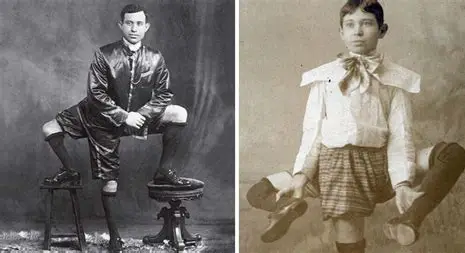
Today, in a digital age where identity, appearance, and self-image are constantly scrutinized, Frank Lentini’s story feels more relevant than ever. Conversations surrounding body positivity, disability pride, and personal authenticity continue to grow, and Frank stands as an early pioneer of these ideals—decades before such concepts had names.
Frank’s extraordinary anatomy drew attention, but it was his attitude that captured hearts. He stood proudly on circus posters not as an object of pity, but as a performer, an entertainer, a husband, a father, and a man who embraced his uniqueness rather than hiding it. He proved that accepting oneself fully is a radical act—one capable of transforming not only personal destiny but also public perception.
The challenges he faced were immense: medical limitations, societal prejudice, cultural superstition, and economic hardship. Yet Frank transformed these obstacles into opportunities. Instead of withdrawing from the world, he placed himself at its center—under bright lights, on grand stages, before crowds numbering in the thousands. His courage challenges modern readers to consider how they respond to their own differences, insecurities, or perceived limitations.
Frank Lentini’s life teaches us several timeless lessons:
- Uniqueness is not a weakness—it is a source of strength.
- Humor can dissolve fear and misunderstanding.
- Visibility matters; hiding oneself only empowers stigma.
- A person’s worth is measured not by physical form but by character and contribution.
In many ways, Frank was more than a performer—he was a cultural ambassador for self-acceptance. His message continues to echo through history, inspiring those who struggle with identity, disability, or the pressure to conform. Frank showed that difference is not merely acceptable; it is beautiful, powerful, and worthy of celebration.
As the years pass, stories like Frank’s remind us why history must preserve the lives of not only leaders and inventors but also entertainers, dreamers, and individuals whose extraordinary journeys illuminate the human experience. His legacy stands as a testament to resilience, individuality, and the remarkable potential of the human spirit.
Today, Frank Lentini remains a symbol of courage—a man who transformed what many would call a burden into a brilliant legacy of empowerment.
This article is published for readers of Empire Magazines, continuing our mission to bring remarkable human stories into the spotlight.
FAQs About Frank Lentini
1. Who was Frank Lentini?
Frank Lentini, born Francesco A. Lentini in 1889 in Sicily, was a famous sideshow and circus performer known worldwide as “The Three-Legged Man.” He was born with three legs, four feet, and other anatomical anomalies due to a parasitic twin.
2. What caused Frank Lentini to have three legs?
His condition was the result of parasitic twinning, a rare phenomenon where a partially developed twin becomes attached to the body of the surviving fetus.
3. Was his third leg functional?
The leg was shorter than the others and not fully functional, but it could move. Frank often used it during performances, especially for humorous or athletic acts.
4. What circus groups did Frank Lentini perform with?
He worked with major circus companies, including Ringling Brothers, Barnum & Bailey, and Buffalo Bill’s Wild West Show, becoming one of the most respected performers of his era.
5. Did Frank Lentini ever consider surgery to remove the extra leg?
Doctors determined early in his life that surgical removal was too dangerous because the parasitic twin tissue was connected near his spinal cord.
6. Did Frank Lentini have a family?
Yes. He married Theresa Murray in 1907, and they had four children—Josephine, Natale, Frank Jr., and James.
7. How did audiences react to him?
Audiences were fascinated by his unusual anatomy, but many were equally drawn to his warm personality, humor, and athletic abilities. Frank became admired rather than pitied.
8. How long was Frank Lentini’s career?
His career lasted more than 40 years, making him one of the longest-performing sideshow attractions in circus history.
9. What is Frank Lentini’s legacy?
Frank is remembered as a symbol of resilience and self-acceptance. He turned a rare medical condition into a celebrated career, inspiring people around the world.
10. Where can I learn more about Frank Lentini?
Information about Frank can be found in historical circus archives, medical case studies on parasitic twinning, and modern articles exploring his life and influence on entertainment and disability representation.